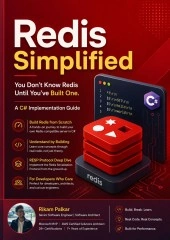

Redis Simplified: You Don't Know Redis Until You've Built One
Redis is famous for being fast. Developers know how to use GET, SET, caching, and other Redis commands-but using Redis and understanding how Redis works internally are two very different things.
Redis Simplified takes a hands-on approach: instead of simply explaining Redis, you will build a working Redis-compatible server from scratch using C# and .NET 8.
Starting with an empty project, the book progressively builds RedisCore, an educational Redis implementation capable of accepting real Redis client connections and handling core Redis operations. Along the way, you will work through the same kinds of engineering problems that make real systems interesting: network communication, protocol parsing, concurrency, thread safety, persistence, rate limiting, testing, and caching architecture.
What You'll Learn
Understand Redis from the inside out
Start with Redis fundamentals, its architecture, in-memory data model, performance characteristics, common use cases, and the situations where Redis is-or isn't-the right technology.
Master the RESP protocol
Learn how Redis clients and servers communicate through the Redis Serialization Protocol (RESP). You will understand its five data types, type markers, length-prefixed data, arrays, null values, binary-safe handling, and how commands such as SET, GET, and HSET are represented on the wire.
Build a TCP server in C#
Create the networking layer that accepts client connections, handles multiple clients concurrently, maintains persistent connections, and connects the network layer to your Redis implementation.
Build a Redis parser
Implement a parser that reads RESP data from network streams, handles partial reads and buffering, identifies protocol types, extracts data, and converts incoming requests into commands.
Create thread-safe in-memory storage
Build storage using C# concurrent data structures, including ConcurrentDictionary, while learning how shared data behaves when multiple clients access the server at the same time.
Implement Redis commands
Build core Redis functionality step by step, including:
SET
GET
HSET
HGET
HGETALL
DEL
PING
The project also includes additional compatibility commands needed for Redis client interactions.
Understand rate limiting
Implement a token bucket rate limiter and learn how per-client request limits, token refilling, configuration, and stress testing work in a network server.
Explore persistence and RDB files
Go beyond purely in-memory storage by implementing an RDB persistence-loading layer. You will learn how binary file formats can be parsed and how persisted strings and hashes can be restored when the server starts.
Test the system like a real application
Verify your server using redis-cli, test invalid commands and error handling, connect multiple clients, test persistence, and benchmark the server under load. The book also introduces a comprehensive xUnit test suite covering storage, RESP parsing, response formatting, rate limiting, and command handlers.
Connect real Redis clients
See your implementation work with actual client libraries rather than a toy application. The book demonstrates interoperability with StackExchange.Redis and redis-py, showing how different client implementations communicate with your Redis-compatible server.
Build a real caching application
Move beyond the server itself and build a product-catalog application with separate database and cache layers. You will implement the cache-aside pattern, observe cache hits and misses, and see how caching can dramatically reduce database work.
Learn practical caching patterns and best practices
The final stages explore Cache-Aside, Write-Through, cache invalidation, TTL strategies, cache warming, cache hit-rate tracking, and production considerations.
From Theory to a Working System
By the end of the book, you won't simply know that Redis is an in-memory data store. You will have built the major components yourself:
RESP parser ? TCP server ? in-memory storage ? command system ? rate limiter ? persistence layer ? automated tests ? Redis client ? caching application
The completed project brings together networking, protocol design, concurrency, data structures, binary parsing, testing, Docker, and application architecture.
Who Is This Book For?
Redis Simplified is ideal for:
C# and .NET developers who want deeper systems knowledge
Developers preparing for system design interviews
Engineers who want to understand Redis beyond basic commands
Developers interested in networking and TCP programming
Engineers learning protocol design and parsing
Developers who learn best by building real projects
Software engineers who want practical experience with concurrency and thread-safe systems
Anyone curious about what actually happens between a Redis client and server
You do not need prior Redis experience. The book is designed to teach the necessary networking, protocol, concurrency, and implementation concepts as you build.
The Result
The goal isn't to create a production replacement for Redis. RedisCore is intentionally an educational implementation designed to expose the engineering decisions behind a system like Redis. The project deliberately leaves out areas such as clustering, replication, authentication, and the full Redis command surface so the focus remains on understanding the core concepts.
By the final chapter, you will have gone from an empty folder and a protocol specification to a working TCP server, RESP parser, thread-safe storage system, rate limiter, RDB persistence layer, test suite, and client application. More importantly, you'll have a much deeper understanding of why Redis works the way it does-knowledge you can carry into system design, production debugging, architecture decisions, and future systems you build.
Redis Simplified is not just a book about using Redis. It is a book about understanding Redis by building one.
Join the conversation! Your thoughts help the community grow.