


Image by Freepik
Introduction to micro frontends
Most of us may be familiar with the term microservices. It is an architectural style that involves the breaking down of an application into small, independent services that communicate with each other through APIs. This approach allows developers to build more manageable services which can then be tested and deployed independently.
Similarly, inspired by the architecture, microfront ends focus on the front-end part of the application. Complex web applications are divided into smaller modules that work independently. Thus, this type of architecture provides front-end developers with the same agility and rapidity as microservices provide to back-end developers.
Use case transforming e-commerce with micro frontends
Consider an expansive e-commerce platform catering to diverse range of products - from electronics to fashion. In the traditional monolith setup, every product listing, checkout functionality, and user authentication process resides within a single, tighly coupled application.
Now, instead of a monolith, picture distinct micro frontends handling specific functionalities. The product catalog become its own micro frontend, ensuring updates to the latest tech gadgets do not disrupt the clothing section. Simultaneously, the shopping cart operates independently, allowing for seamless updates to payment process without affecting product browsing.
Here's where the magic happens
Want to introduce an innovative search algorithm to enhance user experience? With Micro Frontends, the search functionality is a separate micro frontend. You can upgrade the search algorithm without touching the intricacies of product listings or the checkout process.
What makes this real-world scenario even more dynamic?
We have the ability to employ different frameworks for each micro frontend. The product catalog might be running on React, while the checkout process leverages Vue.js. This flexibility in technology choices is a game-changer, empowering development teams to select the best tool for each specific task.
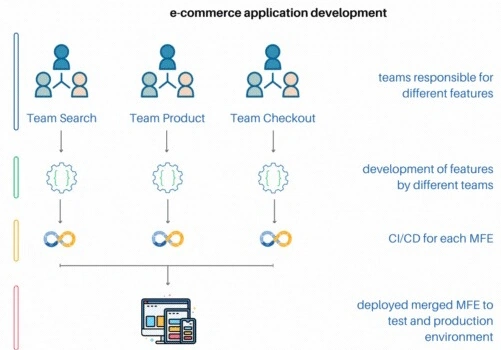
Development process for micro frontends
Teamwork
Picture the product catalog team, proficient in React, meticulously crafting the user interface for seamless product exploration. Simultaneously, the payment processing team, well-versed in Vue.js, dedicates its efforts to optimizing the checkout process for swift and secure transactions.
This division of labor not only allows for faster development but also encourages innovation. The search team, for instance, might be experimenting with cutting-edge algorithms without waiting for approvals from the product team. It's a dynamic dance of specialized units, each contributing to the overarching e-commerce mission without the need for constant coordination.
Each team can select the best tools for their specific micro front end without compromising the overall cohesion of the platform.
In this agile environment, Micro Front Ends redefine team dynamics. They allow for not just parallel development but also for teams to excel in their respective domains. The result is an e-commerce experience crafted by specialized teams, working in harmony to create something transformative, without the constraints of a monolithic approach.
Now, each of these micro front ends, seamlessly operating as independent applications, connects back to the main e-commerce platform, creating a harmonious and agile architecture. It's not just about dividing features; it's about crafting a responsive, modular ecosystem that adapts and evolves without disrupting the entire shopping experience for users.
Benefits of micro frontends
- Smaller and more manageable code: Since we are breaking down a big and complex application into smaller and simpler ones, we will have significantly fewer lines of code. Each function will be more precise and easier to debug. As a result, developers are more likely to work faster.
- Code reuse: We save time and effort when the need to develop multiple applications with common requirements arises. For example, we may simply reuse a checkout feature in another application instead of developing it from scratch.
- Parallel development: Micro frontends, in comparison to the conventional monolithic model, allow autonomous teams to work on different functions separately and concurrently.
- Faster deployment: The scope of each deployment is narrowed, decreasing the occurrence of errors. One does not need to take into consideration the state of other pipelines. Each micro frontend module will have its own continuous delivery pipeline which builds, tests, and deploys all the way to production. The team responsible for their specific micro front end decides whether the feature is ready to move to testing or production.
- Better overall performance: Each team focuses on testing, debugging, and optimizing the performance of its own UI components without affecting other modules or components. Thus, we are greatly improving the reliability of our product.
It is easier to update each business process which produces a better customer experience through iterative and incremental changes in the different components of the application.
Points to consider
- Complex testing of the whole application: It may be difficult to have a complete picture of the application. Each micro frontend can be tested in isolation, however, real-world user testing is crucial to ensure that the application works for the end-users. Using standard black-box end-to-end testing for this case can be helpful.
- Wide variety of standards to keep up with: It can be problematic when the different development teams need to work using the same standards. In order to provide a high-quality user experience, it is essential that everyone is on the same page. Proper communication and documentation of the process and standards can help avoid this kind of situation.
- Conflicting and overlapping styles: Design consistency and usability are critical for an application. It ensures that your website looks coherent in terms of functions, styling, symbols, animations, and other visual elements and works harmoniously across all the different modules. Inconsistency in CSS is something that may occur when dealing with micro frontends. Each team should be aligned and make sure that they have the same outcome in mind. Adding a styled component to the project can help or alternatively, one may use a CSS methodology such as BEM. This transforms the application into a collection of reusable component blocks, each with a distinct class name within the project.
- Communication between micro frontends: Micro frontends do not always need to communicate with each other. However, if they ever need to, it must be a priority so that it does not impact the performance of the application. For example, if the same API is requested more than once to retrieve the same data, it will surely slow down the server. Implementing a way where data between micro frontend can be transmitted on a shared state stored in a cookie, local storage or custom-defined events can help solve this issue.
Micro frontends can have lots of benefits when it comes to large applications that are built on micro-services. On the other hand, we can encounter several challenges as well. So, make sure to evaluate every aspect of your business before considering the implementation of this architectural style.
Join the conversation! Your thoughts help the community grow.