

Introduction
Today, in this article let's play around with one of the interesting and most useful concept in C#.Question: What are lambda expressions?
In simple terms "It is an anonymous function which accepts some input parameters and performs an expected operation with lambda operator."
Step 1: Create a new webform project

Step 2: The complete code of webform1.aspx looks like this
- <%@ Page Language="C#" AutoEventWireup="true" CodeBehind="WebForm1.aspx.cs" Inherits="LamdaExpressionApp.WebForm1" %>
- <!DOCTYPE html>
- <html xmlns="http://www.w3.org/1999/xhtml">
- <head id="Head2" runat="server">
- <title></title>
- </head>
- <body>
- <form id="form1" runat="server">
- <center>
- <div>
- <table>
- <tr>
- <td colspan="2" align="center">
- <asp:Label ID="Label3" runat="server" Text="Arithmetic Operations with Lambda Expressions in C#"
- Font-Bold="true" Font-Size="Large" Font-Names="Verdana" ForeColor="Maroon"></asp:Label>
- </td>
- </tr>
- <tr>
- <td>
- <asp:Label ID="Label4" runat="server" Text="Please Enter FirstNumber" Font-Size="Large"
- Font-Names="Verdana" Font-Italic="true"></asp:Label>
- </td>
- <td>
- <asp:TextBox ID="TextBox2" runat="server"></asp:TextBox>
- </td>
- </tr>
- <tr>
- <td>
- <asp:Label ID="Label7" runat="server" Text="Please Enter SecondNumber" Font-Size="Large"
- Font-Names="Verdana" Font-Italic="true"></asp:Label>
- </td>
- <td>
- <asp:TextBox ID="TextBox3" runat="server"></asp:TextBox>
- </td>
- </tr>
- <tr>
- <td colspan="2" align="center">
- <asp:Button ID="Button5" runat="server" Text="Addition" Font-Names="Verdana" Width="213px"
- BackColor="Orange" Font-Bold="True" OnClick="Button1_Click" />
- </td>
- </tr>
- <tr>
- <td colspan="2" align="center">
- <asp:Button ID="Button6" runat="server" Text="Substraction" Font-Names="Verdana"
- Width="213px" BackColor="Orange" Font-Bold="True" OnClick="Button2_Click" />
- </td>
- </tr>
- <tr>
- <td colspan="2" align="center">
- <asp:Button ID="Button7" runat="server" Text="Multiplication" Font-Names="Verdana"
- Width="213px" BackColor="Orange" Font-Bold="True" OnClick="Button3_Click" />
- </td>
- </tr>
- <tr>
- <td colspan="2" align="center">
- <asp:Button ID="Button8" runat="server" Text="Division" Font-Names="Verdana" Width="213px"
- BackColor="Orange" Font-Bold="True" OnClick="Button4_Click" />
- </td>
- </tr>
- <tr>
- <td colspan="2" align="center">
- <asp:Label ID="Label8" runat="server" Font-Bold="true" Font-Names="Verdana"></asp:Label>
- </td>
- </tr>
- </table>
- </div>
- </center>
- </form>
- </body>
- </html>
Step 3: The complete code of webform1.aspx.cs looks like this
- using System;
- using System.Collections.Generic;
- using System.Linq;
- using System.Web;
- using System.Web.UI;
- using System.Web.UI.WebControls;namespace LamdaExpressionApp
- {
- public partial class WebForm1 : System.Web.UI.Page
- {
- protected void Page_Load(object sender, EventArgs e)
- {
- }
- protected void Button1_Click(object sender, EventArgs e)
- {
- if (string.IsNullOrEmpty(TextBox4.Text) || string.IsNullOrEmpty(TextBox1.Text))
- {
- Label5.Text = "Please Enter Some Values";Label5.ForeColor = System.Drawing.Color.Red;
- }
- else
- {
- ArithmticDelegate objAdd = (x, y) => x + y;
- Label5.Text = "Addition Result is: " + objAdd.Invoke(double.Parse(TextBox4.Text), double.Parse(TextBox1.Text));
- Label5.ForeColor = System.Drawing.Color.Green;TextBox1.Text = string.Empty;
- TextBox4.Text = string.Empty;
- }
- }
- protected void Button2_Click(object sender, EventArgs e)
- {
- if (string.IsNullOrEmpty(TextBox4.Text) || string.IsNullOrEmpty(TextBox1.Text))
- {
- Label5.Text = "Please Enter Some Values";
- Label5.ForeColor = System.Drawing.Color.Red;
- }
- else
- {
- ArithmticDelegate objSub = (x, y) => x - y;
- Label5.Text = "Substraction Result is: " + objSub.Invoke(double.Parse(TextBox4.Text), double.Parse(TextBox1.Text));
- Label5.ForeColor = System.Drawing.Color.Green;TextBox1.Text = string.Empty;TextBox4.Text = string.Empty;
- }
- }
- protected void Button3_Click(object sender, EventArgs e)
- {
- if (string.IsNullOrEmpty(TextBox4.Text) || string.IsNullOrEmpty(TextBox1.Text))
- {
- Label5.Text = "Please Enter Some Values";Label5.ForeColor = System.Drawing.Color.Red;
- }
- else
- {
- ArithmticDelegate objMul = (x, y) => x * y;Label5.Text = "Multiplication Result is: " + objMul.Invoke(double.Parse(TextBox4.Text), double.Parse(TextBox1.Text));
- Label5.ForeColor = System.Drawing.Color.Green;TextBox1.Text = string.Empty;TextBox4.Text = string.Empty;
- }
- }
- protected void Button4_Click(object sender, EventArgs e)
- {
- if (string.IsNullOrEmpty(TextBox4.Text) || string.IsNullOrEmpty(TextBox1.Text))
- {
- Label5.Text = "Please Enter Some Values";
- Label5.ForeColor = System.Drawing.Color.Red;
- }
- else
- {
- ArithmticDelegate objDiv = (x, y) => x / y;
- Label5.Text = "Division Result is: " + objDiv.Invoke(double.Parse(TextBox4.Text), double.Parse(TextBox1.Text));
- Label5.ForeColor = System.Drawing.Color.Green;
- TextBox1.Text = string.Empty;TextBox4.Text = string.Empty;
- }
- }
- #region Public Memberspublic delegate double ArithmticDelegate(double a, double b);
- #endregion
- }
- }
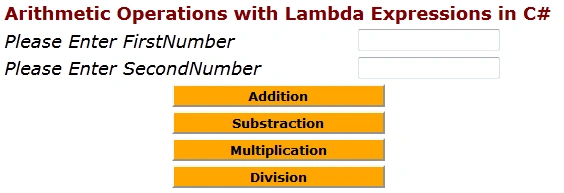
Step 4: The output of the application looks like this
Step 5: The addition operation output of the application looks like this

I hope this
article is useful for you.
Join the conversation! Your thoughts help the community grow.