

Pre-requisite to understand this
Basic application architecture – Understanding how a standalone app interacts with OS, APIs, and local/network resources
Authentication vs Authorization – Knowing the difference between identity verification and permission checks
Networking fundamentals – IP, ports, TLS, client–server communication
Identity concepts – Users, devices, service identities, tokens
Threat models – Malware, insider threats, credential theft
Basic security controls – Encryption, access control, logging
Introduction
Zero Trust Architecture (ZTA) is a security model that assumes no implicit trust, even inside a system boundary. Unlike traditional perimeter-based security, ZTA continuously verifies identity, device health, context, and behavior before granting access to resources. In standalone applications—desktop apps, thick clients, embedded systems, or local services—ZTA focuses on least privilege, strong identity, and continuous verification at runtime. The goal is to reduce the blast radius of compromise and prevent lateral movement, even when the application runs on a single machine or in a controlled environment.
What problem we can solve with this?
Standalone applications often assume that once a user launches the app, they are fully trusted. This assumption fails when credentials are stolen, malware runs locally, or users misuse privileges. ZTA removes the “trusted local environment” myth and enforces security checks at every sensitive operation. It protects against insider threats, privilege escalation, and unauthorized data access. It also helps secure offline-first apps and applications deployed in untrusted environments. ZTA improves auditability, compliance, and resilience against modern attacks that bypass perimeter defenses.
Problems addressed:
Implicit trust after login
Over-privileged users and services
Local malware accessing app resources
Hardcoded or shared credentials
Lack of runtime authorization checks
Poor visibility and auditing
How to implement / use this?
Implementing ZTA in a standalone application means embedding security inside the application flow, not relying on network boundaries. Every access to a protected resource (file, API, service, function) must be verified based on identity, device posture, and policy. The application should use strong identity (tokens, certificates), enforce least privilege, and continuously validate context. Policies should be centralized but enforced locally. Telemetry and logging are essential for trust evaluation and auditing.
Key implementation steps:
Strong identity enforcement – Use user, device, and service identities
Policy decision point (PDP) – Central logic that evaluates access policies
Policy enforcement point (PEP) – Code-level checks before resource access
Context-aware authorization – Use device health, time, location, risk
Least privilege access – Grant minimal permissions per operation
Continuous verification – Re-evaluate trust during runtime
Sequence Diagram
This sequence shows how Zero Trust works at runtime in a standalone application. The user first authenticates through an identity provider, which issues a token representing user and device identity. Every sensitive operation triggers a request to the Policy Enforcement Point inside the app. The PEP consults the Policy Decision Point, which evaluates policies using identity, context, and risk signals. Only after explicit approval does the app access the protected resource. This ensures that no operation is trusted by default, even after login.
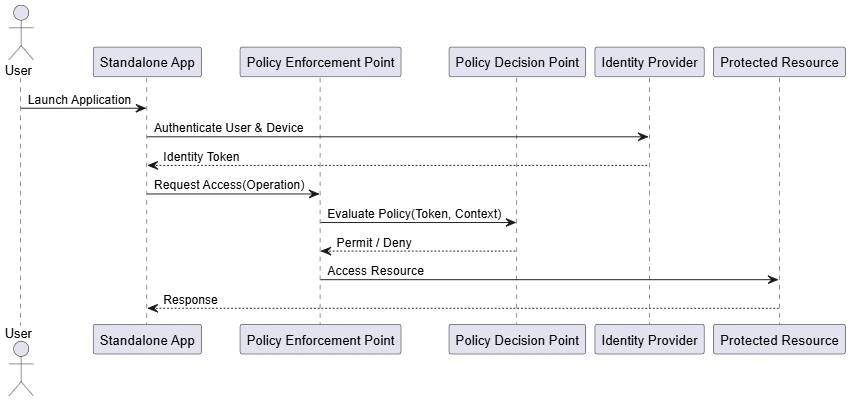
Key points:
Authentication happens before any access
Authorization is evaluated per operation
Policies are separate from business logic
Resource access is never implicit
Trust is continuously validated
Component Diagram
This component diagram illustrates how ZTA components are embedded within a standalone application. The UI and business logic never access resources directly. Instead, all access flows through the Policy Enforcement Point. The PEP communicates with an external or embedded Policy Decision Point, which evaluates access policies using identity data from the Identity Provider. This separation ensures clean architecture, consistent policy enforcement, and easier security updates without modifying core logic.
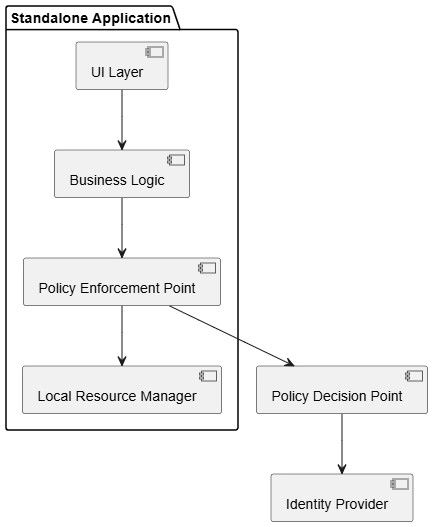
Key points:
Security is decoupled from business logic
PEP acts as a gatekeeper
PDP centralizes authorization logic
Identity provider supplies trust signals
Resources are shielded behind enforcement
Deployment Diagram
The deployment diagram shows how Zero Trust components are physically distributed. The standalone application runs on the user’s device but does not operate in isolation. Identity verification and policy decisions are handled by dedicated security services, which may be local, on-prem, or cloud-based. This design allows centralized control while maintaining standalone functionality. Even offline scenarios can use cached policies and tokens with expiration and revalidation rules.
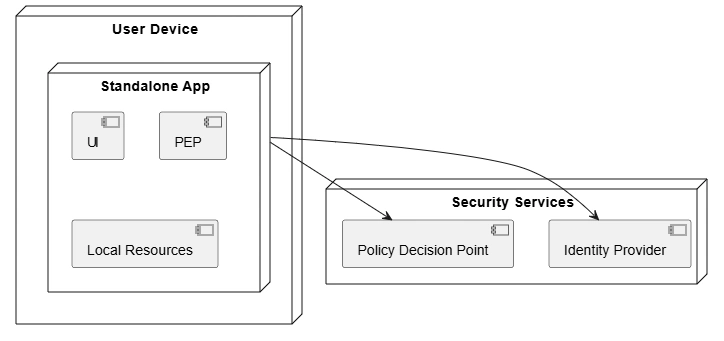
Key points:
App runs locally, policies may be centralized
Identity and policy services are externalized
Supports online and offline modes
Reduces attack surface on the device
Enables centralized governance
Advantages
No implicit trust – Every action is explicitly verified
Reduced blast radius – Compromise affects fewer resources
Strong access control – Fine-grained authorization per operation
Better auditing – All access decisions are logged
Scalable security – Policies evolve without code changes
Resilient to modern threats – Protects against insider and local attacks
Summary
Zero Trust Architecture transforms standalone applications from implicitly trusted software into continuously verified systems. By enforcing identity, context-aware authorization, and least privilege at every access point, ZTA significantly improves security without sacrificing usability. Implementing ZTA requires embedding policy enforcement inside the application while centralizing decision-making and identity verification. The result is a resilient, auditable, and future-proof architecture suitable for modern threat landscapes—even in standalone environments.
Join the conversation! Your thoughts help the community grow.