

🔍 Introduction
Choosing between supervised and unsupervised learning isn’t arbitrary—it hinges on your data, objectives, and resources. This article dives deep into when and why you should pick one paradigm over the other, backed by concrete examples and decision criteria.
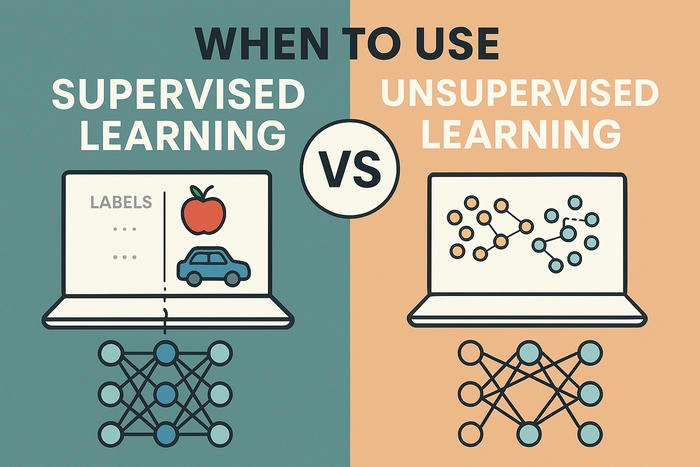
🏷️ 1. Data Availability & Labeling Cost
- Supervised Learning
- Need: A sizable, high-quality labeled dataset.
- Trade-off: Labels cost time and money (e.g., human annotations, expert review).
- Use if: You can reliably label data (spam vs. ham, defective vs. OK parts).
-
Unsupervised Learning
- Need: Raw, unlabeled data in abundance.
- Advantage: No labeling overhead—ideal for exploratory phases.
- Use if: Labels are unavailable, too expensive, or impractical to obtain.
🎯 2. Project Goals & Deliverables
- Supervised Learning
- Objective: Predict specific outcomes or categories.
- Deliverables: Clear metrics (accuracy, precision, RMSE).
- Example: Deploy a credit-risk model that outputs “approve” or “decline.”
- Unsupervised Learning
- Objective: Uncover hidden structures, groupings, or anomalies.
- Deliverables: Clusters, low-dimensional embeddings, anomaly scores.
- Example: Segment customers into natural cohorts for targeted marketing.
⚙️ 3. Complexity & Interpretability
- Supervised
- Complexity: Can leverage complex models but still yield measurable performance gains.
- Interpretability: Easier to validate—compare predictions to known labels.
- Unsupervised
- Complexity: Algorithms can be simpler (K-Means) or more complex (autoencoders), but results demand human interpretation.
- Interpretability: Harder to judge “good” clustering without domain expertise.
📈 4. Real-World Decision Flow
| Decision Factor | Supervised Choice | Unsupervised Choice |
|---|---|---|
| You have labeled examples | ✔ Build a classification/regression pipeline | ❌ |
| You need prediction accuracy | ✔ Optimize against ground truth | ❌ |
| You want data exploration. | ❌ | ✔ Cluster & visualize |
| You suspect hidden segments | ❌ | ✔ Uncover natural groupings |
| Labels too costly/impractical | ❌ | ✔ Leverage all available data |
🔄 5. Hybrid & Advanced Strategies
- Semi-Supervised Learning
- When: You have a small labeled set + a large unlabeled corpus.
- How: Pretrain on unlabeled data (autoencoding, clustering), then fine-tune on labels.
- Self-Supervised Learning
- When: You need powerful representations from raw data (text, images).
- How: Create proxy tasks (e.g., mask-prediction in language) to learn features, then apply supervised heads.
- Active Learning
- When: Labeling is expensive—selectively label the most informative samples.
- How: Model flags uncertain examples for human annotation, maximizing label ROI.
🌐 6. Case Studies
Example A: Fraud Detection
- Start unsupervised to cluster transaction patterns and detect outliers.
- Switch to supervised once fraud labels accumulate, and train a classifier for real-time scoring.
Example B: Recommendation System
- Unsupervised to learn user/item embeddings via matrix factorization or autoencoders.
- Supervised to predict click-through rates using embeddings as input features.
✅ Conclusion
- Use Supervised Learning when you have labeled data and need precise predictions.
- Use Unsupervised Learning when exploring data structure or when labels are unavailable.
- Combine Approaches with semi-supervised, self-supervised, or active learning to balance performance and cost.
By aligning your data strategy with project goals, you’ll ensure you pick the optimal paradigm, driving better insights, faster development, and more impactful AI solutions
Join the conversation! Your thoughts help the community grow.