

Abstract / Overview
Polygon OMS (Order Management System) enables enterprises to execute cross-border B2B payments on blockchain infrastructure with lower costs, faster settlement, and programmable compliance. Built on the Polygon blockchain ecosystem, it combines transaction orchestration, identity controls, and regulatory alignment into a single operational layer. This article explains what Polygon OMS is, how its architecture works, and how compliance requirements such as KYC, AML, and jurisdictional controls are enforced in real-world business environments.
Conceptual Background
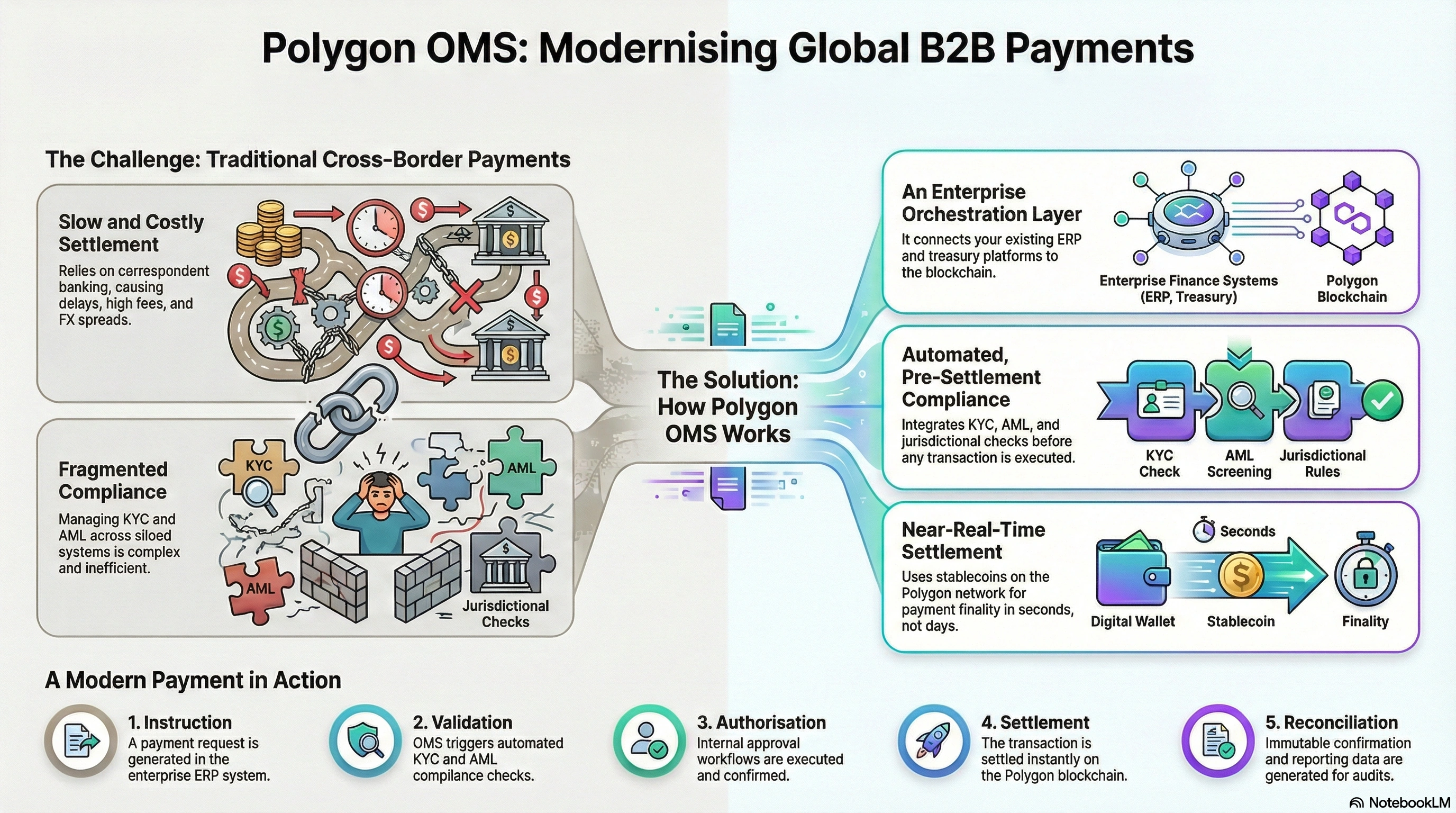
Cross-border B2B payments remain constrained by correspondent banking, FX spreads, delayed settlement, and fragmented compliance processes. Blockchain-based payment rails address these challenges but introduce new requirements around governance, identity, and auditability.
Polygon OMS sits between enterprise payment workflows and blockchain settlement. It does not replace enterprise finance systems. It orchestrates them. The OMS layer manages transaction logic, approvals, compliance checks, and reporting, while the Polygon network provides settlement, immutability, and interoperability.
Polygon is widely adopted for enterprise use because of its low transaction costs, high throughput, and compatibility with Ethereum tooling, making it suitable for regulated financial workflows.
What Is Polygon OMS?
Polygon OMS is an enterprise-grade order and transaction management layer designed to manage cross-border B2B payments on the Polygon blockchain. It coordinates payment instructions, compliance validation, settlement execution, and post-transaction reconciliation.
At a business level, Polygon OMS enables:
Near-real-time international settlements using stablecoins
Reduced dependency on correspondent banks
Automated compliance enforcement at the transaction level
Full audit trails for finance and regulators
Polygon OMS typically integrates with ERP systems, treasury platforms, and compliance engines while using Polygon as the settlement and execution layer.
High-Level Architecture Overview

Core Architectural Components
Enterprise Integration Layer
Polygon OMS integrates with existing enterprise systems such as ERP, invoicing, and treasury platforms. This ensures that blockchain payments align with existing approval workflows, accounting standards, and internal controls.
Common integrations include:
ERP systems (SAP, Oracle, NetSuite)
Treasury management systems
Invoice and procurement platforms
OMS Orchestration Engine
The OMS layer is the operational brain. It handles:
Payment initiation and batching
Multi-party approvals
FX logic (if applicable)
Fee calculation and routing
Exception handling
This abstraction allows enterprises to use blockchain without exposing finance teams directly to wallet or protocol complexity.
Compliance and Identity Controls
Compliance is enforced before any on-chain execution. Polygon OMS integrates with KYC and AML providers to validate:
Counterparty identity
Jurisdictional eligibility
Sanctions lists
Transaction risk thresholds
Only transactions that pass compliance checks are authorized for settlement.
Wallet and Custody Layer
Polygon OMS supports both custodial and non-custodial wallet models, depending on regulatory and operational requirements. Wallets are permissioned and role-based, reducing operational risk.
Key features include:
Multi-signature authorization
Role-based access control
Key management and recovery policies
Polygon Blockchain Settlement
Once authorized, transactions are settled on Polygon using stablecoins or tokenized assets. Polygon’s low fees and fast finality make it suitable for high-volume B2B payment flows.
Settlement benefits include:
Finality in seconds
Immutable transaction records
Transparent reconciliation
Reporting and Audit Layer
Every transaction produces structured data for:
Financial reporting
Regulatory audits
Internal controls
Tax and compliance reviews
Blockchain data combined with OMS metadata ensures traceability end-to-end.
Compliance Model for Cross-Border B2B Payments
Polygon OMS compliance follows a layered model:
Identity and KYC
All counterparties are verified before onboarding. This includes corporate KYC, beneficial ownership checks, and ongoing monitoring.
AML and Transaction Monitoring
Transactions are screened for:
Sanctions exposure
Unusual payment patterns
High-risk jurisdictions
Velocity and volume anomalies
Suspicious transactions are blocked or flagged for manual review.
Jurisdictional Controls
Polygon OMS can enforce geographic restrictions based on regulatory requirements. Payments can be allowed, restricted, or routed differently depending on country-level rules.
Auditability and Record Retention
Every step is logged. On-chain settlement provides immutability, while off-chain OMS records provide business context, satisfying both technical and regulatory audit needs.
As noted in enterprise blockchain governance research, structured compliance and auditability are essential for enterprise adoption of blockchain payment systems.
Step-by-Step Payment Walkthrough
Invoice or payment request is generated in the ERP
Payment instruction is sent to Polygon OMS
OMS triggers KYC and AML validation
Approval workflows are executed
Wallet authorization is confirmed
Transaction is settled on Polygon
Confirmation and reporting data are generated
This flow mirrors traditional finance processes while replacing slow settlement rails with blockchain execution.
Sample Payment Workflow JSON
{
  "payment_id": "B2B-INV-98421",
  "payer": "Company_A",
  "payee": "Company_B",
  "amount": "250000",
  "currency": "USDC",
  "network": "Polygon",
  "compliance": {
    "kyc_status": "approved",
    "aml_check": "passed",
    "jurisdiction": "allowed"
  },
  "settlement": {
    "wallet_type": "custodial",
    "finality": "confirmed"
  }
}
Business Use Cases
International Supplier Payments
Manufacturers and distributors settle invoices with overseas suppliers faster and with lower FX and banking fees.
Global Treasury Operations
Enterprises consolidate global liquidity using stablecoins while maintaining compliance and reporting standards.
Platform and Marketplace B2B Payments
Marketplaces use Polygon OMS to pay merchants across borders without relying on fragmented local banking rails.
Intra-Group Intercompany Transfers
Multinationals move funds between subsidiaries with transparency and near-instant settlement.
Limitations and Considerations
Regulatory clarity varies by jurisdiction
Stablecoin policy risk must be managed
Internal controls must be redesigned for blockchain workflows
Wallet custody decisions impact risk and compliance posture
Polygon OMS reduces friction but does not eliminate the need for strong governance.
Fixes: Common Pitfalls and Solutions
Lack of compliance integration → Embed KYC/AML before execution
Finance team resistance → Maintain familiar ERP-driven workflows
Audit complexity → Combine on-chain data with OMS metadata
Key management risk → Use multi-signature and institutional custody
FAQs
Is Polygon OMS suitable for regulated enterprises?
Yes. The OMS layer enforces compliance before blockchain settlement.Does Polygon OMS replace banks?
No. It complements existing financial infrastructure while reducing reliance on correspondent banking for settlement.Are payments reversible?
Blockchain settlement is final. OMS-level controls and approvals mitigate errors before execution.What assets are typically used?
Regulated stablecoins are most common for cross-border B2B payments.
References
Enterprise blockchain governance and compliance frameworks
Polygon enterprise adoption documentation
Cross-border payments and stablecoin research (2024–2025)
Conclusion
Polygon OMS enables enterprises to modernize cross-border B2B payments without sacrificing compliance, control, or auditability. By separating orchestration, compliance, and settlement layers, it aligns blockchain efficiency with enterprise governance. As regulatory clarity improves and stablecoin adoption grows, OMS-driven blockchain payment architectures are positioned to become a core component of global B2B finance infrastructure.
Join the conversation! Your thoughts help the community grow.