

When you send messages, trade cryptocurrency, or log into a secure website, encryption keeps your data private. But what if, years later, an attacker manages to steal the server’s private key? Could they go back and decrypt all your past conversations ?
That’s where Perfect Forward Secrecy (PFS) comes in. It’s a security property in encryption protocols that ensures past communications remain secret—even if long-term keys are compromised in the future .
Let’s dive into how it works, why it matters, and where it’s used.
🧩 The Basics of Forward Secrecy
Normally, encryption uses a long-term private key to secure communication. If that key is ever exposed, attackers can decrypt any session they recorded in the past.
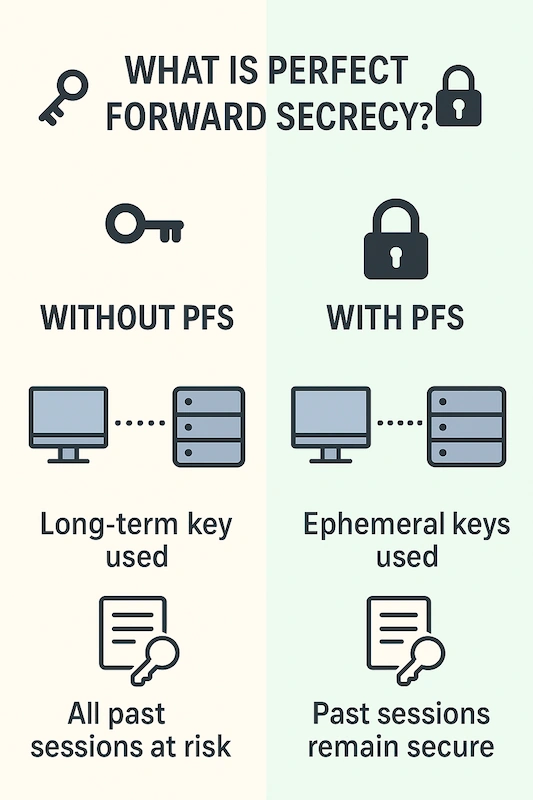
Without PFS: A leaked private key = all past sessions at risk.
With PFS: A leaked private key ≠ past sessions compromised.
Perfect Forward Secrecy achieves this by generating unique, short-lived session keys for every conversation or transaction. Once the session ends, that key disappears forever.
⚙️ How Perfect Forward Secrecy Works
The magic behind PFS comes from a cryptographic technique called ephemeral key exchange .
🔑 Ephemeral Keys
Every new session creates a temporary key pair.
These keys are used only once and then discarded.
Even if recorded data is stolen, the attacker cannot decrypt it later.
📡 Diffie-Hellman (DH) and Elliptic Curve Diffie-Hellman (ECDH)
Diffie-Hellman (DH): An algorithm that lets two parties agree on a shared secret without sending the secret itself over the network.
Ephemeral Diffie-Hellman (DHE): A fresh DH key is generated for every session.
Elliptic Curve Diffie-Hellman Ephemeral (ECDHE): A faster, more secure version using elliptic curves.
🌐 Where PFS is Used
Perfect Forward Secrecy is now standard in many protocols that protect our digital lives:
TLS/HTTPS 🔐 → Modern websites and browsers prefer PFS-enabled ciphers (e.g., TLS_ECDHE).
Messaging Apps 📱 → Signal, WhatsApp, and Telegram use PFS in their end-to-end encryption protocols.
VPNs 🌍 → OpenVPN and WireGuard support PFS for session protection.
Cryptocurrencies 💰 → Some blockchain privacy protocols adopt PFS concepts to protect transaction metadata.
🕵️ Why Perfect Forward Secrecy Matters
Defense Against Key Theft
If a hacker breaks into a server and steals its private key, your past conversations remain safe.
Resilience Against Mass Surveillance
Agencies or attackers that record encrypted traffic can’t retroactively decrypt it later.
Stronger Privacy Guarantees
Users can trust that even future breaches won’t expose their historical data.
Compliance and Trust
Many security standards (like PCI DSS for financial data) encourage or require PFS for secure communications.
⚠️ Challenges of PFS
While powerful, PFS comes with trade-offs:
More Computational Load 💻
Generating ephemeral keys for every session requires extra CPU power, especially on busy servers.
Session Recovery 🚫
Because session keys are destroyed after use, lost connections can’t be recovered by reusing old keys.
Compatibility Issues 🔄
Some older systems and devices don’t support modern PFS-enabled ciphers.
Despite these challenges, the benefits outweigh the costs—especially in a world where data breaches and surveillance are growing threats.
📖 Example in Action
Imagine you’re chatting with a friend using an app that supports PFS:
You and your friend’s apps each generate a random, temporary key.
The keys are exchanged securely using ECDHE.
A shared secret is created for this single chat session.
After you close the chat, the keys vanish.
Now, even if someone steals the app’s long-term private key years later, they cannot decrypt your old messages , because the ephemeral session keys are gone forever.
🚀 The Future of PFS
Perfect Forward Secrecy is quickly becoming the default standard for secure communication. Looking ahead:
Post-Quantum Cryptography 🧮 → Researchers are designing PFS-friendly algorithms that resist quantum attacks.
Universal Adoption 🌍 → Major platforms, browsers, and cloud providers already enforce PFS. Over time, non-PFS systems will fade out.
Blockchain & DeFi 🔗 → As privacy layers grow, forward secrecy principles may play a bigger role in protecting financial data.
🎯 Final Thoughts
Perfect Forward Secrecy is about protecting the past from the future . It ensures that even if today’s security fails tomorrow, your old conversations, transactions, and secrets remain locked away forever.
In an era where data is currency and breaches are inevitable, PFS is one of the strongest shields we have against retroactive attacks.
Join the conversation! Your thoughts help the community grow.