

If you've ever used a website that loads really fast or updates in real-time (like a chat app or live scores), chances are Node.js might be behind it. But what exactly is Node.js, and how does its architecture make it so powerful? Let’s break it down in simple words.
🚀 What is Node.js?
Node.js is not a programming language or a framework; it’s a runtime environment. It enables developers to run JavaScript on the server side, outside of the browser. It’s built on Google Chrome’s V8 JavaScript engine, which makes it super fast.
e.g: "Hello World" in Node.js.
// Import the built-in 'http' module
const http = require('http');

// Create a simple server
const server = http.createServer((req, res) => {
  res.end('Hello World from Node.js!');
});

// Server listens on port 3000
server.listen(3000, () => {
  console.log('Server is running on http://localhost:3000');
});
This simple server handles HTTP requests using a single thread and responds with "Hello World". Even if 100 users open it at once, Node.js can manage that efficiently, thanks to its architecture.
Let’s break it down.
1. Single-Threaded Event Loop
Node.js uses a single thread to handle all client requests. That means it doesn’t create a new thread for every request like traditional web servers (such as Apache). Here the question comes.
Then, how does it handle multiple users simultaneously?
It supports multiple users simultaneously through its Event-Driven Architecture. Let's explore it.
2. Event-Driven Architecture
Imagine you are at a restaurant. Instead of the chef cooking only one dish at a time (waiting for it to finish before starting the next), he puts dishes in the oven and moves on to the next task. When the oven beeps, he knows the food is ready.
Our Node.js works in the same way.
- When a request (like fetching data or reading a file) comes in, it’s added to the event queue.
- Node.js doesn’t wait for the task to finish. Instead, it moves on to the next task.
- Once the task is completed, Node.js receives notification (via a callback function) and processes the result.
This makes Node.js extremely fast and efficient, particularly for I/O-Intensive tasks.
- Reading/writing files
- Talking to databases
- Calling APIs
3. Non-Blocking I/O
- Most web servers use blocking I/O, which means they wait for one operation to finish before moving to the next.
- Node.js uses non-blocking I/O, meaning it doesn’t wait for input. This allows Node.js to handle thousands of requests per second with a single thread.
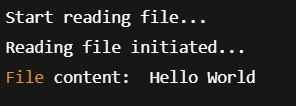
Let's simulate a non-blocking operation, such as reading a file.
const fs = require('fs');

console.log('Start reading file...');

fs.readFile('example.txt', 'utf8', (err, data) => {
  if (err) {
    return console.error(err);
  }
  console.log('File content:', data);
});

console.log('Reading file initiated...');
Output
Key Components of Node.js Architecture
Here are the main parts that makeup Node.js.
| Components | Role |
|---|---|
| V8 Engine | Converts JavaScript code into machine code. It’s fast and powerful. |
| Libuv | A library that provides the event loop and handles asynchronous operations. |
| Event Loop | Keeps checking for completed tasks and runs their callback functions. |
| CallBacks | Functions that are executed when a task finishes. |
| APIs | Node.js provides APIs for file systems, networks, and more. |
✅ Advantages of Node.js Architecture
Fast: Thanks to V8 and the non-blocking model.
- Scalable: Handles a large number of users without crashing or slowing down.
- Efficient: Great for real-time apps like chat, games, or live data.
- Lightweight: Uses fewer system resources compared to traditional servers.
📌 When to Use Node.js?
Node.js is ideal for.
- Real-time apps (chat apps, online games)
- APIs for web/mobile apps
- Data streaming apps
- Single Page Applications (SPAs)
Conclusion
Node.js architecture is what makes it stand out. Its event-driven, non-blocking, and single-threaded design helps developers build fast, scalable, and efficient applications.
Join the conversation! Your thoughts help the community grow.