

Introduction
In this article, we will explore Delta Live Tables (DLT) and their pros and cons. Delta Live Tables (DLT) is a powerful feature within the Databricks Lakehouse Platform that simplifies and automates the data pipelines. It allows data engineers and analysts to build and manage data pipelines using a declarative approach, making it easier to create reliable, maintainable, and scalable data processing workflows.
What are Delta Live Tables?
DLT is an ETL framework that uses a declarative approach to define data pipelines. Instead of writing complex procedural code to extract, transform, and load data, users can define the desired end state of their data using SQL or Python. DLT then automatically handles the execution, optimization, and management of the data pipeline. The below images are taken from Databricks.
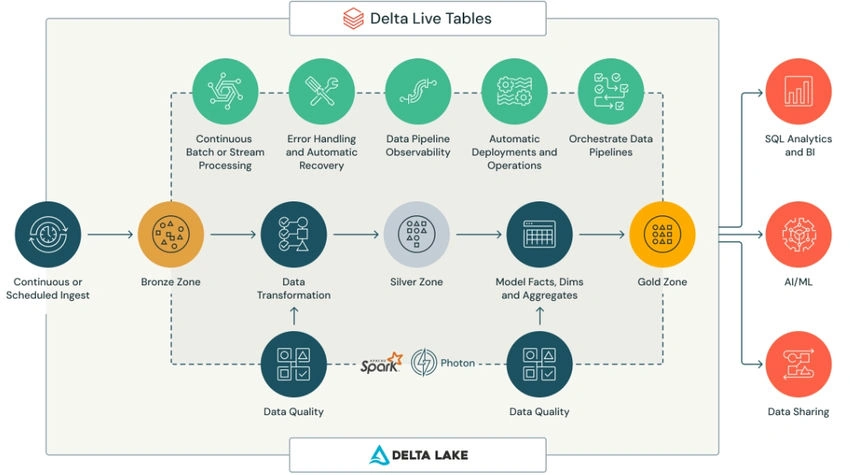
Key Features
- Declarative Pipeline Definition: Define your data pipeline using SQL or Python, focusing on the what rather than the how.
- Automatic Dependency Management: DLT automatically determines the execution order based on the dependencies between tables.
- Data Quality Constraints: Easily define and enforce data quality rules within your pipeline.
- Continuous Data Processing: Support for both batch and streaming data processing.
- Built-in Monitoring and Observability: Track pipeline health, performance, and data quality metrics.
Pros of Delta Live Tables
- Simplified Development: The declarative approach reduces the amount of boilerplate code needed to create data pipelines.
- Improved Reliability: Automatic dependency management and built-in error handling increase pipeline reliability.
- Enhanced Data Quality: Easy-to-implement data quality constraints help maintain data integrity.
- Scalability: DLT leverages Databricks' distributed computing capabilities for efficient scaling.
- Reduced Maintenance: Automated optimization and management reduce the need for manual intervention.
- Version Control and Collaboration: Pipelines can be version-controlled and shared across teams.
- Unified Batch and Streaming: Seamlessly handle both batch and streaming data within the same pipeline.
- Built-in Monitoring: Out-of-the-box monitoring and observability features simplify pipeline management.
Cons of Delta Live Tables
- Learning Curve: While simpler than traditional ETL, there's still a learning curve for those new to Databricks and DLT concepts.
- Platform Lock-in: DLT is specific to Databricks, which may not be ideal for organizations looking for platform-agnostic solutions.
- Cost: Requires a Databricks subscription, which can be expensive for smaller organizations or projects.
- Limited Control: The abstraction provided by DLT may limit fine-grained control over certain aspects of data processing.
Limitations of Delta Live Tables
- Language Support: Currently limited to SQL and Python. Other popular data processing languages are not supported.
- Ecosystem Integration: While improving, integration with external tools and services may not be as extensive as with some other ETL frameworks.
- Complex Transformations: Very complex or custom transformations may still require traditional coding approaches.
- Debugging Challenges: The abstraction layer can sometimes make debugging more challenging compared to traditional ETL pipelines.
- Performance Overhead: The additional layer of abstraction may introduce some performance overhead compared to hand-optimized Spark jobs.
- Limited to Delta Lake: DLT is designed to work with Delta Lake tables, which may not be suitable for all use cases.
Use Cases for Delta Live Tables
- Data Warehousing: Building and maintaining data warehouses with complex ETL processes.
- Real-time Analytics: Creating pipelines that combine batch and streaming data for up-to-date insights.
- Data Quality Management: Implementing and enforcing data quality rules across large datasets.
- IoT Data Processing: Handling high-volume, real-time data from IoT devices.
- Machine Learning Pipelines: Preparing and transforming data for machine learning models.
Summary
Databricks Delta Live Tables offers a powerful and innovative approach to data engineering, simplifying many aspects of building and maintaining data pipelines. Its declarative nature, combined with built-in features for reliability, scalability, and data quality, makes it an attractive option for many organizations. However, it's important to consider the potential drawbacks, such as the learning curve, platform lock-in, and limitations in certain complex scenarios. Organizations should carefully evaluate their specific needs, existing infrastructure, and long-term data strategy when deciding whether to adopt DLT.
Join the conversation! Your thoughts help the community grow.