

Introduction
Algorand blockchain, developed by Silvio Micali, a Turing Award-winning computer scientist, is a permissionless, scalable, and secure blockchain platform designed to enable fast and efficient decentralized transactions. Launched in 2019, Algorand has gained significant attention in the cryptocurrency and blockchain communities due to its innovative approach to consensus, security, and decentralization.
You can learn more about Algorand here.
What distinguishes Algorand as a green blockchain
Algorand blockchain is often referred to as a "green" blockchain due to its low environmental impact compared to traditional blockchains, such as Bitcoin and Ethereum. The following are some key factors that distinguish Algorand as a green blockchain:
-
Energy-efficient consensus algorithm - Algorand uses a Pure Proof-of-Stake (PPoS) consensus algorithm, which is designed to be energy-efficient. In PPoS, validators are randomly selected to propose and confirm blocks, and they do not require extensive computational power or energy-intensive mining equipment. This eliminates the need for energy-intensive mining processes, common in other consensus algorithms like Proof-of-Work (PoW) used in Bitcoin and Ethereum, where miners compete to solve complex mathematical puzzles, resulting in significant energy consumption. Algorand's PPoS consensus requires minimal energy consumption, making it more eco-friendly.
-
Low carbon footprint - Due to its energy-efficient consensus algorithm, Algorand has a significantly lower carbon footprint than PoW-based blockchains. PoW blockchains require massive computational power, leading to high energy consumption and a large carbon footprint. In contrast, Algorand's PPoS consensus algorithm reduces the overall energy consumption, resulting in a lower carbon footprint, and making it more environmentally friendly.
-
Sustainable transaction fees - Algorand's transaction fees are generally low and predictable, regardless of the network's activity levels. This is because the PPoS consensus algorithm does not rely on transaction fees as a primary incentive for validators, unlike PoW-based blockchains, where miners are rewarded with transaction fees. As a result, Algorand's transaction fees do not fluctuate based on network demand, reducing the possibility of excessive transaction fees that could lead to unnecessary resource consumption.
-
Green asset tokenization - Algorand's blockchain can be used for asset tokenization, allowing for the creation of digital representations of real-world assets, such as real estate, art, and intellectual property. By leveraging Algorand's blockchain for asset tokenization, traditional asset transactions can be digitized, reducing the need for physical paperwork and intermediaries. This has the potential to streamline processes and reduce the carbon footprint associated with traditional asset transfers.
-
Commitment to sustainability - Algorand is committed to sustainability and has implemented various initiatives to reduce its environmental impact. For example, Algorand has partnered with PlanetWatch, a global environmental monitoring platform, to integrate environmental data onto the blockchain, facilitating transparency and accountability in environmental monitoring. Additionally, Algorand has joined the Crypto Climate Accord, a voluntary initiative that aims to make the cryptocurrency industry 100% renewable-powered by 2025, further demonstrating its dedication to sustainability.
In conclusion, Algorand's energy-efficient consensus algorithm, low carbon footprint, sustainable transaction fees, support for green asset tokenization, and commitment to sustainability make it a notable example of a green blockchain. By prioritizing environmental considerations, Algorand aims to contribute to a more sustainable future for the blockchain industry, mitigating the negative environmental impact associated with traditional blockchains.
Why Algorand?
Algorand is a revolutionary blockchain platform that has gained significant attention in the blockchain community for its unique features and benefits. In this article, we will delve into the details of why Algorand stands out as a leading choice for developers and enterprises alike.
- One of the key features of Algorand is its unique Pure Proof-of-Stake (PPoS) consensus algorithm, which ensures that the blockchain is secure, scalable, and decentralized. Unlike other consensus algorithms, Algorand's PPoS does not require miners to compete for block rewards, eliminating the need for expensive mining equipment and excessive energy consumption. Instead, Algorand randomly selects a small fraction of token holders as validators in each round, who then propose and confirm blocks. This approach ensures the blockchain remains secure, with fast block confirmations and low transaction fees.
- Algorand's scalability is another standout feature, as it can process thousands of transactions per second (TPS) with near-instant finality, making it suitable for various applications, including decentralized finance (DeFi), asset tokenization, and payments. Additionally, Algorand's consensus protocol does not suffer from forking or double-spending issues, providing robustness and security to the network.
- Algorand also prioritizes decentralization, allowing anyone to participate in the network and have a say in the protocol's governance. Token holders can participate in key decisions through on-chain voting, ensuring that the blockchain evolves in a democratic and decentralized manner.
- Furthermore, Algorand provides a robust smart contract platform that supports Turing-complete smart contracts written in popular programming languages like Python and JavaScript. This makes it easy for developers to build decentralized applications (dApps) on top of Algorand, leveraging its scalability, security, and decentralization features.
- Algorand has also gained significant adoption from businesses and institutions due to its focus on regulatory compliance. The platform supports atomic transfers, enabling users to exchange assets without counterparty risk. It has built-in features for regulatory compliance, making it attractive for enterprises and financial institutions seeking to leverage blockchain technology.
- Algorand blockchain is a revolutionary platform that offers a scalable, secure, and decentralized solution for various use cases, including DeFi, asset tokenization, and payments. With its innovative consensus algorithm, scalability, decentralization features, and focus on regulatory compliance, Algorand has emerged as a promising blockchain platform for the future of finance and beyond. As a developer, exploring and leveraging Algorand's capabilities can unlock new opportunities for building decentralized applications and contributing to the blockchain ecosystem.
Proof-of-stake versus proof-of-work
Algorand, a blockchain platform, utilizes a consensus algorithm called Pure Proof-of-Stake (PPoS), fundamentally different from the traditional Proof-of-Work (PoW) algorithm used in many other blockchains. Let's explore the details of these two consensus algorithms and how they differ in the context of Algorand.
- Proof-of-Work (PoW) Algorithm
PoW is the consensus algorithm used in prominent blockchains like Bitcoin and Ethereum. In a PoW-based blockchain, miners compete to solve complex mathematical problems using computational power to validate transactions and create new blocks. The miner who solves the problem first gets to create the next block and is rewarded with cryptocurrency as an incentive. However, this process requires massive amounts of computational power and electricity, making it energy-intensive and resource-consuming.PoW-based blockchains also face scalability challenges as the number of transactions and participants increases. The time to validate transactions and create blocks can be relatively slow, resulting in longer confirmation times and higher transaction fees. Additionally, PoW can be susceptible to centralization, as miners with more computing power have a higher chance of winning the block rewards, leading to a concentration of power in the hands of a few mining pools.
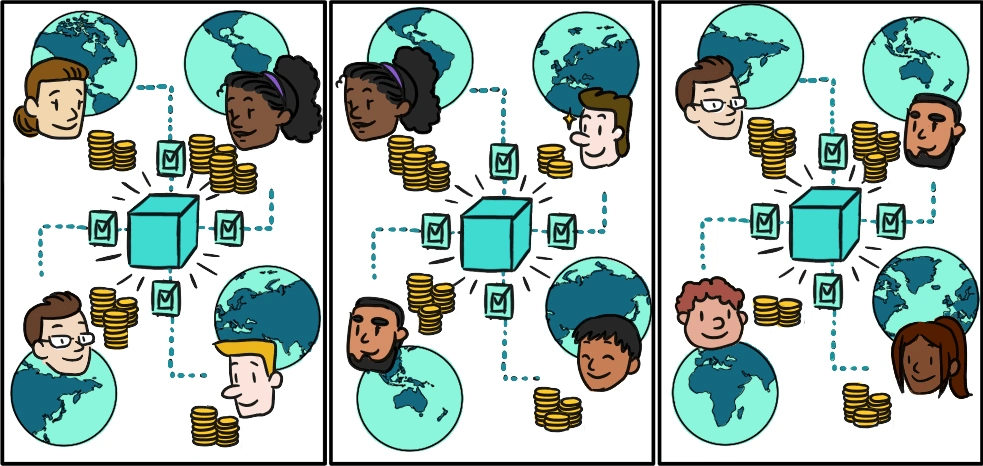
Concept drawing of the voting procedure in proof-of-stake protocols.
Source: https://developer.algorand.org/
-
Pure Proof-of-Stake (PPoS) Algorithm
In contrast, Algorand's consensus algorithm, PPoS, is designed to be energy-efficient, secure, and scalable. In PPoS, the process of selecting those who gets to validate transactions and create blocks is based on the stake or ownership of the cryptocurrency rather than computational power.In Algorand's PPoS, a set of randomly selected stakeholders, known as the "committee," are chosen to validate transactions and create new blocks in each round of consensus. The selection process is based on the stakeholders' stake, with a higher stake resulting in a higher probability of being selected. This eliminates the need for resource-intensive mining, making it energy-efficient and environmentally friendly.
The PPoS algorithm also ensures decentralization by distributing the power to validate transactions and create blocks among a large and diverse set of stakeholders. This eliminates the concentration of power that can occur in PoW-based blockchains, where mining pools with more computational power may have an undue influence over the network.
Furthermore, Algorand's PPoS enables fast transaction confirmations, typically taking a few seconds, and has high throughput, allowing for a large number of transactions per second. This makes Algorand well-suited for applications that require high transaction speeds and throughput, such as financial services and real-world asset tokenization.
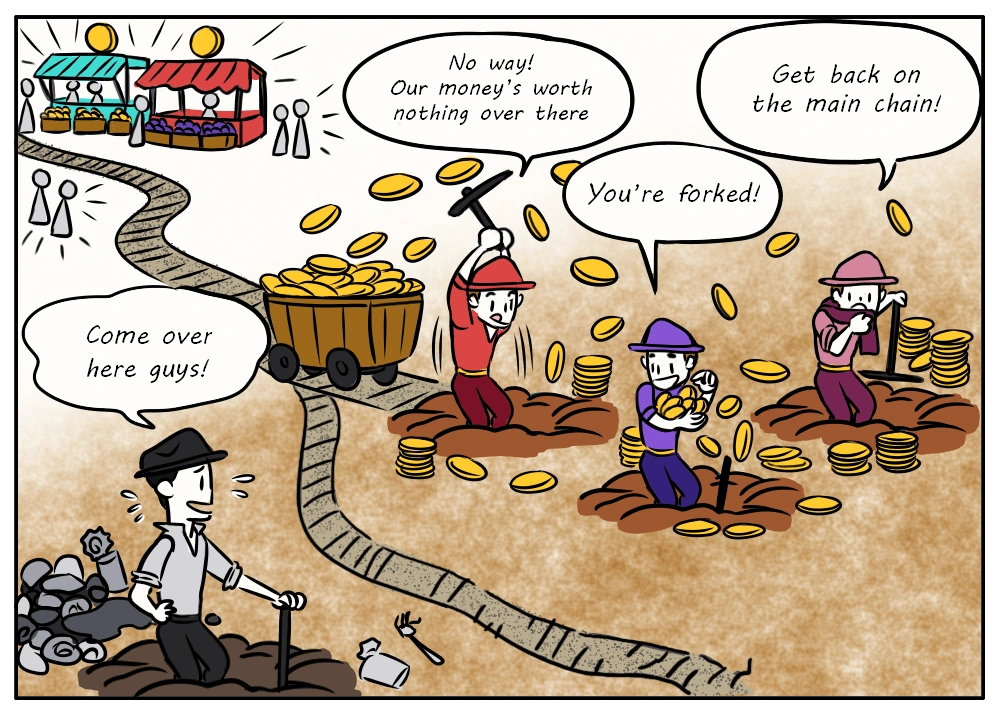
Concept drawing of block miners in proof-of-work protocols.
Source: https://developer.algorand.org/
In summary, Algorand's PPoS consensus algorithm offers several advantages over traditional PoW algorithms, including energy efficiency, security, scalability, and decentralization. These features make Algorand a promising choice for developers and enterprises looking to build decentralized applications on a high-performance and sustainable blockchain platform.
Security and Reliability
Security and reliability are critical aspects of any blockchain platform, as they ensure the integrity, confidentiality, and availability of data and transactions. Algorand, a blockchain platform, employs various mechanisms to achieve high levels of security and reliability.
-
Cryptographic Security - Algorand uses advanced cryptographic techniques to secure transactions and data. Transactions are signed using digital signatures, which provide authenticity and integrity to the data. Algorand employs Elliptic Curve Cryptography (ECC) with 256-bit keys, which is considered highly secure and widely used in modern cryptographic systems.
-
Byzantine Agreement Protocol - Algorand's consensus algorithm, Pure Proof-of-Stake (PPoS), utilizes a Byzantine Agreement (BA) protocol to achieve consensus among the participating nodes. This BA protocol ensures that a vast majority (two-thirds) of the honest nodes in the network agree on the order and validity of transactions, even in the presence of malicious nodes or Byzantine faults. This makes Algorand highly resilient to various types of attacks, including double spending, Sybil attacks, and other forms of network attacks.
-
Fast and Final Transactions - Algorand's PPoS enables fast transaction confirmations, typically taking a few seconds, which ensures quick and efficient processing of transactions. Once a transaction is confirmed in a block, it is considered final and cannot be reversed, providing a high level of transactional security and preventing the possibility of fraud or tampering.
-
Immutable Blockchain - Algorand's blockchain is immutable, meaning that once data is recorded on the blockchain, it cannot be altered or deleted. This ensures the integrity and immutability of transactions and data, making Algorand a reliable platform for recording and storing valuable information.
-
Robust Network Infrastructure - Algorand's network is designed to be highly available and resistant to failures. It employs a decentralized and distributed network architecture with multiple redundant nodes that validate and propagate transactions and blocks. This makes the network resilient to single-point failures and ensures that transactions can be processed reliably even in the face of node failures or other network disruptions.
-
Audited and Transparent - Algorand's codebase is open-source, which means that it can be publicly audited and reviewed by the community and security experts for potential vulnerabilities. Algorand also undergoes regular security audits by independent third-party firms to identify and address any potential security weaknesses.
Algorand prioritizes security and reliability through its cryptographic security measures, Byzantine Agreement consensus algorithm, fast and final transactions, immutable blockchain, secure smart contracts, regular protocol upgrades, robust network infrastructure, and transparent auditing. These features collectively ensure the integrity, confidentiality, and availability of data and transactions on the Algorand blockchain, making it a secure and reliable platform for various decentralized applications and use cases.
Developer-Friendly
One of the key aspects of the Algorand blockchain that makes it attractive to developers is its developer-friendly nature. Algorand offers a variety of features and tools that make it easy for developers to build, deploy, and manage decentralized applications (dApps) on the platform. Here, we will delve into some of the key aspects of Algorand's developer-friendly approach in detail.
-
Simple and Powerful APIs - Algorand provides a rich set of APIs (Application Programming Interfaces) that make it straightforward for developers to interact with the blockchain. These APIs are well-documented, easy to use, and support multiple programming languages such as Python, JavaScript, Go, and Java, making them accessible to a wide range of developers. The APIs allow developers to perform various operations, such as sending transactions, managing accounts, querying blockchain data, and interacting with Algorand's smart contracts.
-
Algorand SDKs - Algorand offers software development kits (SDKs) that provide pre-built libraries, tools, and documentation for developers to build applications on the Algorand blockchain. These SDKs are available in popular programming languages such as Python, JavaScript, Go, Java, and C#, which make it easy for developers to get started quickly and efficiently.
-
Smart Contracts - Algorand supports the development and execution of smart contracts on its blockchain. Smart contracts are self-executing contracts that run on the blockchain and can automate various processes without the need for intermediaries. Algorand's smart contracts are written in TEAL (Transaction Execution Approval Language), a simple and secure language that allows developers to create sophisticated smart contracts with ease.
-
Scalability and High Throughput - Algorand's blockchain is designed to be highly scalable, with the ability to process thousands of transactions per second (TPS). This high throughput makes Algorand well-suited for building applications with high transaction volumes and demanding performance requirements.
-
Community Support - Algorand has a vibrant and growing developer community that offers support, resources, and collaboration opportunities for developers. The Algorand community provides forums, meetups, and developer events that foster collaboration and knowledge sharing, making it easier for developers to learn, grow, and contribute to the Algorand ecosystem.
Algorand's developer-friendly approach provides a conducive environment for developers to build and deploy decentralized applications with ease. From simple and powerful APIs to comprehensive SDKs, smart contract support, developer tools, scalability, security, interoperability, and community support, Algorand offers a robust and accessible platform for developers to create innovative blockchain applications.
High Performance
High performance is one of the key characteristics of the Algorand blockchain, which is designed to deliver fast and efficient transaction processing, making it suitable for a wide range of use cases. Here, we will delve into the details of Algorand's high-performance features.
-
Transaction Throughput - Algorand is designed to handle a high volume of transactions per second (TPS), making it ideal for applications that require fast transaction processing. Algorand's pure proof-of-stake (PPoS) consensus mechanism allows for fast block confirmation times, typically under 5 seconds, enabling high transaction throughput. This makes Algorand well-suited for applications that require real-time or near-real-time transaction processing, such as payment systems, decentralized finance (DeFi) applications, and supply chain management.
-
Instant Confirmation - Algorand's PPoS consensus mechanism allows for instant transaction confirmation, with blocks being finalized as soon as they are added to the blockchain. This means that transactions on the Algorand blockchain are confirmed and irreversible within seconds, providing near-instantaneous transaction finality. This feature is particularly beneficial for applications that require quick and reliable transaction confirmation, such as point-of-sale (POS) systems and micropayments.
-
Low Transaction Fees- Algorand's transaction fees are typically low, making it cost-effective for end-users and developers. Algorand's transaction fees are based on the size of the transaction, rather than the transaction value, which makes it predictable and transparent for developers and users. This makes Algorand attractive for applications that require frequent transactions or microtransactions, such as gaming, content sharing, and remittances.
Algorand's high-performance features, including high transaction throughput, scalability, instant confirmation, low transaction fees, security, reliability, and developer-friendliness, make it an attractive platform for building applications that require fast and efficient transaction processing. Whether it's for payment systems, DeFi applications, supply chain management, gaming, content sharing, or other use cases, Algorand's high-performance capabilities provide a solid foundation for building innovative and high-performing blockchain applications.
Transparency
Transparency is a fundamental principle of blockchain technology, and Algorand is built with a focus on transparency in its design and operation. In this section, we will explore in detail how Algorand achieves transparency in various aspects of its blockchain network.
-
Open Source- Algorand's protocol and software are open-source, meaning the source code is publicly available for anyone to review, audit, and verify. This promotes transparency by allowing the community to have full visibility into the inner workings of the Algorand blockchain, ensuring that the protocol operates as intended without any hidden or proprietary components.
-
Public Ledger- Algorand's blockchain is a public ledger, which means that all transactions and blocks are transparently recorded and publicly visible. Anyone can view and verify transactions and blocks on the Algorand blockchain, promoting transparency and accountability. This also enables Algorand to be used for various use cases, such as supply chain management, where transparency is essential for tracking and verifying the movement of goods.
-
Consensus Protocol- Algorand's consensus protocol, Pure Proof of Stake (PPoS), is designed to be transparent and secure. PPoS ensures that the selection of block proposers and validators is random and decentralized, with no single entity having control over the consensus process. This promotes transparency in the block validation and creation process, as well as prevents any potential for centralization or manipulation.
-
Community Participation- Algorand's governance model, as mentioned earlier, allows the community to participate in decision-making through Algorand Improvement Proposals (AIPs) and voting on proposals. This promotes transparency in the decision-making process, as it is driven by the consensus of the community rather than a centralized entity. Additionally, Algorand has initiatives such as the Algorand Foundation and the Algorand Community Rewards Program, which incentivize community participation and engagement, further promoting transparency and inclusivity.
-
Security Audits- Algorand undergoes regular security audits by reputable third-party firms to identify and fix any potential vulnerabilities or weaknesses in its protocol and software. These security audits are publicly disclosed, promoting transparency and accountability in maintaining the security and reliability of the Algorand blockchain.
Algorand achieves transparency through various means, including open source, public ledger, consensus protocol, community participation, security audits, and upgrade process. This promotes accountability, inclusivity, and integrity in the Algorand blockchain, ensuring that it operates in a transparent and trustworthy manner, which is a fundamental characteristic of blockchain technology.
There are many more points which make you clear why Algorand.
FAQs
Question 1. What is the difference between a permissioned and a permissionless blockchain?
Permissioned and permissionless blockchains are two different types of blockchain networks based on their accessibility and participation requirements.
-
Permissioned Blockchain- A permissioned blockchain, also known as a private or enterprise blockchain, restricts access to the blockchain network to a select group of participants who have been granted permission. Permissioned blockchains are typically used within organizations or consortia where participants are known and trusted entities. Access to the blockchain network is controlled through a predetermined set of rules and protocols, and participants may require authorization or approval to join and participate in the network.
Key characteristics of permissioned blockchains include:- Restricted Access- Only approved participants can join the blockchain network and perform transactions or participate in the consensus process.
- Centralized Governance- Permissioned blockchains often have a central entity or group that controls the decision-making process and sets the rules for the network.
- Higher Efficiency- Permissioned blockchains may have faster transaction times and lower transaction fees compared to permissionless blockchains, as they do not require extensive consensus mechanisms.
- Lower Decentralization- Permissioned blockchains may have a lower degree of decentralization compared to permissionless blockchains, as decision-making and governance are often concentrated in the hands of a few entities.
-
Permissionless Blockchain- A permissionless blockchain, also known as a public or open blockchain, allows anyone to join the network and participate without requiring any authorization or approval. Participants in a permissionless blockchain have equal access to the network and can perform transactions, participate in the consensus process, and validate transactions. Examples of permissionless blockchains include Bitcoin and Ethereum.
Key characteristics of permissionless blockchains include:- Open Access- Anyone can join the blockchain network and participate without needing any authorization or approval.
- Decentralized Governance- Decision-making and governance in permissionless blockchains are distributed across the network, with no single entity having control.
- Higher Transparency- Permissionless blockchains are typically more transparent, as all transactions and activities on the blockchain are publicly visible and verifiable.
- Lower Efficiency- Permissionless blockchains may have slower transaction times and higher transaction fees compared to permissioned blockchains, as they often require extensive consensus mechanisms to maintain integrity and security.
In summary, the main difference between permissioned and permissionless blockchains is the accessibility and participation requirements. Permissioned blockchains restrict access to a select group of participants, while permissionless blockchains allow anyone to join and participate. Permissioned blockchains often have centralized governance, higher efficiency, and lower decentralization, while permissionless blockchains have decentralized governance, higher transparency, and lower efficiency.
Question 2. What are the differences between the many different types of "proof-of-stake" protocols?
Proof-of-stake (PoS) is a consensus mechanism used in blockchain networks to validate transactions and secure the network. There are several different types of PoS protocols that vary in their design, approach, and implementation. Here are some of the key differences among various PoS protocols:
-
Pure PoS- In a pure PoS protocol, validators (also known as stakeholders) create new blocks and validate transactions based on the amount of cryptocurrency they hold and "stake" in the network. The stake typically determines the probability of a validator being selected to create a block, with higher stakes leading to higher chances of block creation. Examples of pure PoS protocols include Tezos and Cardano.
-
Delegated PoS- In a delegated PoS (DPoS) protocol, a limited number of validators (often referred to as "delegates" or "witnesses") are elected or appointed to create blocks and validate transactions on behalf of the network. DPoS protocols rely on a smaller set of trusted validators, which can result in faster transaction times compared to other PoS protocols. Examples of DPoS protocols include EOS and Lisk.
-
Bonded PoS- In a bonded PoS (BPoS) protocol, validators are required to "bond" or lock up a certain amount of cryptocurrency as collateral to participate in block creation and transaction validation. If a validator behaves maliciously or violates the network's rules, their bonded cryptocurrency can be forfeited as a penalty. Examples of BPoS protocols include Polkadot and Cosmos.
Question 3. What is forking?
Forking occurs when a blockchain splits into two or more separate branches. Eventually, only one branch will survive. In the interim, a fork causes significant uncertainty. If a payment made to you appears in only one of the branches you do not know if you have been paid or not, because your payment may end up in a non-surviving branch. There are several types of forking:
- Hard Forking - A hard fork refers to a permanent split in the blockchain network where the original chain and the forked chain become independent and separate from each other. This results in two or more separate blockchains with different rules, features, and possibly different cryptocurrencies.
A hard fork can occur in Algorand if there is a significant disagreement among stakeholders on the protocol upgrades or changes, and the consensus cannot be reached through the normal upgrade process using the Pure Proof of Stake (PPoS) consensus mechanism. In such cases, a portion of the stakeholders may decide to create a new chain with a different set of rules, resulting in a hard fork.
In a hard fork, the new chain will typically have its own governance, consensus rules, and possibly its own native cryptocurrency. This can lead to a divergence in the blockchain's transaction history, as new transactions and blocks may only be valid on the forked chain and not on the original chain, and vice versa.
- Soft Forking - a soft fork refers to a temporary or reversible split in the network that does not result in a permanent divergence of the blockchain. Soft forks are typically introduced to implement protocol upgrades or changes that are backward compatible, meaning that the new rules are compatible with the existing rules, and nodes that do not upgrade can still participate in the network.
The new rules are enforced by a majority of the network's validators, while nodes that have not upgraded can still continue to operate based on the old rules. This means that transactions and blocks that are valid according to the new rules will also be valid according to the old rules, and both types of nodes can still communicate and participate in the same network.
Soft forks are typically used in situations where there is a need to implement changes to the blockchain's protocol or consensus rules while maintaining backward compatibility with existing nodes and avoiding disruptions to the network's continuity. They are considered less disruptive than hard forks, as they do not result in the creation of separate chains or require users to upgrade their software, but they may still require coordination and consensus among stakeholders to ensure a smooth implementation.
Question 4. For the Algorand network, what does it mean for an account to be offline or online?
The terms "offline" and "online" typically refer to the status of an account in relation to its participation in the consensus process and ability to submit transactions to the network.
-
Offline Account
An account is considered "offline" when it does not have an active connection to the Algorand network. This means that the account's associated node, which is responsible for validating transactions and participating in the consensus process, is not connected to the network and therefore unable to actively participate in block validation or transaction processing. An offline account cannot send or receive transactions, and its holdings and status on the blockchain may not be updated until it comes back online. -
Online Account
An account is considered "online" when it has an active connection to the Algorand network. This means that the account's associated node is connected to the network and actively participates in the consensus process, validating transactions, and processing blocks. An online account can send and receive transactions, participate in the consensus process, and its holdings and status on the blockchain are updated in real-time.
It's important to note that being offline or online does not affect the security of an account or its holdings on the Algorand blockchain. Account security is primarily determined by the private key associated with the account, which is used to sign transactions and authorize changes to the account's state. Whether an account is online or offline simply determines its ability to actively participate in the consensus process and submit transactions to the network at a given moment.
Question 5. What is a Multi-Sig account?
A multi-signature (multi-sig) account in the Algorand blockchain refers to an account that requires multiple signatures from different parties to authorize a transaction. It is a form of account control mechanism that enhances security and enables more complex transaction authorization workflows.
In a multi-sig account, the account owner can specify a certain number of signatures required to approve a transaction. For example, a 2-of-3 multi-sig account would require two out of three specified signatures to authorize a transaction. This means that at least two out of the three authorized parties must sign the transaction for it to be valid.
Multi-sig accounts in Algorand can be used in various scenarios where additional authorization is needed for transaction approvals. This can include joint accounts where multiple parties need to approve transactions, corporate accounts where multiple executives or board members need to sign off on transactions, or escrow accounts where a third-party mediator is involved in the transaction process.
The use of multi-sig accounts adds an extra layer of security to Algorand transactions, as it reduces the risk of unauthorized or fraudulent transactions. It also provides flexibility in transaction authorization workflows, allowing for customizable and more complex approval processes.
Conclusion
In this article, we have covered the fundamental concepts of the Algorand blockchain, including its proof-of-stake consensus mechanism, security and reliability features, developer-friendly environment, high performance, governance and upgrades, transparency, and different types of forks. As we continue to delve deeper into the Algorand blockchain, we will explore more aspects and intricacies of this innovative blockchain platform. Stay tuned for more in-depth discussions on Algorand and its unique features!
Pushpendra ShuklaPosted May 16, 2023, 5:49 AM
Nice Article !!!