

Introduction
In 2017, Google researchers published a paper titled “Attention is All You Need”, introducing the Transformer model—a novel neural network architecture that would revolutionize natural language processing (NLP) and reshape the landscape of AI. Today, models like GPT, BERT, T5, and LLaMA are built on this architecture, powering applications from chatbots to translation engines and code generation tools.
But what exactly is a Transformer model, and why is it so powerful?
What is a Transformer?
A Transformer is a deep learning model architecture designed to handle sequential data, such as text, by using mechanisms called self-attention and positional encoding instead of relying on recurrence like LSTM or GRU models.
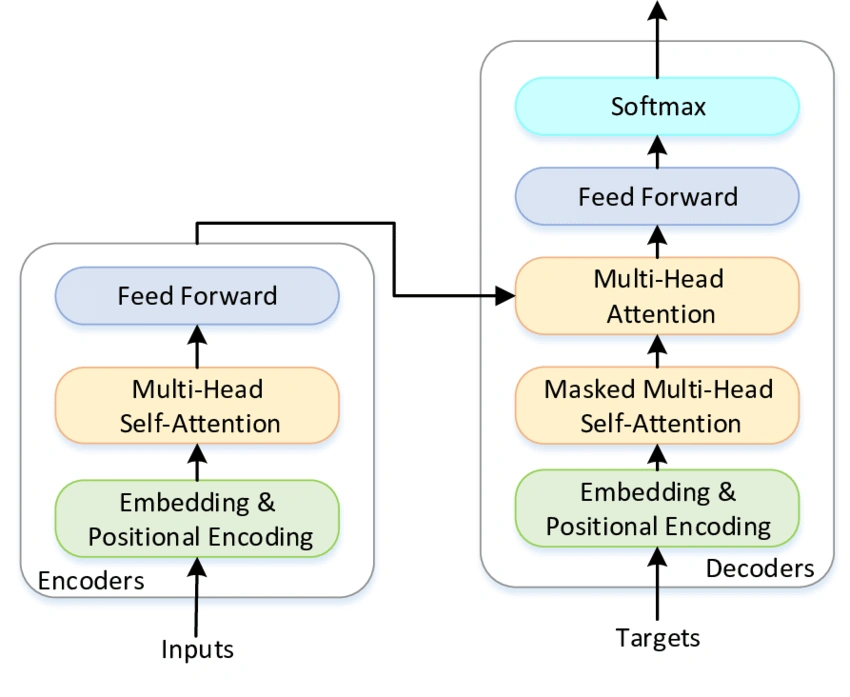
Simplified diagram of the Transformer model. Courtesy: www.researchgate.net
Key Components
1. Self-Attention Mechanism
It allows the model to weigh the importance of different words in a sentence relative to each other. For instance, in the sentence “The cat sat on the mat because it was tired,” the model learns that “it” refers to “cat”.
2. Positional Encoding
Since the model doesn’t process words sequentially, positional encoding is added to tokens so the model knows the order of words.
3. Encoder-Decoder Architecture
The original Transformer has two parts:
- The Encoder processes the input text (e.g., a sentence in English).
- The Decoder generates the output (e.g., the translated sentence in French).
Modern models may use just the encoder (e.g., BERT), just the decoder (e.g., GPT), or both (e.g., T5).
Why Transformers Outperform RNNs and LSTMs
Traditional RNNs struggled with long-term dependencies and took longer to train due to their sequential nature. Transformers eliminated these bottlenecks by:
- Enabling parallel processing of tokens.
- Learning contextual relationships across entire sequences.
- Scaling more effectively with large datasets and hardware accelerators (like GPUs and TPUs).
Real-World Transformer Models
Here are some prominent Transformer-based architectures:
| Model | Architecture | Use Case |
|---|---|---|
| BERT (2018) | Encoder-only | Text classification, Q&A |
| GPT (2018–) | Decoder-only | Text generation, summarization |
| T5 (2019) | Encoder-Decoder | Translation, summarization, Q&A |
| RoBERTa, XLNet | Encoder | Improvements on BERT |
| LLaMA | Decoder | Lightweight, open-source LLM |
| Vision Transformers (ViT) | Transformer applied to images | Image recognition |
Applications of Transformers
Transformers power a wide range of applications:
- Chatbots & Virtual Assistants (e.g., ChatGPT)
- Search Engines (Google uses BERT in its search algorithm)
- Translation Systems (Google Translate)
- Sentiment Analysis
- Speech Recognition
- Code Generation (e.g., GitHub Copilot)
Challenges
Despite their capabilities, Transformer models come with challenges:
- Computational Cost: Training large models requires significant resources.
- Data Hunger: These models often need billions of tokens to perform well.
- Bias & Fairness: Transformers can inherit and amplify biases present in training data.
- Interpretability: It’s hard to explain why a Transformer made a certain prediction.
The Future of Transformers
We are now entering an era of efficient transformers, multimodal models, and fine-tuned domain-specific transformers. Techniques like LoRA (Low-Rank Adaptation), quantization, and distillation aim to make these models lighter and faster without compromising much on performance.
Transformers are also moving beyond text, being adapted for audio, vision, and even robotics, pushing the limits of what AI can achieve.
Transformer Models Code Examples
The Transformer architecture, introduced by Vaswani et al. in 2017, has become the foundation of modern NLP models like BERT, GPT, and T5. I’ll explain the core ideas and walk through minimal code examples using PyTorch to build your own Transformer blocks.
🔧 Prerequisites
- Python 3.8+
- PyTorch
- NumPy
Install dependencies:
pip install torch numpy
⚙️ Step-by-Step Code
1. Positional Encoding
import torch
import math
def positional_encoding(seq_len, d_model):
    pos = torch.arange(0, seq_len).unsqueeze(1)
    i = torch.arange(0, d_model, 2)
    angle_rates = 1 / torch.pow(10000, (i / d_model))
    pos_enc = torch.zeros(seq_len, d_model)
    pos_enc[:, 0::2] = torch.sin(pos * angle_rates)
    pos_enc[:, 1::2] = torch.cos(pos * angle_rates)
    return pos_enc
2. Scaled Dot-Product Attention
def scaled_dot_attention(q, k, v, mask=None):
    d_k = q.size(-1)
    scores = torch.matmul(q, k.transpose(-2, -1)) / math.sqrt(d_k)
    if mask is not None:
        scores = scores.masked_fill(mask == 0, float('-inf'))
    attn = torch.nn.functional.softmax(scores, dim=-1)
    return torch.matmul(attn, v), attn
3. Multi-Head Attention
import torch.nn as nn
class MultiHeadAttention(nn.Module):
    def __init__(self, heads, d_model):
        super().__init__()
        assert d_model % heads == 0
        self.d_k = d_model // heads
        self.heads = heads
        self.qkv_proj = nn.Linear(d_model, d_model * 3)
        self.out_proj = nn.Linear(d_model, d_model)
    def forward(self, x):
        B, T, C = x.shape
        qkv = self.qkv_proj(x).reshape(B, T, 3, self.heads, self.d_k).permute(2, 0, 3, 1, 4)
        q, k, v = qkv[0], qkv[1], qkv[2]
        out, _ = scaled_dot_attention(q, k, v)
        out = out.transpose(1, 2).contiguous().view(B, T, C)
        return self.out_proj(out)
4. Feed-Forward Network
class FeedForward(nn.Module):
    def __init__(self, d_model, d_ff):
        super().__init__()
        self.linear1 = nn.Linear(d_model, d_ff)
        self.relu = nn.ReLU()
        self.linear2 = nn.Linear(d_ff, d_model)
    def forward(self, x):
        return self.linear2(self.relu(self.linear1(x)))
5. Transformer Block
class TransformerBlock(nn.Module):
    def __init__(self, d_model, heads, d_ff):
        super().__init__()
        self.attn = MultiHeadAttention(heads, d_model)
        self.ff = FeedForward(d_model, d_ff)
        self.norm1 = nn.LayerNorm(d_model)
        self.norm2 = nn.LayerNorm(d_model)
    def forward(self, x):
        attn_out = self.attn(x)
        x = self.norm1(x + attn_out)
        ff_out = self.ff(x)
        return self.norm2(x + ff_out)
6. Putting It All Together
class SimpleTransformer(nn.Module):
    def __init__(self, vocab_size, d_model=512, num_layers=6, heads=8, d_ff=2048, max_len=100):
        super().__init__()
        self.embed = nn.Embedding(vocab_size, d_model)
        self.pos_enc = positional_encoding(max_len, d_model)
        self.layers = nn.ModuleList([
            TransformerBlock(d_model, heads, d_ff) for _ in range(num_layers)
        ])
        self.out = nn.Linear(d_model, vocab_size)
    def forward(self, x):
        x = self.embed(x) + self.pos_enc[:x.size(1), :].to(x.device)
        for layer in self.layers:
            x = layer(x)
        return self.out(x)
🧪 Training with Dummy Data
model = SimpleTransformer(vocab_size=10000)
dummy_input = torch.randint(0, 10000, (2, 20))  # (batch, seq_len)
output = model(dummy_input)
print(output.shape)  # torch.Size([2, 20, 10000])
📦 Bonus: Use Hugging Face Transformers in 2 Lines
from transformers import AutoTokenizer, AutoModelForSequenceClassification
model = AutoModelForSequenceClassification.from_pretrained("bert-base-uncased")
tokenizer = AutoTokenizer.from_pretrained("bert-base-uncased")
🧩 Final Thoughts
Understanding Transformers from the ground up gives you a deep appreciation of the architecture behind ChatGPT, BERT, and many other models. You don’t need to reinvent the wheel every time, but knowing what’s under the hood helps with:
- Fine-tuning models
- Debugging
- Building custom variations for research or production
🔍 Resources
- Attention Is All You Need (original paper)
- Annotated Transformer (Harvard NLP)
- The Illustrated Transformer
Conclusion
Transformers have fundamentally changed how machines understand and generate human language. With constant innovation, they continue to unlock new possibilities in AI. Whether you’re building a conversational agent or analyzing financial documents, Transformer models offer the tools to tackle complex language tasks at scale.
Priyanshu AgnihotriPosted Jun 2, 2025, 10:43 AM
Really informative