

Blockchain is known for its security and decentralization. But there’s one scenario that can break that trust: the 51% attack.
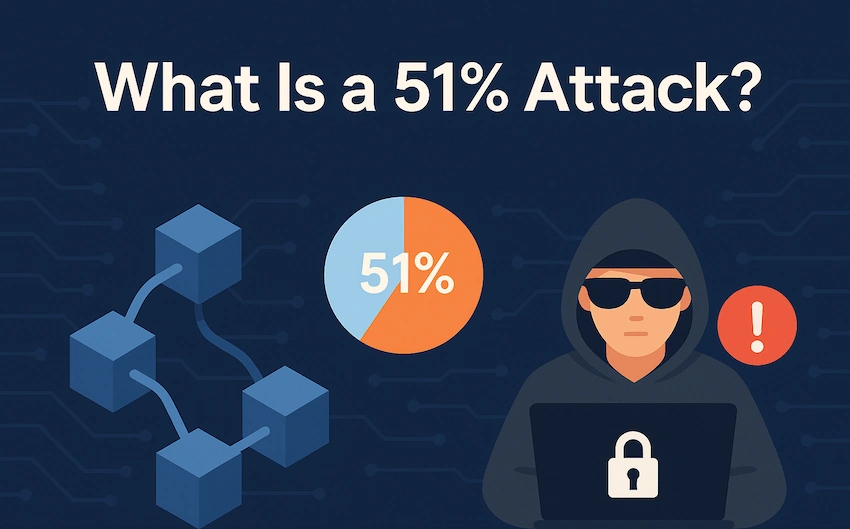
As a developer, you might’ve heard the term tossed around—especially in discussions about Bitcoin or smaller proof-of-work networks. But what exactly is a 51% attack, how does it work, and why should you care?
Let’s break it down in plain English (with a little code mindset).
🧠 The Basics: What Is a 51% Attack?
A 51% attack occurs when a single entity or group controls more than half (i.e., >50%) of the network’s mining or validating power. With this majority, they can manipulate the blockchain in harmful ways.
Specifically, they can:
-
Reverse their own transactions (double spending)
-
Prevent new transactions from being confirmed
-
Temporarily halt the network
-
Censor specific users or smart contracts
What they can’t do:
-
Steal coins from other wallets
-
Create coins out of thin air
-
Change old blocks before the attack began
⚙️ Why Does 51% Matter?
In decentralized systems, consensus is everything. If the majority agrees on the next block, it becomes the truth.
Most blockchains use either:
-
Proof of Work (PoW): Like Bitcoin and Litecoin
-
Proof of Stake (PoS): Like Ethereum 2.0 and Cardano
In both systems, the one with the most computational power (PoW) or stake (PoS) has the biggest influence.
So, if a group gains 51%, they essentially become the system’s dictator—for as long as they hold that majority.
🛠️ How It Works (Developer Perspective)
Let’s say Alice controls 51% of the hash rate in a PoW blockchain.
Here’s what she can do:
-
Broadcast a transaction publicly (e.g., sending coins to Bob)
-
Privately mine another version of the chain where that transaction never happened
-
Wait until her private chain becomes longer than the public one
-
Publish it to the network
The network sees Alice’s version as the longest valid chain and reorganizes history to match it.
Result: Bob’s transaction disappears. Alice keeps both the coins and whatever she received.
That’s a double spend—one of the worst-case scenarios in blockchain.
🔐 Why Bitcoin Is (Mostly) Safe
A 51% attack on Bitcoin is theoretically possible but practically unfeasible.
Why?
-
The sheer cost of hardware and energy to control >50% of the hash rate
-
The economic disincentive—any attack would crash Bitcoin’s price
-
The vast distribution of mining pools across the globe
According to estimates, mounting a 51% attack on Bitcoin for just 1 hour would cost millions of dollars in electricity and mining infrastructure.
In short: the system makes cheating more expensive than playing fair.
⚠️ But Smaller Chains Are at Risk
Blockchains with lower hash rates or stake concentrations are much more vulnerable.
Examples:
-
Ethereum Classic (ETC) suffered multiple 51% attacks in 2020
-
Bitcoin Gold (BTG) lost millions to similar attacks
-
Vertcoin and other altcoins have seen their chains reorganized
These networks don’t have enough decentralized validators or economic incentives to prevent a takeover.
📊 PoW vs PoS: Is One More Vulnerable?
Both systems are exposed to majority attacks—just in different ways.
| Feature | Proof of Work | Proof of Stake |
|---|---|---|
| Attack Resource | Hashing power (hardware, energy) | Staked coins (economic weight) |
| Cost of Attack | High upfront and recurring cost | Lower barrier, but money at stake |
| Recovery Difficulty | Depends on mining pool response | Slashing can penalize bad actors |
In PoS, validators with malicious intent can be slashed (lose their stake), adding an economic penalty. But if stake is concentrated in a few hands, the system can still be gamed.
🔎 How to Detect or Prevent a 51% Attack
As a developer or user, here’s what to look for:
🚨 Red Flags:
-
Sudden reorgs (chain rollbacks)
-
Stalled block production
-
Network forks or inconsistent balances
-
High centralization of validators or mining pools
✅ Best Practices:
-
Build on well-established chains with distributed validators
-
Use finality confirmations before accepting high-value transactions
-
Monitor real-time analytics using tools like:
🧩 Final Thoughts
The 51% attack is a powerful reminder: decentralization isn’t a magic bullet. It’s a balancing act between participation, incentive design, and network size.
As a developer:
-
Choose your blockchain platform wisely
-
Stay informed on network health and validator distribution
-
Understand the trade-offs of consensus mechanisms
In the world of blockchain, the code is law—but consensus is king.
Aishwarya GuptaPosted Jul 5, 2025, 4:37 AM
Helpful read!
KashisPosted Jul 5, 2025, 4:36 AM
Great explanation
Mahesh ChandPosted Jul 2, 2025, 11:38 AM
One of the flawded for consensus mechanism