

One of the most essential concepts in C# and .NET development is understanding the difference between Value Types and Reference Types.
This concept directly affects:
How data is stored in memory
How variables behave during assignment
How parameters are passed to methods
Application performance and memory usage
Bugs related to unexpected data changes
Many logical errors in C# applications arise because developers do not clearly understand how value and reference types work under the hood. This article explains the concept step by step, with clear explanations, examples, and real-world understanding.
What Are Value Types and Reference Types?
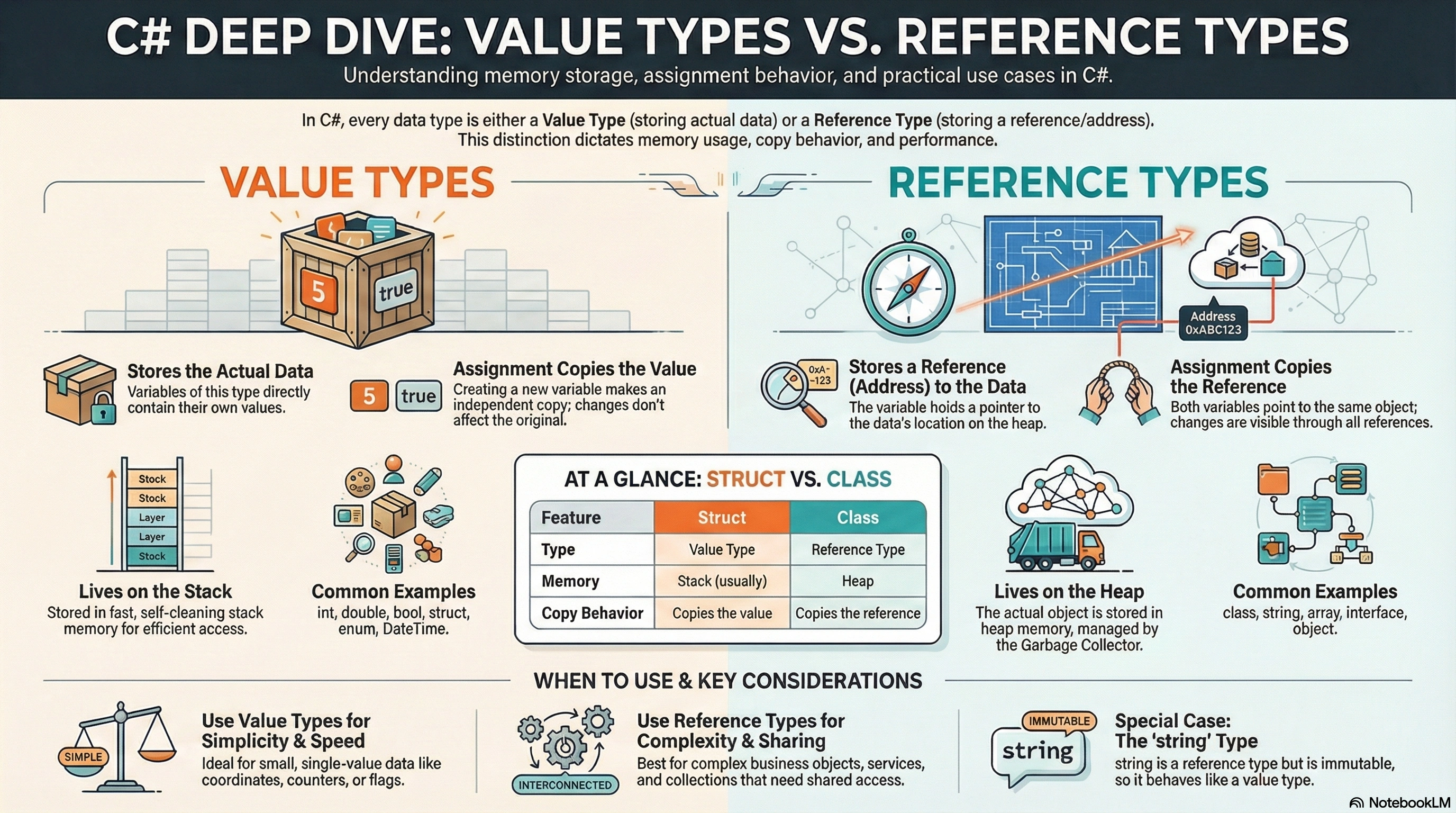
In C#, every type belongs to one of these two categories:
Value Types → store actual data
Reference Types → store a reference (address) to data
The key difference lies in how data is stored and copied in memory.
1. Value Types in C#
A value type directly contains its data. When you assign a value type to another variable, a complete copy of the value is made.
Common Value Types
intdoublefloatboolcharstructenumdecimalDateTime
Key Characteristics of Value Types
Stored as actual values
Value types hold the data itself, not a reference to it.Typically stored in stack memory
Stack allocation is fast and automatically cleaned up.Assignment copies the value
Changing one variable does not affect another.Immutable behavior during copying
Each variable maintains its own independent data.
Example of Value Type Assignment
int a = 10;
int b = a;

b = 20;

Console.WriteLine(a); // 10
Console.WriteLine(b); // 20Explanation:b gets a copy of a. Changes to b do not affect a.
Passing Value Types to Methods
When a value type is passed to a method, a copy is passed.
void ChangeValue(int x)
{
    x = 50;
}

int number = 10;
ChangeValue(number);

Console.WriteLine(number); // 10
The original value remains unchanged.
2. Reference Types in C#
A reference type stores a reference (memory address) to the actual data instead of the data itself.
Common Reference Types
classstringarrayinterfacedelegateobjectrecord
Key Characteristics of Reference Types
Stored in heap memory
The actual object lives in heap memory.Variables store references, not data
Multiple variables can point to the same object.Assignment copies the reference
Both variables refer to the same memory location.Changes reflect across references
Modifying the object affects all references.
Example of Reference Type Assignment
class Person
{
    public string Name;
}

Person p1 = new Person();
p1.Name = "Ajay";

Person p2 = p1;
p2.Name = "Rahul";

Console.WriteLine(p1.Name); // Rahul
Explanation: Both p1 and p2 refer to the same object in memory.
Passing Reference Types to Methods
When reference types are passed to methods, the reference is copied, not the object.
void ChangeName(Person p)
{
    p.Name = "Amit";
}

Person person = new Person { Name = "Ajay" };
ChangeName(person);

Console.WriteLine(person.Name); // Amit
The change affects the original object.
Value Types vs Reference Types – Memory Perspective
Stack Memory
Faster access
Stores value types
Automatically cleaned
Heap Memory
Stores reference type objects
Managed by Garbage Collector
Slower than stack but flexible
What Actually Happens
Value types → direct data storage
Reference types → pointer on stack + object in heap
Struct vs Class – A Common Comparison
| Feature | Struct | Class |
|---|---|---|
| Type | Value Type | Reference Type |
| Memory | Stack (mostly) | Heap |
| Copy Behavior | Copies value | Copies reference |
| Inheritance | Not supported | Supported |
| Null Allowed | No (except nullable) | Yes |
| Use Case | Small data | Complex objects |
Special Case: string in C#
Although string is a reference type, it behaves like a value type because it is immutable.
string a = "Hello";
string b = a;

b = "World";

Console.WriteLine(a); // Hello
This behavior improves safety and avoids unexpected changes.
Using ref and out with Value Types
C# provides ref and out keywords to allow passing value types by reference.
void Update(ref int x)
{
    x = 100;
}

int number = 10;
Update(ref number);

Console.WriteLine(number); // 100
This allows modifying the original value.
When to Use Value Types
Use value types when:
Data is small and simple
An object represents a single value
Performance is critical
Immutability is desired
Examples:
Coordinates
Counters
Flags
Status values
When to Use Reference Types
Use reference types when:
Data is complex
Object has behavior (methods)
Shared access is required
Memory flexibility is needed
Examples:
Business entities
Services
Models
Collections
Real-World Example Scenario
Imagine a banking system:
AccountBalance → Value type (decimal)
Customer → Reference type (class)
This ensures:
Money is handled safely
Customer data is shared consistently
Choosing the right type directly impacts correctness.
Performance Considerations
Value types reduce heap allocations
Reference types increase GC pressure
Large structs can degrade performance
Small immutable structs are ideal
Balanced usage is key.
Understanding Value Types and Reference Types in C# is essential for writing correct, efficient, and maintainable code. This concept influences memory usage, performance, behavior during assignments, and method calls.
By mastering this difference, developers gain deeper control over how their applications behave and avoid subtle bugs that are otherwise difficult to trace.
This knowledge is foundational and directly applicable in real-world .NET development and technical interviews.
Thank you for reading this detailed guide on Value Types and Reference Types in C#.
A clear understanding of memory behavior is a hallmark of a strong C# developer.
Join the conversation! Your thoughts help the community grow.