
Introduction
An instructor I once had made a statement that has echoed in my head for years. When you are a programmer, you have two groups of end users, the people who will actually use the software AND other programmers who may someday have to modify your code. With that in mind, I have always tried to write my code to be as easily readable to other programmers as possible.
Visual Studio .NET gives us some very handy tools to improve the readability of our code. One that I am particularly fond of is the #region directive that allows us to collapse code in a customized manner.
Regions are created in this format.
#region MyRegion

your code here

#EndRegion
Everything that falls within the directives will be collapsible.
The method I've chosen to adapt is to create regions for each different type of element in a class (i.e., constructors, variables, methods, properties, enumerators) so that my code can be easily navigated.
Here is an example.
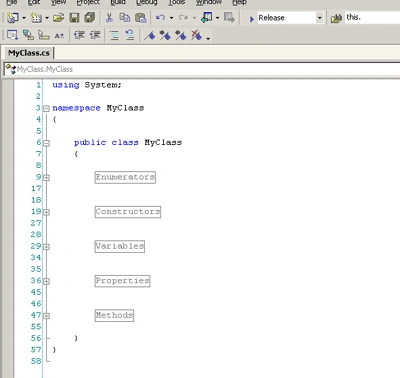
Doing this will keep your code more organized, which in turn, will increase efficiency. And someday, down the road, when another programmer comes across your source code, they will be very thankful.
Marcus DupreePosted Aug 23, 2024, 2:54 PM
Regions are an anti pattern and should RARELY ever be used. Classes should be concise in what they do, functions should be clearly named and defined in their intention, if we do the prior effectively there will never be a need for regions. Only use cases i can see for regions is monstrosity classes which have thousands of lines of code. I've seen so many devs use regions blindly just because prior devs used them in the codebase
Bhavleen SinghPosted Jun 3, 2019, 10:45 PM
I'm new to programming, so for me to write code is very difficult. So, if its difficult to code then it should be difficult to read as well.
conrad mbaPosted Feb 19, 2018, 9:53 PM
Thanks James. Nice and concise explanation.
Filip SkakunPosted Mar 12, 2015, 6:54 PM
Ahh, but that plugin isn't there right now. #regions win! :)