
Introduction
In this article we are going to look at Microsoft .NET Framework. This is the newly established software development environment which helps developers to develop applications quickly and gives optimum, efficient, scalable, performance oriented applications in different languages like Visual Basic .NET, C#, ASP .NET, and Jscript .NET etc...
Overview of the .NET Framework
The .NET Framework is a new computing platform that simplifies application development in the highly distributed environment of the Internet.
Services
NET Framework provides the following services:
- Tools for developing software applications,
- run-time environments for software application to execute,
- server infrastructure,
- value added intelligent software which helps developers to do less coding and work efficiently,
The .Net Framework will enable developers to develop applications for various devices and platforms like windows application web applications windows services and web services.
Objectives
The .NET Framework is designed to fulfill the following objectives:
- A consistent object-oriented programming environment, where object code can be stored and executed locally, executed locally but Internet-distributed, or executed remotely.
- A code-execution environment that minimizes software deployment and versioning conflicts.
- A code-execution environment that guarantees safe execution of code, including code created by an unknown or semi-trusted third party.
A code-execution environment that eliminates the performance problems of scripted or interpreted environments. - Developers can experience consistency across widely varying types of applications, such as Windows-based applications and Web-based applications.
- Build all communication on industry standards to ensure that code based on the .NET Framework can integrate with any other code.
Understanding the .NET Framework Architecture
The .NET Framework has two components: the .NET Framework class library and the common language runtime.
The .NET Framework class library facilitates types (CTS) that are common to all .NET languages.
The common language runtime consists of (class loader) that load the IL code of a program into the runtime, which compiles the IL code into native code, and executes and manage the code to enforce security and type safety, and provide thread support.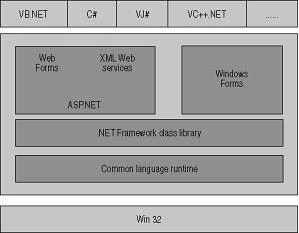
.NET Framework Architecture has languages at the top such as VB .NET C#, VJ#, VC++ .NET; developers can develop (using any of above languages) applications such as Windows Forms, Web Form, Windows Services and XML Web Services. Bottom two layers consist of .NET Framework class library and Common Language Runtime. This we are going to understand using this article.
Understanding the Roll of .NET Framework
The .NET Framework has two main components: the common language runtime (CLR) and the .NET Framework class library. The common language runtime is the foundation of the .NET Framework. CLR act as an agent that manages code at execution time, providing core services such as memory management, thread management, and remoting, while also enforcing strict type safety and facilitates with code accuracy that ensure security and robustness. The concept of code management is a fundamental principle of the CLR. Code that targets the CLR is known as managed code, while code that does not target the CLR is known as unmanaged code.
The class library, is a integral component of the .NET Framework, consists of object-oriented collection of reusable classes (types) that we can use to develop applications ranging from traditional command-line or any graphical user interface (GUI) applications such as Windows Forms, ASP. NET Web Forms and Windows Services the newly invented XML Web services.
The European Computer Manufacturers Association (ECMA) standard has defines the Common Language Specification (CLS); this enforces that software development languages should be interoperable between them. The code written in a CLS should be compliant with the code written in another CLS-compliant language. Because the code supported by CLS-compliant language should be compiled into an intermediate language (IL) code. The CLR engine executes the IL code. This ensures interoperability between CLS-compliant languages. Microsoft .NET Framework supports Languages like Microsoft Visual Basic .NET, Microsoft Visual C#, Microsoft Visual C++ .NET, and Microsoft Visual J# .NET.
The language compilers generate an Intermediate Language code, called Microsoft Intermediate Language (MSIL), which makes programs written in the .NET languages interoperable across languages.
The ECMA standard, Common Language Infrastructure (CLI), defines the specifications for the infrastructure that the IL code needs for execution. The CLI provides a common type system (CTS) and services such as type safety, managed code execution and side by side execution. 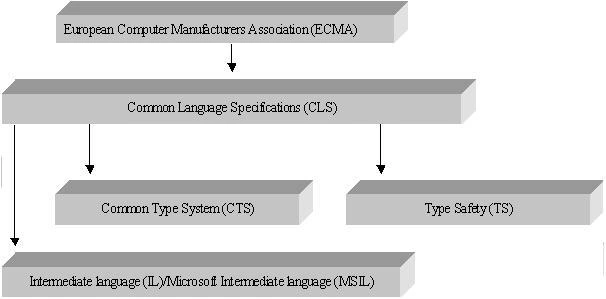
Figure 1. ECMA Standards under Microsoft .NET Framework.
The .NET Framework provides the infrastructure and services. The CLI specifications. These include:
- Common language runtime
- The CLR includes the CLI,
- The CLR also provides the execution environment for .NET Applications.
- Common type system.
- Provides the data types, values, object types. This helps developers to develop applications in different languages.Where .NET languages share CTS mean all the types used in applications shares the same types defined under CLI.
- Type safety
- .NET Framework performs operations on the values or objects for which .NET Framework requires each value or object has a type and which reference to the value or object type.
- Managed code execution.
- .NET Framework manages the state of the object while executing the .NET Applications.
- .NET Framework automatically allocates memory and provides garbage collation mechanism to de-allocate memory.
- Side-by-side execution
- .NET Framework allows different version of the same application to run on the same machine by using assemblies of different versions. Assemblies consist of IL Code and Metadata. Where metadata determines the application dependencies. By this .NET Framework Runtime executes multiple version of assembly and solves the major problem of legacy development environment. That is the "DLL HELL".
.NET Assembly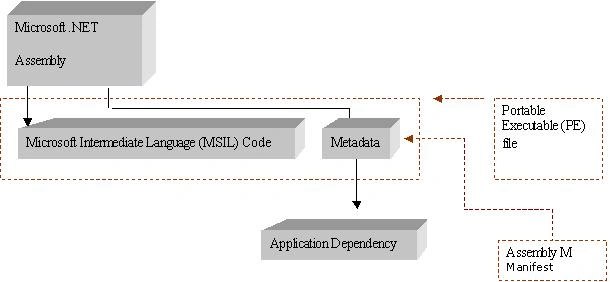
Figure 2 Side-by-side Execution.
Understanding .NET Framework CLR
The common language runtime facilitates the followings:
- Run-time environment
- CLR Compiles application into the runtime, compile the IL code into native code, execute the code.
- Run-time services.
- Memory management,
- Type safety,
- Enforces Security,
- Exception Management.
Thread support
Debugging support
Understanding Architecture of .NET Framework CLR 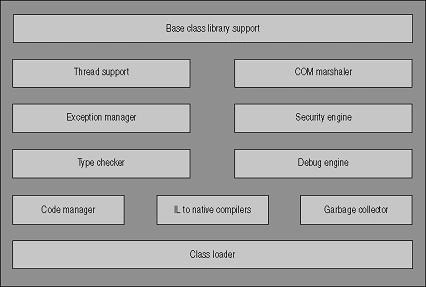
- Class loader, which loads classes into CLR.
- MSIL to native code compiles, this converts MSIL code into native code.
- Code manager, this manages the code during execution.
- Memory allocation and Garbage collector, this performs automatic memory management.
- Security engine, this enforces security restrictions as code level security folder level and machine level security using tools provided by Microsoft .NET and using .NET Framework setting under control panel.
- Type checker, which enforces strict type checking.
- Thread support, which provides multithreading support to applications.
- Exception manager, which provides a mechanism to handle the run-time exceptions handling.
- Debug engine, which allows developer to debug different types of applications.
- COM marshaler, which allows .NET applications to exchange data with COM applications.
- Base class library support, which provides the classes (types) that the applications need at run time.
Features of the Common Language Runtime
The CLR has the following Fractures
- Manages memory,
- Allocation of Memory
- De-Allocation of Memory (garbage collation)
- Thread execution support,
- Code execution,
- Code safety verification,
- Compilation.
- MSIL to Native Code.
- Code Security based on Trust (granted permission to execute code. Code level, Folder level, Machine level) These features are intrinsic to the managed code that runs on the common language runtime.
Understanding CLR
To execute the program and gain all the benefits of managed execution environment we write code in a language which is supported by CLS that is .NET Framework. The language compiler compiles the source code into the MSIL code which consists of CPU- independent code and instructions which is platform independent. MSIL consists of the followings:
- Instructions that enables to perform arithmetic and logical operations
- Access memory directly.
- Control the flow of execution,
- Handles exceptions,
MSIL code can be compiling into CPU specific instructions before executing, for which the CLR requires information about the code which is nothing but metadata. Metadata describes the code and defines the types that the code contains as well referenced to other types which the code uses at run time.
An assembly consists of portable executable file. At the time of executing PE file the class loader loads the MSIL code and the metadata form the portable executable file into the run time memory.
Before the execution of PE file it passes the code to the native code compiler for compilation, IL to native code compilation is done by JIT compiler. For different CPU architecture and compilers for the IL code in to the native instructions.
Futures of CLR
- Managed multithreading support and monitor the threads. Application domain contains one or more threads to execute.
- Manages interoperability with unmanaged code, and COM marshaling
A structured exception handling mechanism, - The infrastructure and managed execution process, memory management and garbage collection.
Architecture of CLR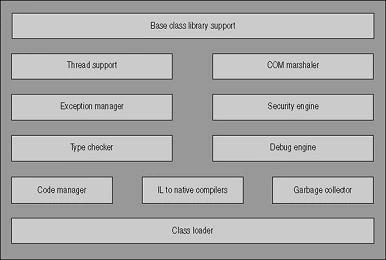
- Base class library support supports al the base classes used for .net languages to support basic functionality.
- COM Marshaler supports Marshaling of data between COM objects.
- Exception management supports handling Errors at runtime using try catch finally blocks.
- Security engine enforces security rules at runtime.
- Type checker checks for Type safe checks at runtime.
- Debug engine supports debugging at runtime.
- Code manger manages the Managed code at runtime.
- IL to native compiler compiles the MSIL code to the Native code which is machine independent.
- Garbage collector supports the Memory management and supports Clearing unused memory at runtime.
- Class loader lodes the classes at runtime .
Understanding JIT compiler
JIT compiler compiles is the integral part of CLR. the MSIL code to Native code and executes the batch of code Just in time which will be cached and next time when the code gets executed from cache in stud of compiling again. 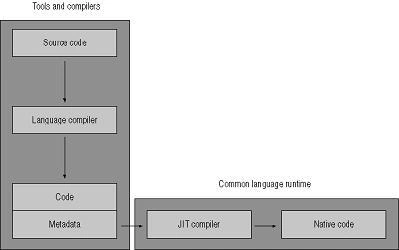
JIT Execution process
CLR class loader lodes MSIL code and metadata are loaded into memory; the code manager calls the entry point method which is WinMain or DLLMain method. The JIT compiler compiles the method to before its execution of the entry point method. The code manager places the objects in memory and controls the execution of the code. The garbage collector performs periodic checks on the managed heap to identify the objects which is not in use for the application.
At the time of program execution the type checker ensures that all objects and values, and the references of objects and values has its valid type. The type checker also makes sure that only valid operations are performed on the code other wise the exception will be thrown. The code is controlled by CLR at run time. CLR enforces security in following manner.
- To control and access the system recourses like hard disk.
- To control and access the network connections.
- To control and access the other hard ware resources.
Managed code Execution
Managed code execution is known as the process executed by the CLR which is as follows:
- CLR loads the MSIL & refers metadata,
- CLR executes the Native code,
- CLR provides automatic memory management.
- Managed execution also performs JIT compilations,
- Ensuring type safety,
- Enforcing security,
- Handling exceptions.
Managed Execution Process
- Managed code is self-explanatory code which gives information to CLR for multiple runtime services in .NET Framework.
- This information is stored in MSIL code in the form of metadata inside the PE file. Mata data information will describe the types that the code contains.
- Managed data is allocated and released from memory automatically by garbage collection. Managed data can be accessible form managed code but managed code can be accessible from managed and unmanaged data.
Memory Management
Automatic memory management means no need to write code to allocate memory when objects are created or to release memory when objects are not required the application.
The process of automatic memory management involves the following tasks:
Allocating memory
- When a process is initialized, the runtime reserves a contiguous address space without allocating any storage space for it.
- This reserved address space is called a managed heap. The managed heap keeps a pointer at the location where the next object will be located.
- When an application uses the new operator to create an object, the new operator checks whether the memory required by the object is available on the heap.
- When the next object is created, the garbage collector allocates memory to the object on the managed heap.
- Allocating memory to the objects in a managed heap takes less time than allocating unmanaged memory.
- In unmanaged memory, the pointers to memory are maintained in linked-list data structures. Therefore, allocating memory requires navigating through the linked list, finding a large memory block to accommodate that.
- You can access objects in managed memory faster than objects in unmanaged memory because in managed memory allocation, objects are created contiguously in the managed address space.
Releasing Memory
- The garbage collector periodically releases memory from the objects that are no longer required by the application.
- Every application has a set of roots. Roots point to the storage location on the managed heap. Each root either refers to an object on the managed heap or is set to null.
- An application's roots consist of global and static object pointers, local variables, and reference object parameters on a thread stack.
- The JIT compiler and the run-time maintain the list of the application roots.
- The garbage collector uses this list to create a graph of objects on the managed heap that are reachable from the root list.
- When the garbage collector starts running, it considers all the objects on the managed heap as garbage.
- The garbage collector navigates through the application root list, it identifies the objects that have corresponding references in the application root list and marks them as reachable.
- The garbage collector also considers such objects as reachable objects.
- The garbage collector considers all unreachable objects on the managed heap as garbage.
- The garbage collector performs a collection process to free the memory occupied by the garbage objects.
- The garbage collector performs the memory copy function to compress the objects in the managed heap.
- The garbage collector updates the pointers in the application root list so that the application roots correctly point to the objects to which they were pointing earlier.
- The garbage collector uses a highly optimized mechanism to perform garbage collection. It divides the objects on the managed heap into three generations: 0, 1, and 2. Generation 0 contains recently created objects.
- The garbage collector first collects the unreachable objects in generation 0. Next, the garbage collector compacts memory and promotes the reachable objects to generation 1.
- The objects that survive the collection process are promoted to higher generations.
- The garbage collector searches for unreachable objects in generations 1 and 2 only when the memory released by the collection process of generation 0 objects is insufficient to create the new object.
- The garbage collector manages memory for all managed objects created by the application.
- The garbage collection can explicitly release these system resources by providing the cleanup code in the Dispose method of the object.
- We need to explicitly call the Dispose method after you finish working with the object.
Implementing Finalizers
- The finalization process allows an object to perform cleanup tasks automatically before garbage collection starts.
- The Finalize method ensures that even if the client does not call the Dispose method explicitly, the resources used by the object are released from memory when the object is garbage collected.
- After the garbage collector identifies the object as garbage during garbage collection, it calls the Finalize method on the object before releasing memory.
- Finalizers are the methods that contain the cleanup code that is executed before the object is garbage collected. The process of executing cleanup code is called finalization. The Dispose and Finalize methods are called finalizers.
- The Dispose method of an object should release all its resources in addition to the resources owned by its parent object by calling the Dispose method of the ?parent object.
- We can execute the Dispose method in two ways.
- The user of the class can call the Dispose method on the object that is being disposed, or
- The Finalize method can call the Dispose method during the finalization process.
.NET Framework Tools
Assembly Linker
Al.exe Tool
- tool can create an assembly or resource file with the manifest in a separate file out of modules.
Syntax: al [source] [options] - This tool allows us to create multi-file assembly outside .NET. A multi-file assembly is useful to combine modules developed under different .NET languages into a single application.
IL Assembler
Ilasm.exe Tool
- When we compile managed code, the code is converted into MSIL code; this is CPU independent language which is converted to native code.
- We can use Ilasm tool to generate a portable executable (PE) file from the MSIL code. The resulting executable file is performance optimized, where the Ilasm tool does not create intermediate object file Syntex:
Ilasm [source] filename [options] - We can specify multiple source files to produce a single PE file.
IL Disassembler
Ildasm.exe Tool
- Ildasm tool is used to view PE file contains that is nothing but the MSIL code as a parameter and creates the text file that consists of managed code.
Code Access Security Policy Tool
Caspol.exe Tool
- Caspool is nothing but Code Access Security Policy tool, which allows us to grant and modify permissions granted to code groups at the user-policy, machine-policy, and enterprise-policy levels. Etc...
Syntex: caspol [options]
.NET Framework Configuration Tool
Mscorcfg.msc
- With this tool we can manage and configure assemblies in to the global assembly cache. And also manage the code access security along with remoting services.
- This tool also creates code group policies at user level- policies, machine level-policies, and enterprise level policies to assign and remove the permissions on assemblies within .NET Framework.
Anshu SinghPosted Dec 29, 2012, 3:11 AM
you can look here for your answer http://infostuffs.com/2012/12/29/2-understanding-net-the-c-environment/
Manas MohapatraPosted May 9, 2012, 1:40 AM
Nicely described.