

Introduction
Programming paradigms such as object-oriented programming (OOP) are supported by JavaScript, a strong and adaptable programming language. Inheritance is a fundamental aspect of OOP that permits a class to inherit methods and properties from another class. JavaScript inheritance, its types, and examples with explanations will all be covered in this article.

inheritance
A new class (child or subclass) can inherit attributes and methods from an existing class (parent or superclass) through the mechanism of inheritance. This creates a hierarchical relationship between classes and encourages code reuse.
Types of Inheritance in JavaScript
- Prototype Inheritance
- Class Inheritance (ES6)
- Mixins
Prototype Inheritance
Every object in JavaScript has a prototype. JavaScript first determines whether a property or method of an object actually exists on the object before attempting to access it. If not, the prototype chain is looked up.
As an illustration
// Parent class
function Animal(name) {
    this.name = name;
}

Animal.prototype.speak = function() {
    console.log(`${this.name} makes a noise.`);
};

// Child class
function Dog(name) {
    Animal.call(this, name); // Call the parent constructor
}

// Inherit from Animal
Dog.prototype = Object.create(Animal.prototype);
Dog.prototype.constructor = Dog;

// Override the speak method
Dog.prototype.speak = function() {
    console.log(`${this.name} barks.`);
};

const dog = new Dog('Rex');
dog.speak(); // Output: Rex barks.
Justification
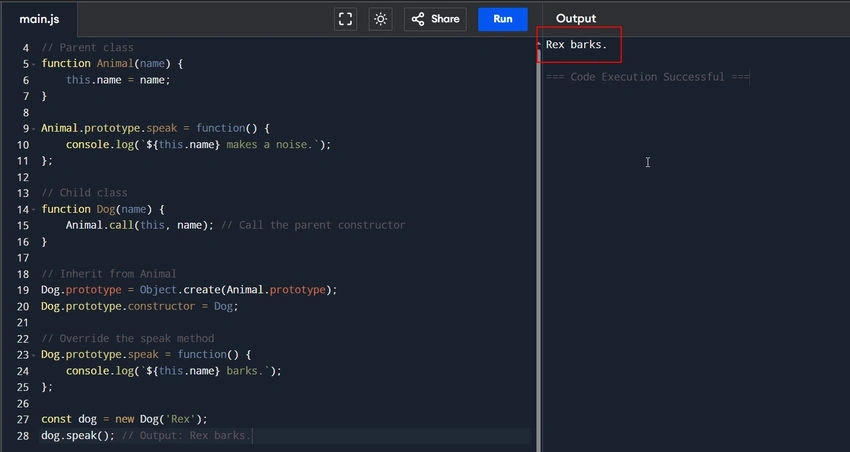
- The parent class, Animal, has a method speak and a constructor that initializes the name property.
- The child class that comes from Animal is called Dog. Animal.call(this, name) is used to invoke the parent constructor.
- To create the inheritance, we set the Dog.prototype to an object derived from the Animal.prototype.
- The Dog class provides specific behavior by overriding the speak method.
Class Inheritance (ES6)
JavaScript now supports a simpler syntax for class and inheritance creation with the release of ES6.
As an illustration
class Animal {
    constructor(name) {
        this.name = name;
    }

    speak() {
        console.log(`${this.name} makes a noise.`);
    }
}

class Dog extends Animal {
    speak() {
        console.log(`${this.name} barks.`);
    }
}

const dog = new Dog('Rex');
dog.speak(); // Output: Rex barks.
Justification
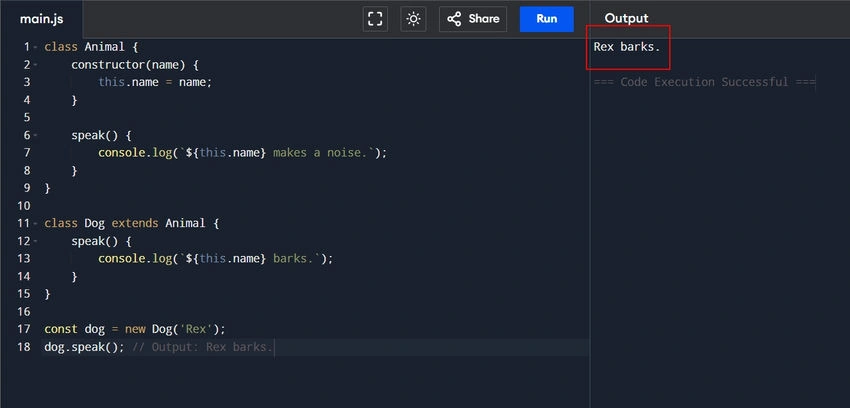
- For people coming from other OOP languages, the class keyword is used to define classes in a more recognizable manner.
- A subclass is created using the extends keyword. Dog extends Animal in this instance.
- As in the prototype example, the Dog class overrides the speak method.
Mixins
Classes can gain functionality through mixins instead of inheritance. They enable you to create classes using a variety of sources.
As an illustration
const CanFly = {
    fly() {
        console.log(`${this.name} can fly.`);
    }
};

class Bird {
    constructor(name) {
        this.name = name;
    }
}

Object.assign(Bird.prototype, CanFly);

const parrot = new Bird('Polly');
parrot.fly(); // Output: Polly can fly.
Justification
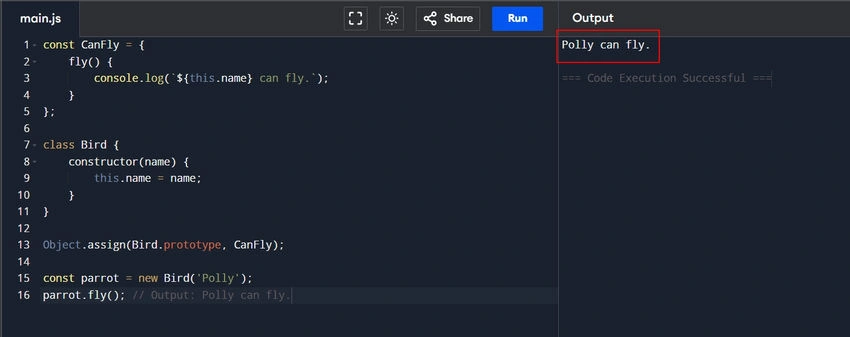
- An object called CanFly has the fly method.
- CanFly's methods and properties are copied to the Bird class's prototype using the Object.assign() method.
- This makes it possible for Bird to employ the fly method in situations where there is no parent-child relationship.
Conclusion
JavaScript inheritance is a potent feature that enables programmers to use reusable code to create intricate applications. By knowing the differences between prototype inheritance, class inheritance, and mixins, you can select the best strategy for your particular use case. You can write code for your JavaScript apps that is cleaner and easier to maintain by utilizing these ideas.
We learned the new technique and evolved together.
Happy coding!
Leo QiaoPosted Dec 13, 2024, 8:36 AM
As far as I know, Javascript has the same inheritance mechanism as Python. They both share attributes of the parent class, and the instance looks up itself first, then looks up the type it belongs to, and then the parent class. python supports multiple inheritance. Since classes are objects (called class objects) in Python, I think Python's inheritance is also prototypical. Is that right?