

We have seen that in large organizations business groups focus in each of their functional areas for delivering the best for their consumers. Applications are created for that along with back end services require this is hence are also boxed in by organization structures and functional areas. A simple example is shown below where the Products are being managed independently by each department.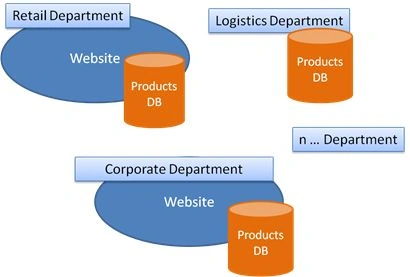
The problem with this is duplicate and redundant data, management overhead, maintenance cost and so on. Instead of isolation and repetition the organization can go for a centralized structure for commonly used data as shown below.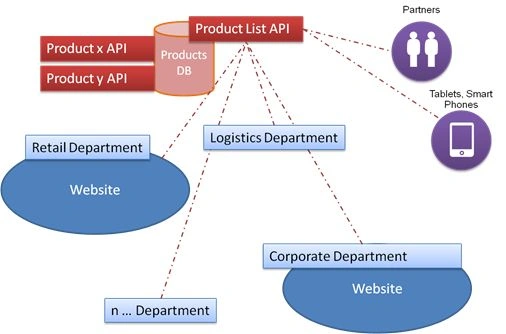
Here for example, Products is maintained centrally and APIs are created to access it, not only from internally within the organization but even by partners for extensions.
But again with this structure as API creation continues, it becomes very difficult to manage the explosion of APIs. Also discoverability of existing APIs becomes a big issue due to poor documentation, control, education to new developers. Hence management of APIs becomes crucial.
A complete API strategy should address both API creation and consumption. There are many market players that provide API management as a service. API management software can be built in-house or purchased as a service using a third-party provider like Windows Azure API Management Service, Oracle API Management Service, IBM API Management service and so on. API management software tools need to address the needs of multiple stakeholders like Developers, API Managers, API Performance and monitoring administrators and Infrastructure managers.
Some of examples of publicly available APIs are:
- Google APIs: – Google has multiple APIs publicly available for free; for example for books, maps, feeds and so on.
- Yahoo, Twitter, Microsoft are some of the big names that has multiple APIs available for use for free.
- SalesForce, FeedBurner and Oodle to name a few.
- You can get an exhaustive list at: ProgrammableWeb.
Some of the types of APIs in financial services could be:
- Coupon redemption
- Payment options
- Partner Loyalty Programs
For the Healthcare sector some examples are:
- Appointment book access
- Insurance coverage requests
- Pharmacy order entry
For Energy and Utilities some examples are:
- Energy consumption & management.
- Service requests including new service, repair and rate management.
- Location services for mobile repair teams.
- Inventory management for field repair depots and teams.
For eCommerce some examples are:
- Product catalog
- Price list
- Inventory by location
- Store location
An API Management service should provide at least the following:
- Provide API documentation and an interactive console.
- Take any backend and publish an API in minutes.
- Ensure a secure and scalable environment.
- Throttle, rate limit and quota of APIs for performance improvement.
- Monitor the health of APIs and quickly identify errors.
- Gain analytic insights on how the APIs are being used.
- Provide consistency among multiple versions of API implementations.
With the explosion of apps in the cloud, exposing or creating an API can become a new revenue model for a company.
Join the conversation! Your thoughts help the community grow.