

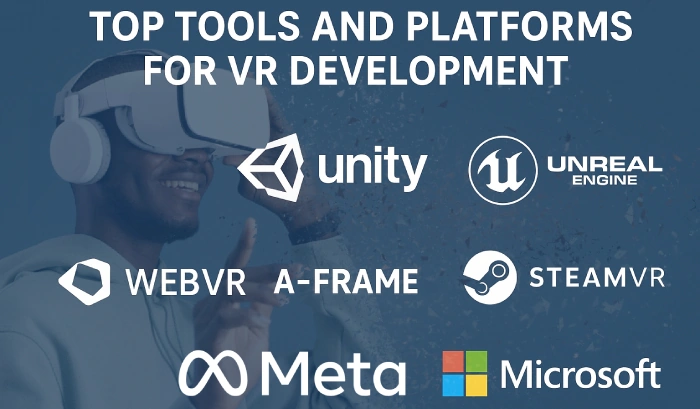
Virtual Reality (VR) is no longer just a futuristic idea—it’s a fast-growing industry shaping the way we learn, play, work, and connect. From immersive gaming experiences to medical training simulations and architectural walkthroughs, VR is unlocking creative opportunities across industries. But behind every VR experience is a set of tools and platforms that developers rely on to bring these virtual worlds to life.
If you’re curious about what powers VR development, let’s break down the primary tools and platforms that professionals use today.
1. Game Engines: The Foundation of VR Experiences
A VR app or game typically begins with a game engine—a software framework that provides everything from graphics rendering to physics simulation. These engines make it possible to build interactive 3D environments efficiently.
Unity
Unity is one of the most popular engines for VR development. Its user-friendly interface, cross-platform support, and a huge asset store make it ideal for both beginners and professionals. Unity supports all major VR hardware (like Meta Quest, HTC Vive, PlayStation VR), making it a go-to choice for creating immersive experiences.

Unreal Engine
Known for its cutting-edge graphics, Unreal Engine is often the tool of choice for projects requiring hyper-realistic visuals—such as architectural visualization, high-end games, and film production. Its Blueprint system also allows developers to prototype without writing extensive code.

2. VR Hardware and SDKs
The experience wouldn’t be possible without VR hardware and the software kits that connect them with applications.
Meta Quest (formerly Oculus)
Comes with the Oculus SDK, which provides tools for integrating features like hand tracking, passthrough, and spatial audio.HTC Vive
Uses the SteamVR SDK, allowing developers to build applications that support motion tracking, controllers, and room-scale VR.PlayStation VR
Offers Sony’s development kit tailored for console VR experiences, integrated into the PlayStation ecosystem.Other Platforms
Hardware like Pico, Varjo, and Windows Mixed Reality headsets each provide their own SDKs and APIs, ensuring developers can build compatible apps.
3. 3D Modeling and Design Tools
Before a VR scene comes to life, it must be designed. This is where 3D modeling tools come in.
Blender (open-source, free, and versatile for modeling, animation, and texturing).
Autodesk Maya & 3ds Max (industry standards for complex modeling and animations, often used in film and gaming).
Cinema 4D (popular for motion graphics and quick prototyping).
These tools help create characters, environments, and assets that are later imported into a game engine.
4. Collaboration and Version Control Platforms
VR development often requires collaboration among designers, developers, artists, and testers. To keep everything on track, teams use:
GitHub / GitLab / Bitbucket – For version control and collaborative coding.
Plastic SCM – Especially favored by Unity teams for handling large project files.
Perforce – Popular in big studios that need to manage huge asset libraries.
5. Specialized VR Development Tools
Beyond engines and modeling, developers also use specialized platforms to improve productivity:
Vuforia & ARCore/ARKit – Though primarily for AR, they are often integrated into VR projects for mixed-reality experiences.
Tilt Brush / Gravity Sketch – For designing and prototyping directly in VR.
Substance Painter (Adobe) – For detailed texturing and realistic material creation.
6. Testing and Deployment Platforms
Once a VR application is built, it must be tested and distributed:
SteamVR – A platform for testing and distributing PC VR content.
Meta Quest Store / App Lab – For publishing standalone VR apps to Quest devices.
PlayStation Store – The official distribution channel for PlayStation VR titles.
Conclusion
Developing a VR experience is like building a house: you need architects (3D modeling tools), a foundation (game engines), infrastructure (SDKs and hardware), and distribution (stores and platforms). While Unity and Unreal are at the heart of most projects, the ecosystem is supported by a wide range of tools that enable the design, collaboration, and delivery of immersive experiences.
As VR continues to expand into industries like healthcare, education, and remote work, the tools are also evolving to make development faster, more collaborative, and more accessible. For aspiring VR creators, the key is to start with a strong foundation (Unity or Unreal) and gradually explore the specialized tools that align with your project’s goals.
Join the conversation! Your thoughts help the community grow.