

Pre-requisite to understand this
TOGAF, or The Open Group Architecture Framework, is a standardized methodology for enterprise architecture. It provides a structured approach to align business strategy with IT capabilities using diagrams like sequence, component, and deployment views.
Enterprise architecture basics: Understanding business-IT alignment concepts.
ADM phases: Familiarity with iterative cycles like Preliminary, Vision, and Change Management.
Enterprise modeling tools: Experience with tools like PlantUML for visual architecture artifacts.
Introduction
TOGAF is a proven enterprise architecture framework developed by The Open Group to help organizations design, plan, implement, and govern their IT architecture. It emphasizes the Architecture Development Method (ADM), a cyclical process that spans business, data, application, and technology domains. This framework promotes reusability through the Enterprise Continuum and ensures architectures are adaptable to changing business needs.
Problems Solved
TOGAF addresses siloed IT systems, misaligned business goals, and inefficient change management in large enterprises. It solves integration challenges by providing a common language for stakeholders, reducing redundancy in applications, and enabling scalable digital transformation. Organizations use it to bridge strategy and execution, mitigate risks in mergers or cloud migrations, and optimize costs by rationalizing legacy systems.
Key issues resolved include:
Poor IT-business alignment, ensuring strategies drive technology decisions.
Fragmented architectures, unifying disparate systems via standardized models.
Compliance gaps, embedding governance from the start.
Slow adaptability, supporting iterative updates through ADM cycles.
High project failure rates, with gap analysis and roadmaps for feasibility.
Implementation Steps
Implementing TOGAF starts with establishing an architecture capability via the Preliminary phase, then cycles through ADM phases A-H and Requirements Management. Tailor it to your enterprise using guidelines like the Architecture Content Framework for artifacts (catalogs, matrices, diagrams). Engage stakeholders early, baseline current vs. target states, and govern via Phase G. Success requires executive buy-in and tools for modeling.
Customize ADM for your context; iterate as needed.
Define scope in Architecture Vision (Phase A).
Develop domain architectures (B-D: Business, Data, Application, Technology).
Plan solutions and migrations (E-F).
Govern deployment (G) and manage changes (H).
Sequence Diagram
This sequence diagram illustrates the ADM's iterative flow, showing stakeholder interactions with the Architecture Board across phases. Arrows depict message flows from visioning to governance, highlighting feedback loops for requirements management. It models time-ordered steps, emphasizing TOGAF's cyclic nature for continuous refinement. In practice, this visual aids stakeholder reviews by clarifying responsibilities and transitions.
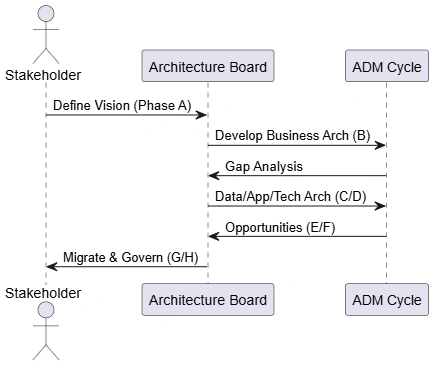
Captures phase interactions sequentially for process walk throughs.
Uses actors/participants to represent roles like stakeholders.
Arrows show synchronous/asynchronous exchanges (e.g., approvals).
Loops (implicit) reflect iterations between phases.
Simplifies complex ADM for training or presentations.
Component Diagram
The component diagram depicts TOGAF's modular structure, with rectangles as components (e.g., architecture domains) and dependencies showing relationships. Interfaces like the Enterprise Continuum classify reusable assets, while lollipops/sticks indicate provided/required ports. This view helps visualize how parts interconnect, supporting the Content Framework's artifacts for domain-specific modeling.
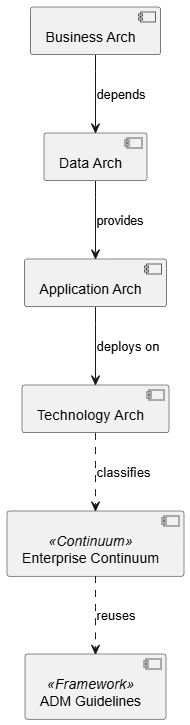
Components represent reusable architecture building blocks.
Dependencies/arrows show interfaces and flows between domains.
Stereotypes classify elements like frameworks.
Aids in identifying reusable assets across projects.
Supports modularity for scalable enterprise designs.
Deployment Diagram
This deployment diagram maps TOGAF elements to physical nodes, like tools on dev nodes deploying to production apps/infra. Clouds represent shared repositories, with artifacts flowing via associations. It clarifies runtime environments, security boundaries, and scalability, aligning with Phase D (Technology Architecture).
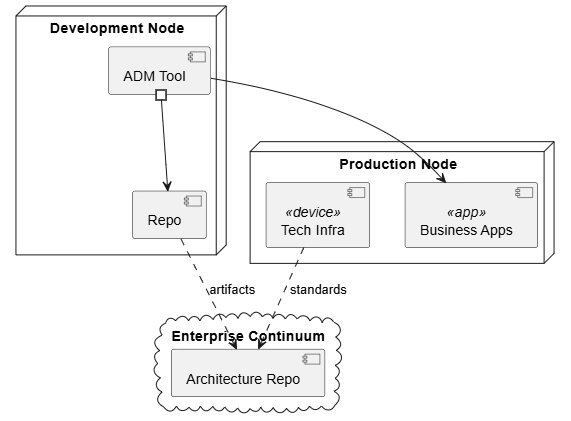
Nodes/devices show hardware/software hosts.
Artifacts/components deploy across environments.
Associations depict communication paths and multiplicities.
Clouds for external/shared resources like repositories.
Ensures physical feasibility in TOGAF roadmaps.
Advantages
Provides a vendor-neutral standard for consistent architecture practices.
Iterative ADM reduces risks through phased delivery.
Enterprise Continuum accelerates reuse of proven assets.
Strong governance framework ensures compliance and auditability.
Scalable for any organization size, from startups to globals.
Summary
TOGAF empowers enterprises with a comprehensive, adaptable framework centered on ADM to align IT with business goals. By using structured diagrams and phases, it streamlines transformations while minimizing disruptions. Adopting TOGAF yields long-term efficiency, better decision-making, and resilience in dynamic environments.
Join the conversation! Your thoughts help the community grow.