

Introduction
Strapi is an open-source headless CMS that allows the editor to easily manage and distribute content, which is the actual mindset of Strapi creator Pierre Burgy - Co-founder & CEO of Strapi. He's a strong believer in open-source, remote, and people-first organizations that define the environment of Strapi.
A headless CMS refers to a content management system that makes it easy for members across an entire organization to manage, write, and access content. This kind of tool is not concerned with how and where the content is displayed. Organizational members can do this throughout all their applications using an API. Otherwise, there is a serious concern about storing and delivering structured content across the needs, minimizing back-and-forth and communication along the same direction. We can say that headless CMS is getting some pretty big playtime today.
About Strapi
Strapi has been built on the popularity of a custom Node.JS framework. It also provides complex things and slows down the development of new features. Nowadays, developers love working to split everything for maintainability, and with its configuration files, Strapi is working for the same.
A part of a plug-in ecosystem, Strapi is built as a core. Strapi makers plan to grow that ecosystem and engage all in the community to develop new plug-ins and publish them on the marketplace. With faster functionalities, Strapi allows a robust and broad ecosystem of plug-ins. But being plug-in oriented and with its interface, Strapi works differently. The dedicated section on the left menu that is displayed in Strapi. In Strapi now, links often lead and are introduced to Configurations pages.
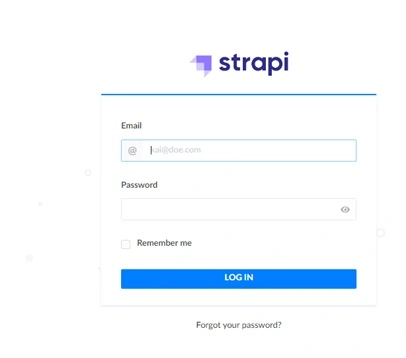
When we log in and create some collection type, i.e., Dynamic in nature and Single type, Looks like - User name will display in the right corner, and all collection types display in the left corner.
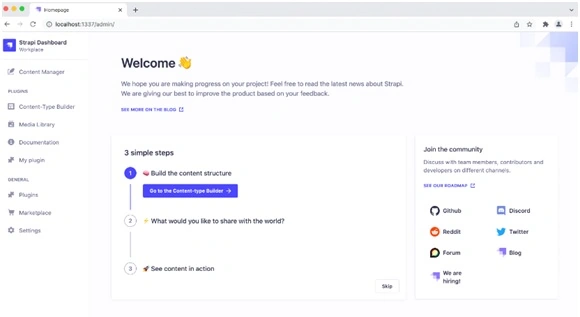
Features - Strapi V4 is required to enable these features.
Import
- Import data directly from the Content Manager.
- Import data from CSV and JSON files or from typing raw text according to user permissions.
- In Collection type Content is imported.
Export
- From the Content Manager, direct the data that is being exported.
- According to user permissions, export JSON & CSV (comma-separated values file) contents.
- Export data to clipboard and download or copy files from there.
- Using Content Manager filters & sorting, filter & sort the data.
Fetching Data
We’ll use Strapi as a data source to handle data fetching in Next.JS. There are so many other sources you could use to achieve the same result. Data that flows from one state to another is an integral part of any application. This data may be static, from the file system, or, in Strapi's ends, as is the case with many dynamic applications, from an external source.
In other words, we can say that Next.js is a React framework for building highly dynamic applications that make users' work easier by the approach of choosing to statically generate pages at build time or server-render them on every request with the help of pre-rendering and automatic code-splitting, file-system based routing, and hot code reloading with the Zero configuration.
Configuring fields for content-types
When your Strapi application is in a development environment, the Content-type Builder is only accessible to create and update content types. Otherwise, it will be in a read-only mode in other environments.
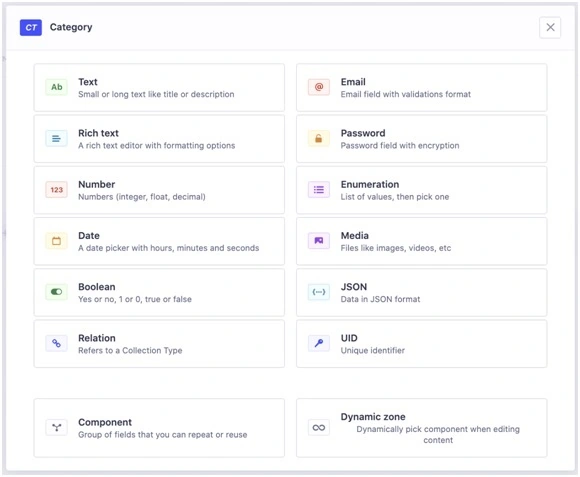
In the Content-type Builder, when a content-type or component is edited or updated, fields can be added at the creation of a new content-type or component.
All the listed fields look like:
Why is Strapi growing more popular these days?
- Open source functionality
Strapi is free, open-source, and easily accessible to users. Its entire codebase is on GitHub, managed by different contributors. Users can use it whenever needed.
- REST full API
Strapi makes it easy to consume the API from any client, app, or even IoT framework.
- JavaScript in totality
We can use JavaScript in our front-end and headless CMS.
- Host data safely
Strapi enables us to host our data on our servers for ultimate safety. And, it’s guaranteed by license.
- Plug-ins included
We can install the auth system, content management, custom Plug-ins, and so on, seamlessly.
- Change your admin panel
Strapi understands that no two projects are the same. We can customize the admin panel and API.
- Control you can access endpoints
Using authentications and permissions, we can decide who has access to your API or not. This provides them with total control.
- Custom Content Structure
We can generate the admin panel in a few clicks and get our whole CMS set up in a matter of a few minutes.
- Easy Content Management
Strapi's admin panel gives us an intuitive interface to create, edit, and delete our content.
- Developer-Friendly API
If our content has to be displayed to the world, an API is required. Strapi provides us with an API that will easily match our needs. We can fetch any data we might need via a REST API or GraphQL endpoint.
- Roles & Permissions
Strapi has a built-in user system that allows us to manage who can access what.
- Plug-in system
Need a new feature for the application? Fetch a plug-in in the marketplace. And yes - installing a GraphQL endpoint has never been so easy!
- Customization
Every part of our application can be easily customized. Strapi's architecture allows us to extend our app to match your exact use case.
Summary
In a few words, Strapi is offered free and open-source for users and for those developers who wish to self-host their software. Strapi has introduced so many possible deployment options for our project or applications. Strapi can be deployed to services such as AWS, Azure, and others. Also, we can deploy it using traditional hosting servers. Strapi has gone above and beyond to create a simplistic interface that is effective and easy to understand. There is no need to think twice about building content types for the application. These types can be adjusted according to user needs with different fields and mix-and-match options. With this, you can manage any kind of content in a fraction of the time spent in the programming world.
The above documentation covers how to develop locally with Strapi and why to use Strapi with various hosting options. Strapi is an open-source project, and all of Strapi's source code is under the MIT license, i.e., a permissive free software license by software institutes. Strapi is known as content-type Builder where we can create easily in the same way as collection and single types. It makes developer and user work easier and more effective.
Join the conversation! Your thoughts help the community grow.