
Introduction
The evolution of JavaScript to the ES6 version has brought a whole array of new tools and utilities. One such new feature is the spread operator.
Spread operator
Spread operator allows an inerrable to expand in places where 0+ arguments are expected. It is mostly used in the variable array where there is more than 1 value is expected. JavaScript ECMAScript 6 introduced the spread operator. The operator’s shape is three consecutive dots and is written as:
Syntax
- var variablename = [...value];
- const nambers = [1, 2, 3 ,4 ,5 ,6 ,7 ,8 ,9 ,10];
console.log (...nambers);

-
Spread in function calls
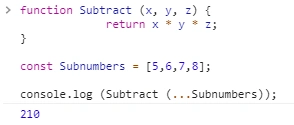
- function Subtract (x, y, z) {
- return x * y * z;
- }
- const Subnumbers = [5,6,7,8];
- console.log (Subtract (...Subnumbers));
-
Spread in array literals
- var one = ['Ravi', 'Vicky'];
- var two = ['mohit', ...one, 'and', 'Jasi'];
- console.log (two);
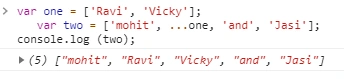
- A better way to concatenate arrays.
- var First = [0, 1, 2];
- var Second = [3, 4, 5];
- var third = [...First, ... Second];
- console.log (third);
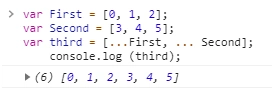
- Spread in object literals
- var Emp1 = {Name:'baljit', Address: 'New York', Salary:'5000'};
- var Emp2 = {Age: 32, Mobile: 98729648};
- var mergedEmp = {...Emp1, …Emp2};
- console.log (mergedEmp);
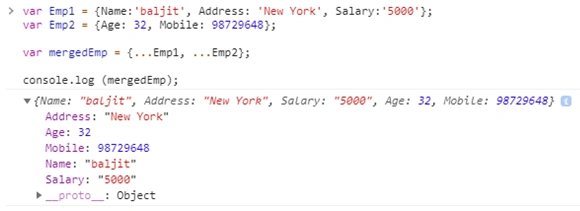
-
Spread in with Functions
- const numbers = [5, 6, 8, 9, 11, 999];
- Math.max (...numbers)
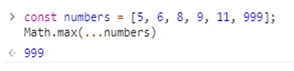
- Spread in with Array
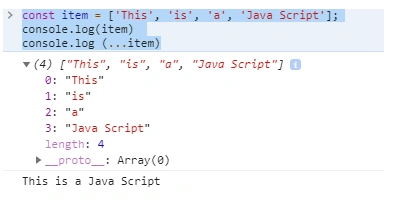
- const item = ['This', 'is', 'a', 'Java Script'];
- console.log(item)
- console.log (...item)
Summary
In this article, we learned about the Spread operator in JavaScript and how to use it in the program example.
Join the conversation! Your thoughts help the community grow.