

Introduction
Solana supports C, C++, and Rust for blockchain development. These languages offer different advantages and are popular choices for building efficient and secure applications on the Solana blockchain. Additionally, Solana provides the Anchor framework to simplify smart contract development, making it easier for developers to create decentralized applications (dApps) with Solana.
If you are new to Solana, I recommend exploring the following article first.
Language Supported by Solana
Solana blockchain supports three languages: C, C++, and Rust. Let's understand what are the benefits and limitations of these languages.
| Language | Benefits | Limitations |
| C |
|
|
| C++ |
|
|
| Rust |
|
|
Projects or Libraries Using Rust in Solana Development
- Serum DEX (Decentralized Exchange): Serum, a decentralized exchange built on Solana, leverages Rust extensively for its smart contracts and backend infrastructure. Rust's performance and safety features are crucial for handling the high-volume trading activity on Serum, ensuring reliability and security for users.
- Anchor: Anchor is a framework for building Solana smart contracts in Rust. It provides developers with high-level abstractions and tooling to streamline the development process. Using Rust, Anchor enables developers to write expressive and efficient smart contracts while leveraging Solana's unique capabilities.
- Solana Runtime: The Solana runtime is written in Rust, underscoring the platform's commitment to the language. By utilizing Rust, Solana benefits from its performance optimizations and safety guarantees, laying a strong foundation for building decentralized applications and scaling the network.
We can say that Rust will be the first choice for the Solana development as Rust's integration with Solana opens up a world of possibilities for blockchain developers. With its focus on performance, safety, and concurrency, Rust empowers developers to build fast, secure, and scalable decentralized applications on the Solana blockchain. So we move forward with the Anchor framework. Let's install the Anchor.
Anchor Setup
The Anchor framework for Solana is a powerful tool designed to simplify and accelerate the development of decentralized applications (dApps) on the Solana blockchain. Built with developers in mind, Anchor provides a robust and developer-friendly environment for building, deploying, and managing smart contracts on Solana. At its core, Anchor leverages Rust programming language, a language known for its performance, safety, and concurrency features. By using Rust, Anchor offers developers a familiar and powerful ecosystem to build secure and efficient smart contracts for the Solana blockchain.
Installation and Setup
Getting started with Anchor is straightforward. To install Anchor, follow these simple steps:
1. Install Rust
Before installing Anchor, ensure that Rust is installed on your system. Rust can be installed using the Rustup tool, which is available for Windows, macOS, and Linux. For WSL, macOS, Linux, and Unix-like OS, run the following command to install Rust.
curl --proto '=https' --tlsv1.2 -sSf https://sh.rustup.rs | sh -s -- -y
Output
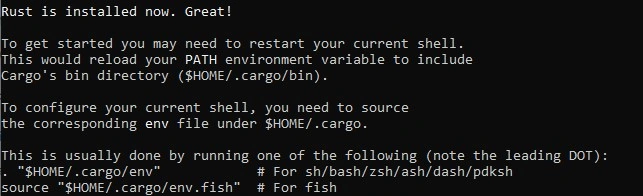
Now restart your current shell to reload the PATH environment variable to include Cargo's bin directory, or run the following command to achieve the same.
. "$HOME/.cargo/env"
2. Install Anchor CLI
Once Rust is installed, the next step is to install the Anchor Command Line Interface (CLI). For this first, we install AVM(Anchor Version Manager) by running the following command.
cargo install --git https://github.com/coral-xyz/anchor avm --locked --force
Once installation is done run the following command for the confirmation. It will display the current installed version.
avm --version
After this, run the following command to install the anchor.
avm install latest
avm use latest
You can replace the 'latest' with a specific version like '0.29.0' also as your requirement. Once it is done, run the following command to verify the installation.
anchor --version
3. Create a new anchor project
Run the following command to create a new anchor workspace.
anchor init <YOUR_PROJECT_NAME>
it will create a new workspace that has the following structure.
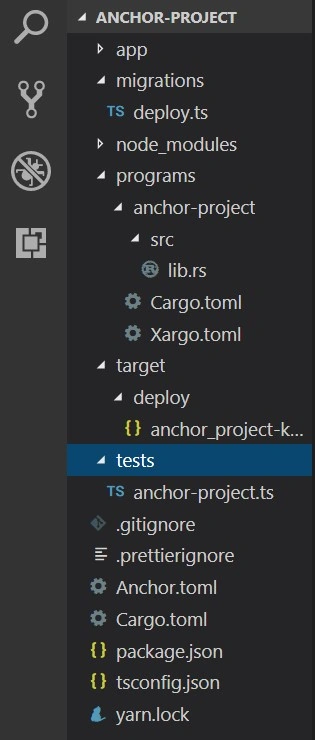
Let's understand the workings of these directories one by one.
- The .anchor directory: It holds the most recent program logs and a local ledger used for testing.
- The app directory: An empty directory designed to accommodate your front end if you choose a monorepo configuration.
- The programs directory: This folder houses your programs. At first, it might have only one program named <YOUR_PROJECT_NAME>. This program comes with a pre-existing lib.rs file containing sample code.
- The tests directory: The location of your end-to-end (E2E) tests is already provided, along with a file that tests the sample code found in the programs/<YOUR_PROJECT_NAME> directory.
- The migrations directory: You have the option to keep your deployment and migration scripts for your programs here.
- The Anchor.toml file: This document establishes settings that apply to your programs across the entire workspace. Initially, it sets up
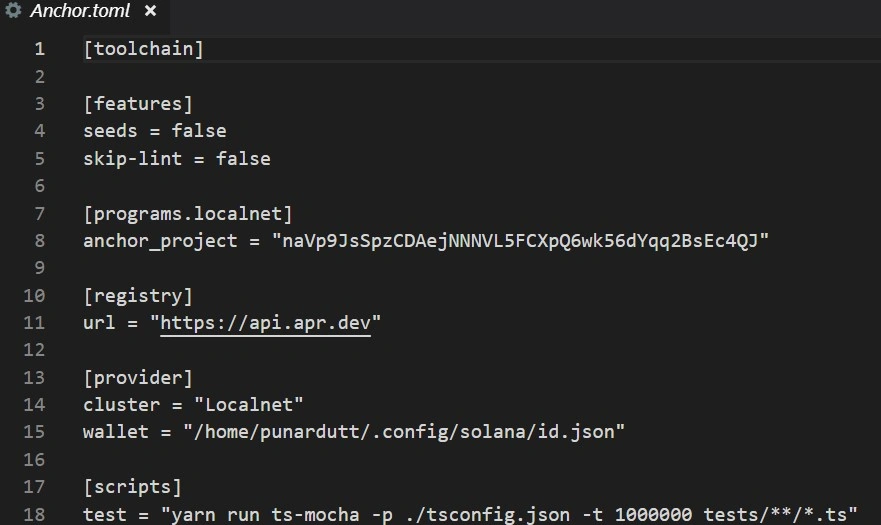
- [programs.localnet]: The addresses of your programs within the localnet.
- [registry]: A registry where your program will be pushed.
- [provider]: A provider to be used in your tests.
- [scripts]: Anchor automatically runs scripts for you, including the test script, during "anchor test" execution. You can execute your scripts using "anchor run <script_name>".
Anchor Commands
- account: Fetch and deserialize an account using the IDL provided
- build: Builds the workspace
- cluster: Cluster commands
- deploy: Deploys each program in the workspace
- expand: Expands the macros of a program or the workspace
- help: Prints this message or the help of the given subcommand(s)
- idl: Commands for interacting with interface definitions
- init: Initializes a workspace
- migrate: Runs the deploy migration script
- new: Creates a new program
- shell: Starts a node shell with an Anchor client setup according to the local config
- test: Runs integration tests against a local network
- upgrade: Upgrades a single program. The configured wallet must be the upgrade authority
- verify: Verifies the on-chain bytecode matches the locally compiled artifact.
We have done with the setup of the anchor framework, in the next article we will learn to write a program(smart contract) and test using the anchor framework.
Conclusion
Solana supports C, C++, and Rust for blockchain development, with Rust being a preferred choice for its performance and safety features. The Anchor framework simplifies smart contract development on Solana, making it easier for developers to build decentralized applications.
Join the conversation! Your thoughts help the community grow.