

Introduction
We know the difference between Unit Testing and Integration Testing. But sometimes, we may mix the Unit Test with Integration Testing. In this article mainly I'll focus on white box testing. If we know the the unit testing principles and best practice technique, then it will be easy to maintain the quality of the application. It is also most importaint to know, how to write the test cases using Behavior Driven Development (BDD) during white-box testing.
Topics
- White-box & black-box testing
- Advantage and disadvantages of unit testing
- Principles to write unit testing
- Best practice technique to write unit testing
- Writing test scenarios, test case & test data
- Traditional unit testing principle
- Naming convention of the test method
- Why we need Behavior Driven Development (BDD)
- Avoid tight coupling object
- Unit test object mocking
Basic overview of the software testing
Benefit of software testing
- Reduce risk of failures when systems are transferred to production or live operation.
- Documented proof that business requirements have been met.
- Assurance that users are able to operate designed solution productively.
- Assurance that the system works properly with existing legacy systems.
Test focusing point between developers and QA testers
Developer's point of view
Developers verify the implemented logics or codes of the modules of the application according to the business requirements. They make sure that, all the logics can run smoothly. On the other hand, they confirm that, if end-user passes any unexpected data then the logics still can handle the exception as well as it can show the proper messages. This is known as white-box testing because they can see their internal logics or codes. For example, automated unit testing or automated integration testing.
QA tester's point of view
Quality assurance (QA) testers verify the modules of the application according to the business requirements. But they don't need to worry about the logics or codes. They test the functionality as an end-user. They input the positive data to verify the positive functionalities. On the other hand, they put the wrong data to make sure that they get the proper messages for the wrong input. This is known as a black box testing because, they can't see the internal logics or codes of the modules of the application. They verify the external behaviors only. For example, acceptance testing.
Let's drill down the basic testing concept
Test documentation basic
- Test case - A set of conditions and steps to determine whether a system satisfies the requirements correctly or not. This is described by test data, environment and expected result.
- Test suite - a collection of test cases.
- Test plan - document describing testing approach, test suites and test cases.
- Test strategy - a way to identify test cases from the specification.
- Test effectiveness - relative ability of test strategy to find bugs.
- Test coverage - the percentage of testable elements that have been tested.
Test scenarios & test cases
If you have to withdraw money from an ATM machine, then it is a scenario. But to withdraw money, you need to execute some actions (test cases).
- Test scenarios - A test-scenarios have multiple test cases. So while starting testing, first prepare test scenarios, then create test cases for each scenario. Example, Checking the functionality of the login button.
- Test case - A test case is a condition which is executed for expected output with predefined set of steps with known inputs. Examples, Test-Case1: Click on the button without entering user-name and password; Test-Case2: Click on the button only entering user-name; Test-Case3: Click on the button while entering wrong user-name and wrong password. etc. These all the test-cases will have some expected, unexpected and exceptional results.
Term of mistake
- Error - mistake made by developers during implementation of a software system.
- Failure - incorrect behavior of a program.
- Fault - incorrect code that caused a failure.
- Incident - symptoms associated with a failure.
- Bug - an error or fault.
- Fault directed testing – finding bugs through failure.
Positive & negative testing
- Positive testing: When tester tests the application with valid input/data from positive point of view then it is known as positive testing.
- Negative testing: When tester tests the application with invalid input/data from negative point of view then it is known as negative testing.
- Exceptional testing: When tester tests the application with data and get an exceptional error then it is known as exceptional testing.
White box & black box testing
- Depending on the developers and QA testers, we can say that we have two types of testing. Developers can test the internal logics of the implemented modules of the application system or development box. This box is visible to the developers and it's called white-box.
- Other the hand, the QA testers can't see the internal logics of the source codes and they can see only the front-end functionalities of the system as an end user. That's why, the box is black and they test the external behaviors. It is called black-box testing.
Advantages & disadvantages of white box testing
- Advantages - Reveals bugs in hidden code; Forces reason in implementation for positive, negative and exceptional cases; Get confident and documental proof; Improving design and code quality.
- Disadvantages - Expensive comparing to time and design; Need proper knowledge about testing methodology; Cases missed can miss out code.
Advantages & disadvantages of black box testing
- Advantages: Tester and programmer are independent; Testing from end user’s point of view; Test cases can be prepared right after specification are decided.
- Disadvantages: Duplication of test cases by testers and developers; Only simple testing can be done as all cases can’t be build and tested.
White box testing vs. black box approach
- White box approach: Statement coverage; Decision coverage; Condition coverage; Path coverage.
- Black box approach: Field level check; Field level validation; User interface check; Function level check.
Type of testing
Unit testing; Integration testing; Functional testing; System testing; Stress testing; Performance testing; Usability testing; Acceptance testing; Regression testing; Beta testing.
Most common testing in many organizations
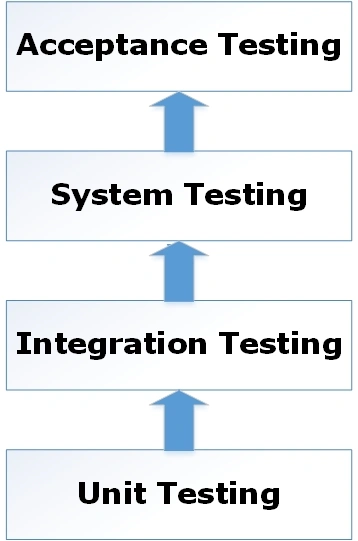
Granularity levels
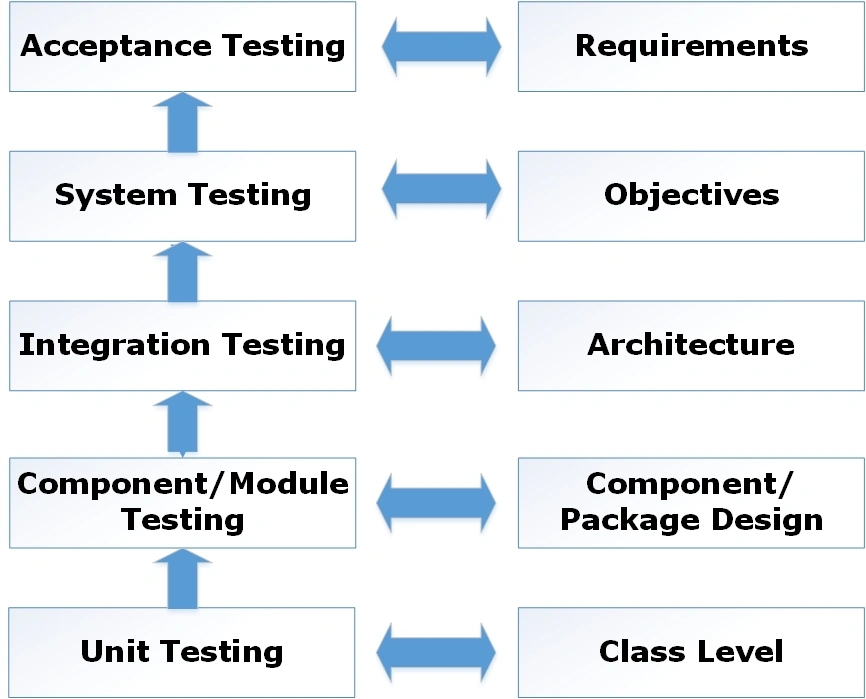
- Unit test - Verification of single classes.
- Module test - Testing interaction of groups of classes (package).
- Integration test - Verification of interactions between modules/components.
- Functional test - Verification of external behaviors of modules, components and system.
- System test - Testing of the system against objectives.
- Acceptance test - Validation of application against user requirements.
- Regression test - Re-running all tests on system when it is changed.
Speared the unit test
Top 5 Excuses For Not Doing Unit Testing
- I don’t have time to do the unit test.
- The office pays me to write down the codes, not to write down unit tests.
- I am supporting a legacy application without unit tests and existing design are not suitable for a unit test.
- QA and user acceptance testing are far more effective in finding bugs.
- I don’t know how to write unit tests.
Advantages of unit test
Reduces the level of bugs in production code; Saves your development time; Automated tests can be run as frequently as required; Make it easier to change and refactor code; Improve the design of code especially with Test-Driven-Development; A form of documentation; Inspires confidence!; Measures of completion.
Disadvantages of unit test
Not implementable to logical operators; Insensitive to loop operators (number of iterations).
Best practice & principles to write unit test
Principles to write unit test
First principle, “Test the logic of the class only, nothing else”
One of the most important principles during unit testing: when you are going to test a class, you should not have dependency on database, file, registry, web services, etc. You should be able to test any class in complete "isolation" and it should be designed to support complete "isolation." According to this principle mock out all external services and state and remember unit test NEVER uses- configuration settings; a database; Another Application/Service/file/network I/O; logging.
Scond principle, “Fail first and set a guard at the door"
Before you write piece of logic, first write your fail test. After that, add or refactor your guard logics and throw proper exceptions or messages for the negative or exceptional data. Finally run it and pass the test.
Explanation of the unit test principles
First principle
Suppose, you have a method 'IsValidUser' to verify the user name and password for login.
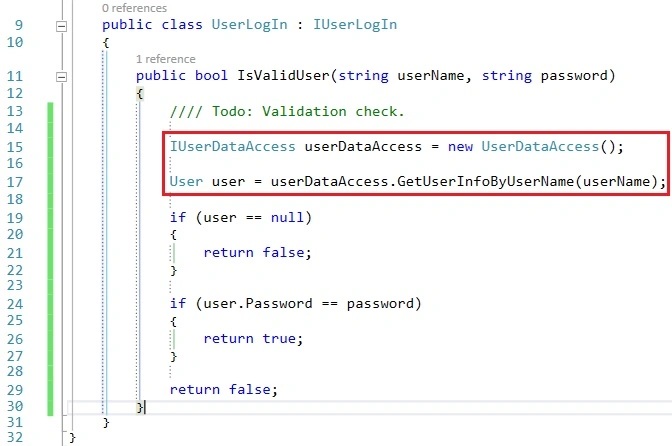
Now if you look at the line no. 15 and 17, then you will see class 'UserLogIn' has a dependency to the class 'UserDataAccess' and it is tightly coupled. Now the problem is that, you need to test a method 'IsValidUser' of a class 'UserLogIn' and you have to avoid the dependency. Because, if you call 'IsValidUser', then it will call the method 'GetUserInfoByUseName'. According to the unit test principle, if you have a dependency from one method to another out sider class, then you have to mock object for that outsider class. It means that you have to inject some dummy data into the outsider classs-object. So in this example, you need to inject dummy data for the 'GetUserInfoByUseeName(userName). If you do so, then you will able to verify the logics of the method 'IsValidUser' in the 'UserLogIn' class.
So, avoid the tight coupling code and refactor your the code again. Find my other article to know dependency, tight coupling and loose coupling. Now my main goal to make you know the unit testing principle only. Anyway, let's refactor the class.
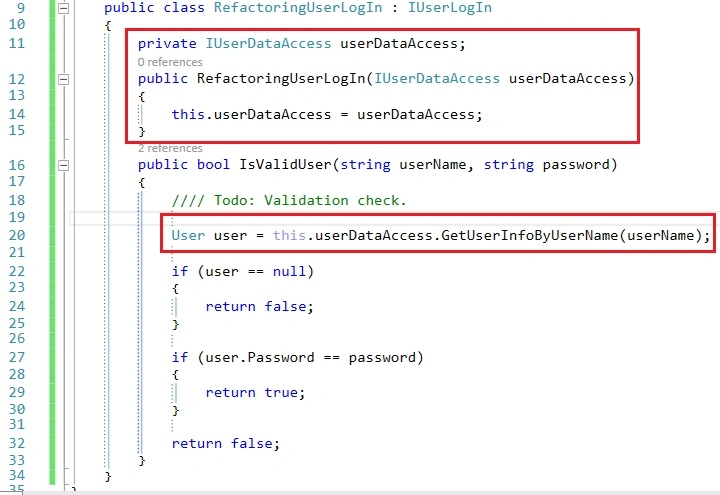
Now the class 'RefactoringUserLogIn' is loosely coupled and you can inject the implemented class of the 'IUserDataAccess' interface which will make your life easy as far as unit testing. Note that, there are many ways to inject the implemented class. I'll explain later how to mock an object of a class. During unit testing, if you mock the 'IUserDataAccess' it means you are implementing a dummy object of 'IUserDataAccess' interface and the method 'IsValidUser' will not able to get any data directly from outsider like the database or ORM via 'UserDataAccess' class.
Scond Principle
Say, the first time more than 50% people fail their road driving test, THEN "practicing on the highway"; "seeking tips from others"; - they ensure the success in the road test.
Anyway, If you're already familiar with Test-Driven-Development (TDD), then you're already familiar about the fail test. I will explain TDD also bellow in this article.
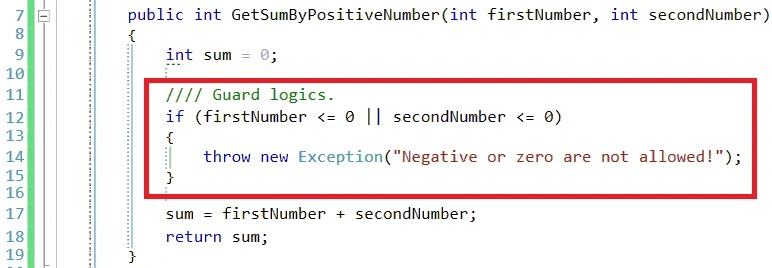
Let’s explain the guard logics and how it will help you to pass your unit testing. Say, you have a method ‘GetSumByPositiveNumber’ and it has two parameters. The business requirement is always input the positive numbers and get return the sum. Never input a negative or zero number.

Now according to your business requirements, if you pass the values of parameters like 1 and 2 then the method will return 3 which is correct. But what happens if you pass the negative values as a parameter or some combination like (-5, -1), (-5, 1), (5, 0), (0, 0) etc.?
But if you put some guard logics into the method at the beginning then the test should be passed. Because you may throw the exception for the negative data.
Best practices for writing unit test
- If old test fails for the extension of the method which is introduced, then remove or enhance old test and avoid requirement conflict.
- If you remove a single line in your tested class and all tests still pass, then you haven’t enough unit tests.
- Developer will often run the test, so make test easy to run.
- Test only public methods and public interface of the component
- Don't create instances of classes directly inside a unit test - use factory method.
- Refactor the unit test and "Keep It Simple". Remember that tests must be maintained by any code - so better to keep it simple.
- Any test should run in any order; so avoid dependencies between tests.
- Test should be readable like a book; so write comments in Asserts. Write descriptive method names. Use Behavior-Driven-Development (BBD) Technique
- Test everything that could possibly break.
- Test everything, but not Private Methods.
Writing test scenario, test cases & test data
Only three test cases for unit testing, nothing else
Positive Test Cases
Correct data to check for correct output;
Negative Test Cases
Broken or missing data to check for proper handling;
Exception Test Cases
Giving unexpected data or behavior and check for the exception caught properly or not.
Test data according to the test cases
Let’s set some test data and consider “GetSum()” as an example. Here my main goal to show you, how you can set some TEST DATA for the test cases.

Type of Test Data: Positive data; Negative data; Exceptional data.
Positive data for positive test cases
The main goal of the positive test cases, to verify the functionality of the logics.
TestCase-1: Given positive values, should return expected result; TestData-1: Set input parameters as firstNumber =1, secondNumber=1.
Negative data for negative test cases
The main goal of the negative test cases, to get proper messages for the bad input according to your business requirements.
TestCase-2: Given invalid values, should produce invalid argument message
TestData-2: Set Input Parameters as firstNumber =-1, secondNumber =-1
TestData-3: Set Input Parameters as firstNumber =-1, secondNumber = 1
TestData-4: Set Input Parameters as firstNumber = 0, secondNumber = 1
TestData-5: Set Input Parameters as firstNumber = 0, secondNumber =-1
TestData-6: Set Input Parameters as firstNumber = 0, secondNumber = 0 etc.
Exceptional data for exceptional test cases
The main goal of the exceptional test cases, to find out the proper exception handling with proper messages. So that, your code can’t break for the threshold limits. Here you can set the threshold limits of your test data. In DOT NET, the minimum value for a variable of type int is -2147483648 and the maximum value for a variable of type int is 2147483647.
TestCase3: Given threshold limit values, should throw exception message
TestData-7: Set Input Parameters as firstNumber =1, secondNumber =2147483649
TestData-8: Set Input Parameters as firstNumber =1, secondNumber = -2147483649
TestData-9: Set Input Parameters as firstNumber =2147483649 secondNumber = -2147483649
TestData-10: Set Input Parameters as firstNumber =2147483647, secondNumber=2147483647 etc.
Naming convention of the test method for unit testing
Traditional principle of unit test
One test method is written to test one and only one method and one assert method should test only one expectation at a time. In a short the principle says – “one function/method and one assert per test method”. So, let’s consider the bellow example,
Comparing the traditional principle to the real world
Test scenario, verify the “GetSum” method. Test cases,
Positive test cases
TC1: Given positive values, should return expected result
Test Data-1: firstValue =5, secondValue =6
Negative test cases
TC2: Given zero values, should produce invalid argument message
Test Data-2: firstValue =0, secondValue =0
TC3: Given negative values, should produce invalid argument message
Test Data-3: firstValue =-5, secondValue =-6
Exceptional test cases
TC4: Given threshold limit values, should throw exception message
Test Data-4: firstValue =2147483647, secondValue =2147483647.
Test method example: Now according to the traditional principle, let’s write the test method for the “GetSum”
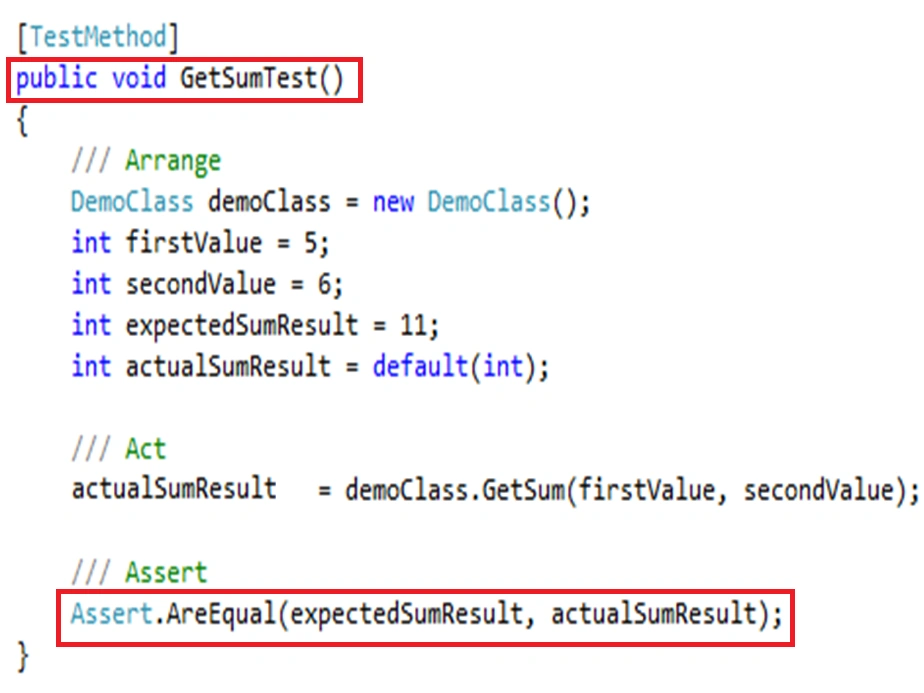
Now according to the traditional principle we have covered the positive test Case with “Test Data-1”. But what about negative and exceptional test cases?? How do we cover the negative and exceptional test cases with traditional principle??
Behavior Driven Development (BDD)
Why need BDD
If you want to cover all the behaviors of your test cases according to your previous example then you need to follow some technique; so that, you can write down all the behaviors of the method. So, The BDD is the technique which gives you the opportunity to fulfill all of the test cases with standard and readable naming convention. "Many peoples, many minds", there are many techniques to write the naming convention of the test method. But it really depends on you and your preference. If you follow some other technique, then there is nothing right or wrong directly; because, everything is relative. Anyway, in short you can say that, "in BDD, component tests the expected behavior".
Concept of BDD
- Given: I am a beginner to the BDD technique, and I never use this technique before
- When: I read this tutorial for BDD
- Then: I have started to like it and finally I learn it.
BDD naming convention
Test Scenario: verify the “GetSum” method.
Test Cases
Positive Test Cases: TC1: Given positive values, should return expected result; Test data-1: firstValue =5, secondValue =6.
Test method & naming convection
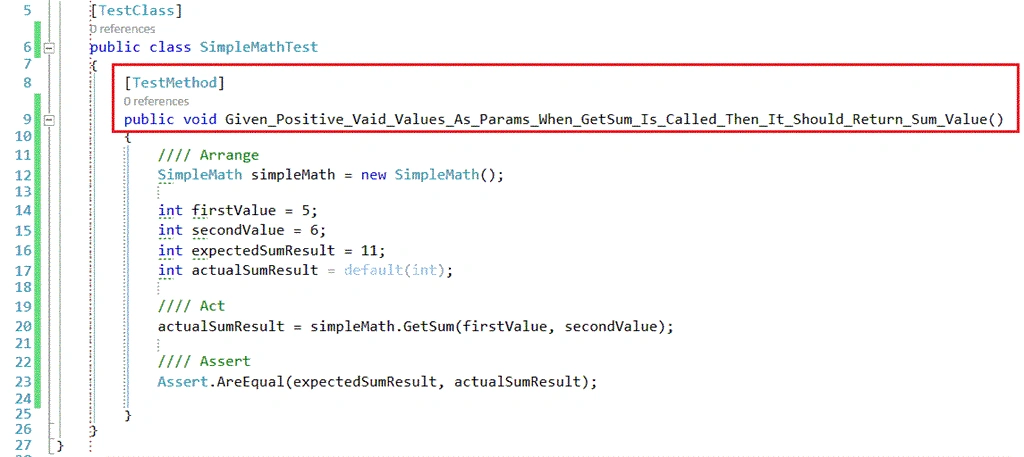
GivenPositiveVaidValuesAsParams_WhenGetSumIsCalled_ThenItShouldReturnSumValue
More readable
Given_Positive_Vaid_Values_As_Params_When_GetSum_Is_Called_Then_It_Should_Return_Sum_Value
Negative test cases
TC2: Given zero values, should produce invalid argument message; Test data-2: firstValue = 0, secondValue = 0.
Test method - naming convection:
GivenZeroValuesAsParams_WhenGetSumIsCalled_ThenItShouldThrowInvalidArgumentException
More readable,
Given_Zero_Values_As_Params_When_GetSum_Is_Called_Then_It_Should_Throw_Invalid_Argument_Exception
TC3: Given negative values, should produce invalid argument message; Test data-3: firstValue =-5, secondValue =-6
Test method - naming convection:
GivenNegativeValues_WhenGetSumIsCalled_ThenItShouldThrowInvalidArgumentException
More readable
Given_Negative_Values_When_GetSum_Is_Called_Then_It_Should_Throw_Invalid_Argument_Exception
Exceptional test cases: TC4: Given threshold limit values, should throw exception message; Test data-4: firstValue =2147483647, secondValue =2147483647.
GivenMaxLimitValuesOfIntAsParams_WhenGetSumIsCalled_ThenItShouldThrowSumException
More readable
Given_Max_Limit_Values_Of_Int_As_Params_When_GetSum_Is_Called_Then_It_Should_Throw_Sum_Exception.
Body structure of the test method
There is no hard code rules for that. We generally follow the structure because it’s easy to read and understand. The general AAA structure are given bellow for the Test Method.
AAA structure
- Arrange
- Act
- Assert
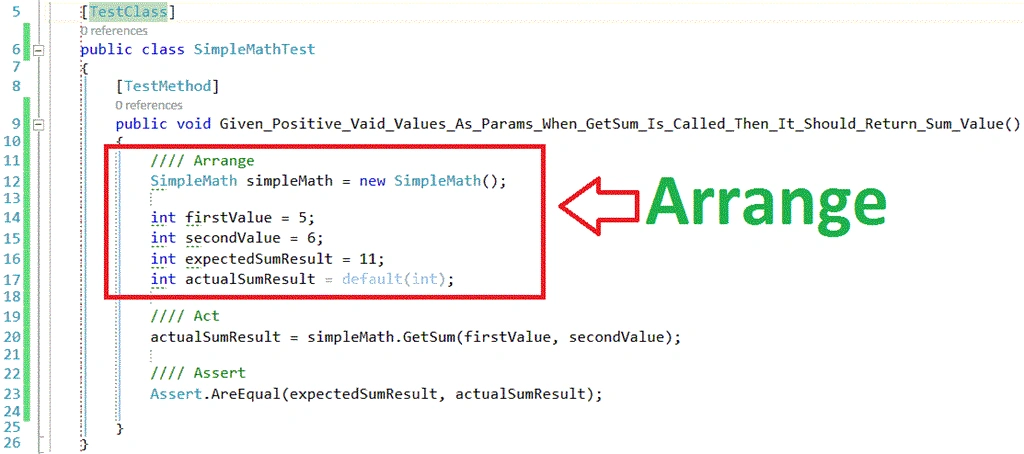
Arrange
In this arrange portion, you need to declare variables and you have to create the instance of the objects of the classes.
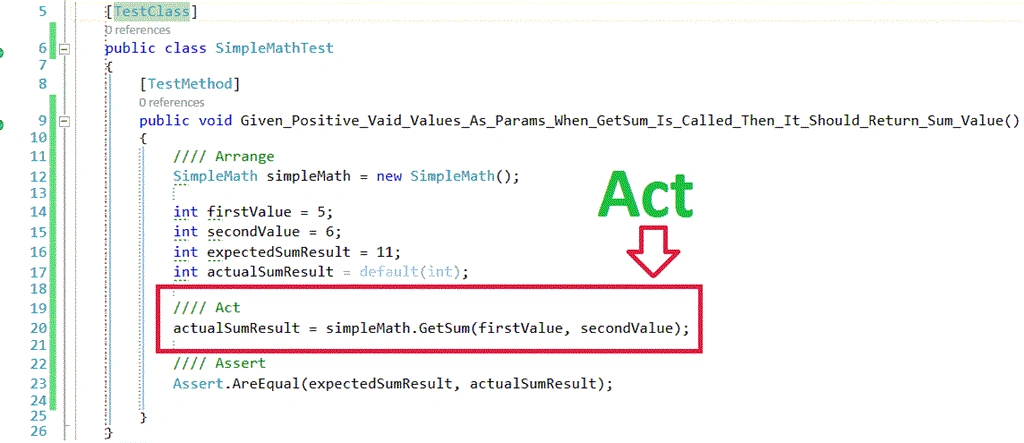
Act
The verified method is called in the portion. This is mainly used for passing the input parameters into the method and collecting the return result from the calling method.
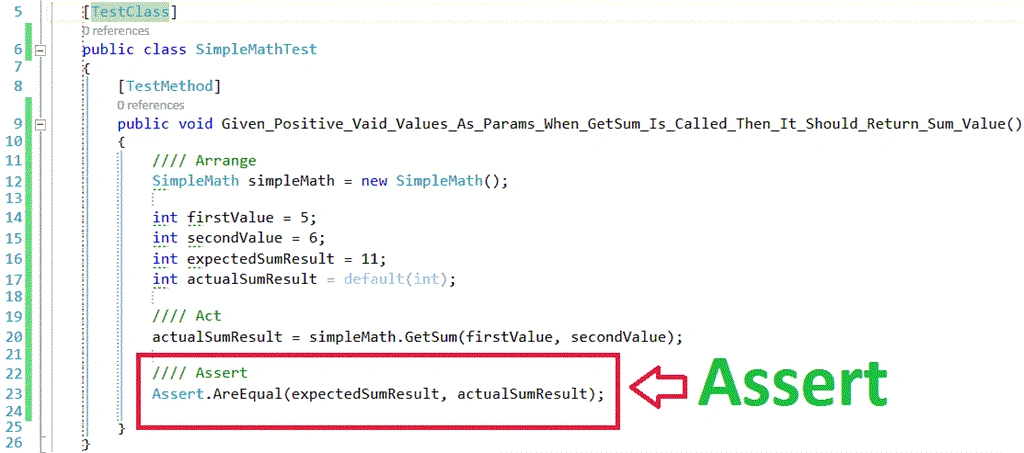
Assert
In this portion we compare the actual result of the calling method with the expected result. The test is passed or failed depends on this assert portion.
Object mocking for unit testing
Why do we need mock
Suppose, you need to test the behavior of one method and it has an external service or method within it. During the unit testing, you can avoid this kind of external dependencies and the mock technique which gives you the facility to avoid the behavioral test of the external method or service. Let’s see the example,
This GetSum method has no external dependencies within it. So, it does not need object mocking.
Now see the bellow example of the class and this has two dependencies; that are CheckingAccount and SavingAccount.
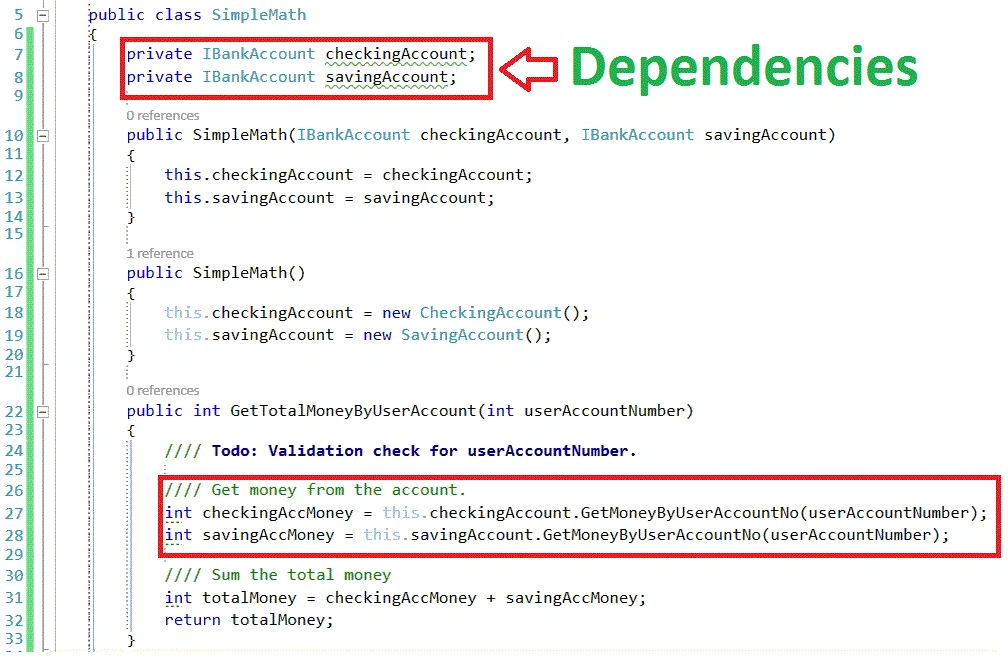
Now you may want to verify the method “GetTotalMoneyByUserAccount” and it has two dependencies within it. So, to solve this kind of situation, you need mocking.
Mock framework
There are many mock frameworks like Typemock Isolator, Rhino Mocks, Moq and NMock. You can use any one of them.
Requirement before making mock
The class can’t be sealed; The method can’t be static; but if you need then use adaptor pattern; you can mock if Interfaces, Abstract methods or properties or Virtual Methods or properties on concrete classes.
Adding MOQ into the unit testing project: Select your Unit Testing Project. Go to Reference> Click Right button of the mouse and select “Manage NuGet Packages”. Now write down ‘Moq’ into the search textbox and finally install it to your project.

Object mocking using MOQ
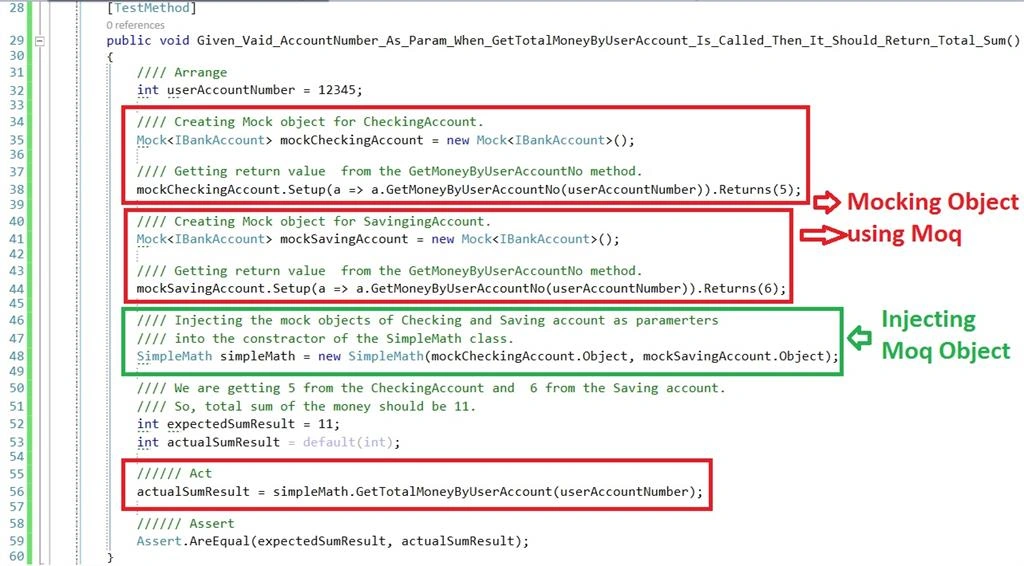
In the above example line number 35 and 41, first we are creating instances of the object using Mock.
Mock<IBankAccount> mockCheckingAccount = new Mock<IBankAccount>();
Mock<IBankAccount> mockSavingAccount = new Mock<IBankAccount>();
In the line numbers 38 and 44, you are implementing the dummy implementation and if the "GetMoneyByUserAccountNo" method is called then it will return the 5 and 6. So you don't need to know any internal logics of that.
mockCheckingAccount.Setup(a => a.GetMoneyByUserAccountNo(userAccountNumber)).Returns(5);
mockSavingAccount.Setup(a => a.GetMoneyByUserAccountNo(userAccountNumber)).Returns(6);
Now line number 48 shows that you are injecting the mock objects into the class via constructor.
SimpleMath simpleMath = new SimpleMath(mockCheckingAccount.Object, mockSavingAccount.Object);
Secondly in the line number 56 of the 'Act' portion, you are calling the verified method and result is into the actualResult variable and finally inline number 59, which is giving you the actual result.
actualSumResult = simpleMath.GetTotalMoneyByUserAccount(userAccountNumber);
My main goal here, is to introduce you to the object mocking world. So this is just an example, you can use any of the mocking frameworks. NOTE that, I didn’t care about the latest version of the packages; because, this is just an example and I use my old images and codes. So, you should use the latest version of the packages.
How to call order of test methods using moq sequences
Download Moq.Sequences.dll from github then add Moq.Sequences.dll as a reference in your .Net project and add a using Moq.Sequences; in your test class. Or simply use "Manage NuGet Packages” Manager and type "Moq.Sequences" and search it.
Finally install it to your project and use it to call as a reference.
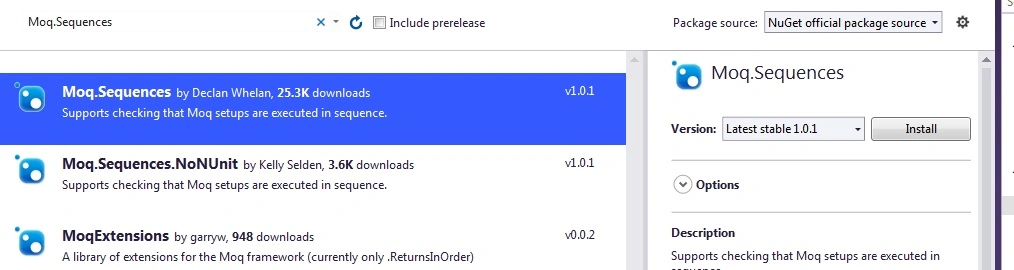
Moq.Sequences supports the following
Checks order of the method calls, property gets and property sets; Allows you to specify the number of times a call is made before the next one is expected; Allows inter-mixing of sequenced and non-sequenced expectations; Thread safe – each thread can have its own sequence
Example for calling methods sequentially
[TestMethod]
public void Given_Valid_Data_For_Object_Model_When_TestMethod_Is_Called_Then_It_Should_Be_Done_Successfully()
{
    ......
    ......

    //// Methods are called sequentially.
    using (Sequence.Create())
    {
        //// First, it is called
        Given_Valid_Template_Data_When_MethodSave_Is_Called_Then_It_Should_Be_Saved_Successfully();

         //// Second, it is called.
        Given_Valid_Template_Value_When_MethodUpdate_Is_Called_Then_It_Should_Update_Template();

        ///// Third, it is called.
        Given_Valid_Template_ID_When_DeleteTemplate_Is_Called_Then_It_Should_Delete_Template();
    }

    ......
    ......
}
[TestMethod]
public void Given_Valid_Data_For_Model_When_TestMethod_Is_Called_Then_It_Should_Be_Done_Successfully()
{
    ......
    ......
    ///
    using (Sequence.Create())
    {
        //// Methods are called sequentially.
        mockObject.Setup(x => x.MethodA()).InSequence();
        mockObject.Setup(x=>x.MethodB()).InSequence(Times.AtMostOnce());
        mockObject.Setup(x=> x.MethodC()).InSequence(Times.Once());
    }
    ......
    ......
}
Regression testing
How we introduce new bugs
Software enhancement and maintenance are now our daily work. New addition or modification of the existing components or modules or any error correction can sometimes introduce new bugs. So in short, I can say that when I fix one bug then maybe, I'm introducing new bugs.
What's our expectation?
Everybody knows the answer and that is, we want continuous improvement. But this new enhancement should not affect any existing tested modules or features.
Where is the solution
Yes, you are right it is the Regression Testing which is the solution of this problem. Because it verifies that current bugs are fixed and newly added functionality has not affected any other part of the application.
What exactly we do in regression testing
We rerun the previous tests and verify the current result to our previous expected results.
Regression testing is not re-testing
Regression Testing ensures that new changes are not affecting the other part of the application; Re-Testing means testing bugs or the functionality again to ensure that the code fixes the bug. If it is not fixed then we need to reopen the defect. Otherwise if defect is fixed, then close the defect.
Mahesh ChandPosted Jan 11, 2021, 9:40 PM
Thank you, Habibur. Should this post move to the Testing category?