

Today, in this article lets dig out some theory stuff first and later we will
try to implement the studied concepts i: e Per Single based Instance Management
using WCF.
Based on My Earlier Articles
Per Call Based - Instance Management in WCF:
http://www.c-sharpcorner.com/UploadFile/54db21/per-call-based-instance-management-in-wcf-hosted-on-web-ap/
Per Session Based - Instance Management in WCF:
http://www.c-sharpcorner.com/UploadFile/54db21/per-session-based-instance-management-in-wcf-hosted-on-web/
Let's also try this good concept eventually.
In the meanwhile I will take very less time in letting you know the main key
differences in tabular format. Which is described as below
|
S.No
|
Per-Call Based |
Per Session- Based |
Single Instance Based |
|
1 |
New Service Instance will be created for every client request. In Simple terms "Single Client but Many Instances".
|
For Every Client New Service Instance will be created. It Simple terms "Dedicated Instance for Client" or "Each Client has allocated independent instance".
|
Here the entire clients are interacted in very rigid fashion as they will be communicating with single service instance. In Simple terms "Many Clients but Single Instance".
|
|
2 |
Instance will be disposed or discharged only after the response is reverted back to client. In Simple terms" Deliver the Content and die" |
Instance will be disposed or discharged only after the response is reverted back to client. In Simple terms" Deliver the Content and die"
|
But, Here What happens exactly is the instance is disposed or deleted when the client is destroyed. I mean in Simple term "Service Instance will be there forever until and unless client is destroyed".
|
Question Arises: What is Instance Management?
We can say it is a type of rules governed to manage the services with clients.
It provides high end in scalability, durability and effective transaction
management.
Question Arises: What is Per-Single Based Instance Management?
Key Point Here To Remember
-
Basically we can term it as "SHARED SERVICE" because scenario behind this all the clients calls are divergently connected to single instance and itself says half of the hints like its singleton. I mean to say in simple terms "Single Instance is generated only once and lives lifelong and longer. It is generated when the host is created."
-
The Client does not needs sessions because singleton instance will generate a session ID for the client.
-
The main reason to go and opt for singleton instance management is you can provide valuable and effective stateful interaction across multiple clients deployed
Let's Now Try and Dig for Some Disadvantages or Demerits as well
-
When the request calls are more from the client the singleton instance which will be assisting towards request will be served with multiple threads. But though provide response simultaneously at some point of peek time the concurrency will be lost and throughput is genuinely lower with less availability to the client
-
Avoiding it would be much better unless you have got multiple clients who want to have shared stateful resource.
So, let's try to implement this concept so that we can get much better idea on
this:
So, firstly we will create simple method in IService1, Where the Complete Code
of IService1.cs looks like this:
using
System;
using
System.ServiceModel;
namespace
SimpleInstanceManagement
{
// NOTE: You can use the "Rename" command on the "Refactor"
menu to change the class name "Service1" in code, svc and config file together.
[ServiceBehavior(InstanceContextMode = InstanceContextMode.Single)]
public class
Service1 : IService1,
IDisposable
{
public int
Heighter = 0; public
int SimpleMethod(int a)
{
a = (Heighter = Heighter + 1); return
a;
}
public void
Dispose()
{
Heighter = Heighter - 1;
}
}
}
The Complete Code of Service1.svc looks like this:
using
System.ServiceModel;
namespace
SimpleInstanceManagement
{
// NOTE: You can use the "Rename" command on the "Refactor"
menu to change the interface name "IService1" in both code and config file
together.
[ServiceContract]
public interface
IService1
{
[OperationContract]
int SimpleMethod(int
a);
}
}
The Complete Code of Web.Config looks like this:
|
<?xml version="1.0"?> <configuration> <system.web> <compilation debug="true" targetFramework="4.0" /> </system.web> <system.serviceModel> <behaviors> <serviceBehaviors> <behavior name="Application"> <!-- To avoid disclosing metadata information, set the value below to false and remove the metadata endpoint above before deployment --> <serviceMetadata httpGetEnabled="true"/> <!-- To receive exception details in faults for debugging purposes, set the value below to true. Set to false before deployment to avoid disclosing exception information --> <serviceDebug includeExceptionDetailInFaults="false"/> </behavior> </serviceBehaviors> </behaviors> <serviceHostingEnvironment multipleSiteBindingsEnabled="true" /> <services> <service name="SimpleInstanceManagement.Service1" behaviorConfiguration="Application"> <endpoint address="/SimpleAddress" binding="wsHttpBinding" contract="SimpleInstanceManagement.IService1"> </endpoint> <endpoint address="mex" binding="mexHttpBinding" contract="IMetadataExchange"> </endpoint> <host> <baseAddresses> <add baseAddress="http://localhost:49257/Service1.svc"/> </baseAddresses> </host> </service> </services> </system.serviceModel> <system.webServer> <modules runAllManagedModulesForAllRequests="true"/> </system.webServer> </configuration> |
http://localhost:49257/Service1.svc
The Complete Code of WebForm1.aspx looks like this:
<%@ Page Language="C#" AutoEventWireup="true" CodeBehind="WebForm1.aspx.cs" Inherits="Instance.WebForm1" %>
<!DOCTYPE
html PUBLIC
"-//W3C//DTD XHTML 1.0 Transitional//EN"
"http://www.w3.org/TR/xhtml1/DTD/xhtml1-transitional.dtd">
<html
xmlns="http://www.w3.org/1999/xhtml">
<head
id="Head1" runat="server">
<title></title>
</head>
<body>
<form
id="form1"
runat="server">
<div>
<center>
<table>
<tr>
<td>
<asp:Label
ID="Label1"
runat="server"
Text="Please Enter Some
Value" ForeColor="Brown"
Font-Bold="
true" Font-Italic="true"></asp:Label>
</td>
<td>
<asp:TextBox
ID="TextBox1"
runat="server"></asp:TextBox>
</td>
</tr>
<tr>
<td>
</td>
<td>
<asp:Button
ID="Button1"
runat="server"
Text="Click Here"
OnClick="Button1Click"
Style="margin-left:
0px" Width="118px"
/>
</td>
</tr>
</table>
</center>
</div>
</form>
</body>
</html>
The Complete Code of WebForm1.aspx.cs looks like this:
using
System;
using
Instance.ServiceReference1;
namespace
Instance
{
public partial
class WebForm1
: System.Web.UI.Page
{
protected void
PageLoad(object sender,
EventArgs e)
{
}
protected void
Button1Click(object sender,
EventArgs e)
{
if (TextBox1.Text !=
null)
if ((TextBox1.Text) ==
"1")
{
var ab =
new Service1Client();
Response.Write("<center>The
Value is: <b>" + ab.SimpleMethod((Convert.ToInt32(TextBox1.Text)))
+
"</br></b></center>");
Response.Write("<center>The
Value is: <b>" + ab.SimpleMethod((Convert.ToInt32(TextBox1.Text)))
+
"</br></b></center>");
Response.Write("<center>The
Value is: <b>" + ab.SimpleMethod((Convert.ToInt32(TextBox1.Text)))
+
"</br></b></center>");
Response.Write("<center><i>Second Instance Created
for Service</i></center>");
var bc =
new Service1Client();
Response.Write("<center>The
Value is: <b>" + bc.SimpleMethod(Convert.ToInt32(TextBox1.Text))
+
"</br></b></center>");
Response.Write("<center>The
Value is: <b>" + bc.SimpleMethod(Convert.ToInt32(TextBox1.Text))
+
"</br></b></center>");
Response.Write("<center>The
Value is: <b>" + bc.SimpleMethod((Convert.ToInt32(TextBox1.Text)))
+
"</br></b></center>");
Response.Write("<center>The
Value is: <b>" + bc.SimpleMethod((Convert.ToInt32(TextBox1.Text)))
+
"</br></b></center>");
}
else
{
Response.Write("<center><b><i>Please
Enter Some Values or Enter Correct Values</i></b></center>");
}
}
}
}
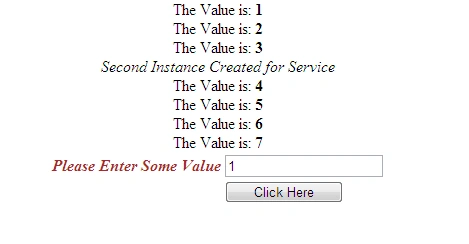
The Output of the application looks like this:
The Output of the application if entered wrong or null:

I hope this article is useful for you.
Alten ChingumbraPosted Dec 22, 2011, 1:29 AM
wonderful article
Monika AroraPosted Dec 22, 2011, 12:59 AM
Nice article.
Akash AhlawatPosted Dec 22, 2011, 12:00 AM
Nice article
Emmy DickensPosted Dec 21, 2011, 11:59 PM
Keep posting more
Alec StewartPosted Dec 21, 2011, 11:42 PM
Nice article...Please keep posting
Jimmy UnderwoodPosted Dec 21, 2011, 11:33 PM
Very good work
Nitin SinghPosted Dec 21, 2011, 11:20 PM
Very nice presentation
Vineet Kumar SainiPosted Dec 21, 2011, 12:21 PM
Good
Deepak VermaPosted Dec 21, 2011, 1:24 AM
Please check for errors in your "web.config" and update accordingly...