

Introduction
Cloud computing has evolved significantly over the past decade. Organizations today are expected to deliver applications faster, scale efficiently, reduce operational costs, and support modern technologies such as Artificial Intelligence (AI), Machine Learning (ML), and microservices.
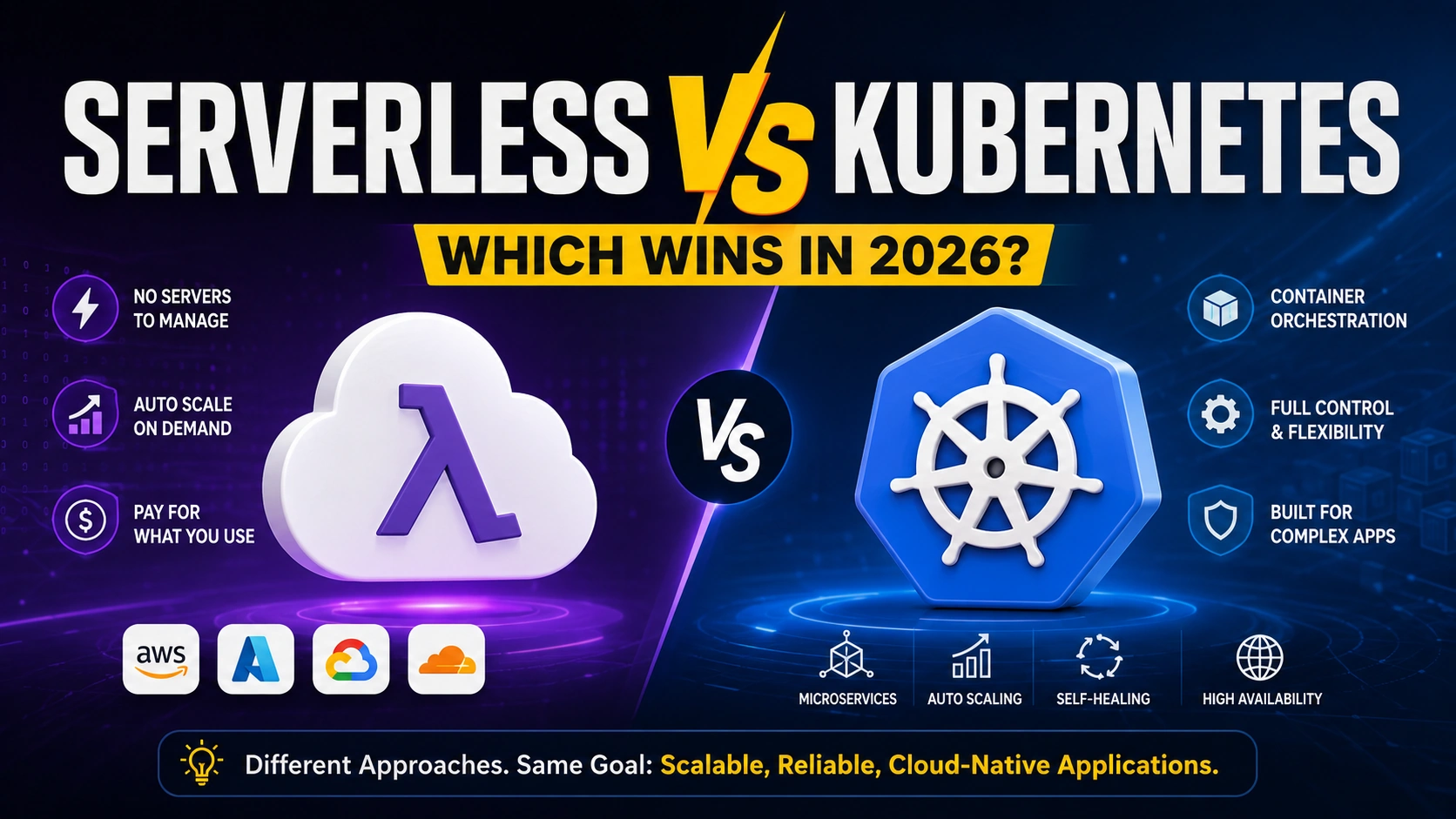
Two technologies that frequently appear in cloud architecture discussions are Serverless Computing and Kubernetes. Both help organizations build scalable cloud-native applications, but they approach the problem differently.
Serverless focuses on eliminating infrastructure management so developers can concentrate on writing code. Kubernetes focuses on container orchestration, giving organizations complete control over how applications are deployed, managed, and scaled.
As businesses continue modernizing their applications in 2026, understanding the differences between Serverless and Kubernetes is essential for making the right architectural decisions.
In this article, we'll explore both technologies, compare their strengths and limitations, examine real-world use cases, and discuss when each approach makes the most sense.
What Is Serverless Computing?
Serverless Computing is a cloud execution model where developers deploy code without managing servers or infrastructure.
The cloud provider handles:
Server provisioning
Scaling
Maintenance
Operating system updates
Resource allocation
Developers are charged based on actual execution rather than continuously running infrastructure.
Popular Serverless platforms include:
AWS Lambda
Azure Functions
Google Cloud Functions
Cloudflare Workers
Example
Consider an image-processing application.
When a user uploads an image:
The image is stored in cloud storage.
A Serverless function is triggered automatically.
The image is resized.
The processed image is saved.
No server management is required throughout the process.
What Is Kubernetes?
Kubernetes is an open-source container orchestration platform that automates the deployment, scaling, and management of containerized applications.
Applications are packaged into containers, typically using Docker, and Kubernetes manages those containers across multiple servers.
Kubernetes provides features such as:
Container orchestration
Load balancing
Service discovery
Automated scaling
Self-healing
Rolling updates
Popular managed Kubernetes services include:
Amazon EKS
Azure Kubernetes Service (AKS)
Google Kubernetes Engine (GKE)
Red Hat OpenShift
Example
An e-commerce platform may consist of multiple services:
Product Catalog Service
Inventory Service
Payment Service
Recommendation Service
Order Management Service
Kubernetes manages these services and ensures they remain available even when traffic increases.
Why This Comparison Matters
Modern applications are becoming increasingly complex.
Organizations are now building:
AI-powered applications
Microservices architectures
Event-driven systems
Real-time analytics platforms
Global SaaS products
As cloud spending increases, businesses must balance:
Scalability
Performance
Cost optimization
Developer productivity
Operational complexity
Choosing between Serverless and Kubernetes directly impacts these factors.
Serverless vs Kubernetes: Key Differences
| Feature | Serverless | Kubernetes |
|---|---|---|
| Infrastructure Management | Fully Managed | Customer Managed |
| Deployment Unit | Function | Container |
| Scaling | Automatic | Configurable |
| Operational Complexity | Low | High |
| Startup Time | May Experience Cold Starts | Consistently Running |
| Resource Control | Limited | Extensive |
| Pricing Model | Pay Per Execution | Pay for Infrastructure |
| Best Use Cases | Event-Driven Workloads | Complex Distributed Applications |
Scalability Comparison
Serverless Scalability
Serverless platforms automatically scale based on incoming requests.
Benefits include:
No manual configuration
Automatic resource allocation
Efficient handling of sudden traffic spikes
Example
An online ticket-booking system receives thousands of requests during a major event launch.
Serverless functions automatically scale to handle increased demand.
Kubernetes Scalability
Kubernetes supports scaling through mechanisms such as:
Horizontal Pod Autoscaler
Cluster Autoscaler
Node Scaling
Organizations have greater control over how applications scale.
Example
A video streaming platform predicts increased traffic during a live sporting event and automatically provisions additional pods.
Key Takeaway
Serverless provides simpler scaling, while Kubernetes offers greater customization and control.
Cost Comparison
Serverless Cost Model
Serverless platforms charge based on:
Number of requests
Execution duration
Memory usage
Applications with inconsistent traffic patterns often benefit from this model.
Example
A startup application receiving a few hundred requests daily can operate at very low cost.
Kubernetes Cost Model
Kubernetes clusters typically run continuously.
Organizations pay for:
Compute resources
Storage
Networking
Monitoring services
Costs remain even during periods of low traffic.
Example
A SaaS platform serving customers 24/7 may find Kubernetes more cost-effective than executing millions of serverless functions.
Key Takeaway
Serverless often reduces costs for variable workloads, while Kubernetes can be more economical for continuously running applications.
Performance Comparison
Serverless Performance
Serverless environments may experience cold starts.
A cold start occurs when:
No function instance is available.
The platform must initialize a new execution environment.
This can introduce additional latency.
Kubernetes Performance
Containers remain active and ready to process requests.
Benefits include:
Consistent response times
Lower latency
Predictable performance
Key Takeaway
Applications requiring extremely low latency often benefit from Kubernetes.
Developer Experience
Working with Serverless
Developers primarily focus on:
Writing business logic
Building APIs
Creating event-driven workflows
Advantages include:
Faster development
Simpler deployment
Reduced operational overhead
Working with Kubernetes
Developers and DevOps teams manage:
Containers
Networking
Storage
Security policies
Cluster operations
Advantages include:
Greater flexibility
Advanced deployment strategies
Enterprise-level customization
Key Takeaway
Serverless improves developer productivity, while Kubernetes provides greater architectural control.
Security Comparison
Serverless Security
Cloud providers manage much of the underlying infrastructure security.
Benefits include:
Automatic patching
Managed environments
Reduced infrastructure exposure
Developers remain responsible for:
API security
Identity management
Application security
Kubernetes Security
Kubernetes offers advanced security capabilities including:
Role-Based Access Control (RBAC)
Network Policies
Pod Security Standards
Service Mesh Security
However, proper configuration is essential.
Key Takeaway
Serverless simplifies security management, while Kubernetes offers more advanced security controls.
AI and Machine Learning Workloads
AI workloads continue to drive cloud adoption in 2026.
Examples include:
Generative AI
Large Language Models (LLMs)
Recommendation Systems
AI Agents
Predictive Analytics
Serverless for AI
Serverless is suitable for:
AI-powered automation
Event-driven inference
Lightweight AI APIs
Kubernetes for AI
Kubernetes is commonly used for:
GPU workloads
Model serving
Distributed training
AI platform development
Example
A chatbot powered by a Large Language Model may use Kubernetes to host model-serving infrastructure and manage GPU resources efficiently.
Key Takeaway
Kubernetes is generally better suited for large-scale AI and Machine Learning environments.
Real-World Use Cases
Best Use Cases for Serverless
Serverless works well for:
REST APIs
Background processing
File processing
Notification systems
Scheduled jobs
Event-driven applications
Best Use Cases for Kubernetes
Kubernetes works well for:
Microservices architectures
SaaS platforms
AI applications
Financial systems
Enterprise software
Video streaming platforms
Hybrid Architecture: Using Both Together
Many organizations no longer choose a single approach.
Instead, they combine Serverless and Kubernetes.
Example Architecture
Serverless Handles
Email notifications
Event processing
Background tasks
Scheduled jobs
Kubernetes Handles
Core APIs
AI services
Microservices
Long-running applications
This approach allows organizations to leverage the strengths of both technologies.
Best Practices
When evaluating Serverless and Kubernetes, consider the following recommendations:
Choose Serverless for event-driven workloads.
Use Kubernetes for complex distributed systems.
Evaluate expected traffic patterns before estimating costs.
Implement monitoring regardless of the chosen platform.
Consider hybrid architectures for large applications.
Optimize resource usage to control cloud spending.
Apply security best practices across all cloud services.
Plan for future scalability requirements during architecture design.
Key Takeaways
Serverless removes infrastructure management and improves developer productivity.
Kubernetes provides advanced orchestration and infrastructure control.
Serverless is ideal for event-driven and unpredictable workloads.
Kubernetes is well-suited for microservices, AI platforms, and enterprise applications.
Cost efficiency depends heavily on workload patterns.
Many organizations adopt hybrid architectures that combine both technologies.
The best choice depends on business requirements rather than technology trends.
Frequently Asked Questions (FAQs)
Q1. Is Serverless replacing Kubernetes?
No. Both technologies solve different problems and often complement each other within modern cloud architectures.
Q2. Which is more cost-effective in 2026?
Serverless is often more cost-effective for low or unpredictable traffic. Kubernetes may be more economical for continuously running applications.
Q3. Which platform is better for AI workloads?
Kubernetes is generally preferred for large-scale AI workloads because it supports GPU management, distributed training, and model serving.
Q4. Can Serverless and Kubernetes be used together?
Yes. Many organizations use Serverless for event-driven processing while running core services on Kubernetes.
Q5. Is Kubernetes difficult to learn?
Kubernetes has a steeper learning curve compared to Serverless because it involves container orchestration, networking, storage, and cluster management.
Conclusion
Serverless and Kubernetes are two of the most influential cloud technologies in 2026. Both enable organizations to build scalable and reliable cloud-native applications, but they serve different purposes.
Serverless simplifies development by removing infrastructure management and automatically scaling workloads. Kubernetes provides greater flexibility, control, and support for complex distributed systems.
Rather than viewing them as competing technologies, organizations should evaluate their application requirements, operational capabilities, and long-term goals. In many cases, a hybrid architecture that combines Serverless and Kubernetes delivers the best balance of scalability, performance, cost efficiency, and developer productivity.
As cloud-native development, AI workloads, and distributed applications continue to grow, understanding when to use Serverless, Kubernetes, or both will remain an important skill for modern software architects and developers.
Join the conversation! Your thoughts help the community grow.