

As Redis usage grows in production systems, teams eventually face a critical architectural decision. Should Redis be scaled using Redis Sentinel or Redis Cluster?
This decision is often made late, and under pressure, usually after performance issues, memory exhaustion, or availability incidents appear. Unfortunately, Redis Sentinel and Redis Cluster solve very different problems, and choosing the wrong one leads to painful redesigns.
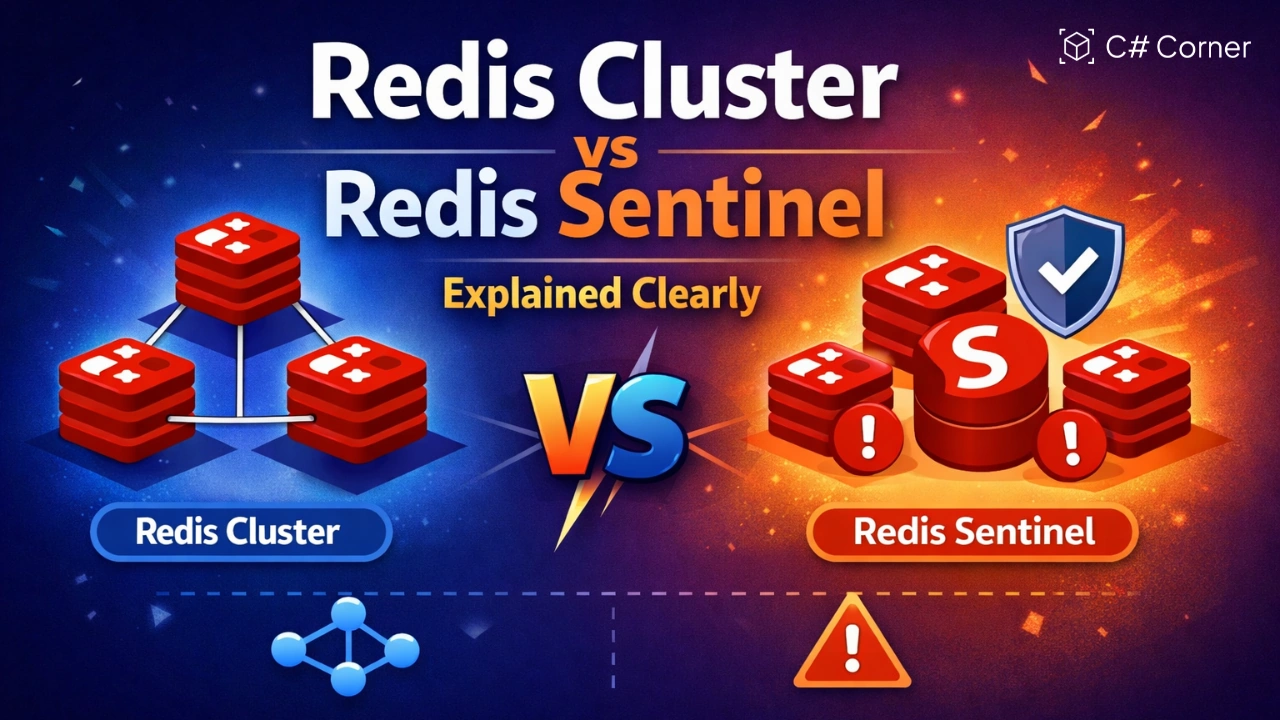
Redis Sentinel is about availability. Redis Cluster is about scalability. Confusing the two is one of the most common mistakes in Redis architecture.
The Core Problem Redis Sentinel Solves
Redis Sentinel is designed to provide high availability for a single Redis dataset.
Its primary responsibilities are:
Monitoring Redis master and replica nodes
Detecting failures
Performing automatic failover
Updating clients about the new master
Redis Sentinel does not shard data. There is still exactly one logical Redis instance holding all keys.
If the master fails, Sentinel promotes a replica. From an application perspective, Redis continues working with minimal interruption.
How Redis Sentinel Works Internally
A typical Redis Sentinel setup includes:
One Redis master
One or more Redis replicas
Multiple Sentinel processes monitoring them
Sentinels constantly check the health of the master. When a quorum of Sentinels agrees that the master is down, a failover is triggered.
One replica is promoted to master, and remaining replicas are reconfigured to follow it.
The key point is that data remains the same size and shape. There is no redistribution of keys.
What Redis Sentinel Does Not Do
Redis Sentinel does not:
Increase memory capacity beyond a single node
Increase write throughput beyond one core
Shard or distribute data
If your Redis instance runs out of memory or CPU, adding Sentinel does not help. Sentinel keeps Redis available, not bigger.
The Core Problem Redis Cluster Solves
Redis Cluster addresses scalability rather than availability alone.
It solves:
Memory limits of a single machine
Throughput limits caused by single-threaded execution
Redis Cluster shards data across multiple master nodes. Each master owns a subset of the keyspace.
Replication is used for availability, but sharding is the defining feature.
How Redis Cluster Works at a High Level
Redis Cluster divides the keyspace into 16,384 hash slots.
Each master node owns a portion of these slots. Keys are assigned to slots based on a hash function.
When a client issues a command, it is routed to the node responsible for that slot.
If a master fails, one of its replicas is promoted automatically, similar to Sentinel, but only for that shard.
Availability Model Comparison
Redis Sentinel provides:
One active master at a time
Full dataset on a single node
Automatic failover
Redis Cluster provides:
Multiple masters
Data distributed across nodes
Failover at the shard level
Sentinel protects against node failure. Cluster protects against both node failure and capacity limits.
Scaling Characteristics
Redis Sentinel scales vertically.
You can move Redis to a larger machine, add more memory, or use faster CPUs, but you still hit a ceiling.
Redis Cluster scales horizontally.
You add nodes to increase memory and throughput. Each node handles only part of the dataset.
Once a single Redis node is no longer enough, Sentinel alone is insufficient.
Application Design Impact
Redis Sentinel is mostly transparent to applications.
Applications still think they are talking to one Redis instance. Clients reconnect to the new master after failover.
Redis Cluster requires cluster-aware clients.
Applications must:
Handle redirections
Respect hash slot boundaries
Avoid unsupported multi-key operations
Cluster adoption impacts key design and data modeling significantly.
Multi-Key Operations and Transactions
With Redis Sentinel:
All keys live on one master
Multi-key operations work normally
Transactions and Lua scripts behave as expected
With Redis Cluster:
Keys may live on different nodes
Multi-key operations only work within the same hash slot
Cross-slot operations fail
This single difference is often the biggest shock for teams migrating to Redis Cluster.
Operational Complexity
Redis Sentinel introduces moderate operational complexity.
You manage:
Master and replicas
Sentinel quorum
Failover behavior
Redis Cluster introduces significantly more complexity.
You manage:
Multiple masters and replicas
Slot allocation and balancing
Resharding operations
Client compatibility
Cluster demands stronger operational discipline.
When Redis Sentinel Is the Right Choice
Redis Sentinel is a good fit when:
The dataset fits comfortably on one machine
Write throughput fits within a single core
High availability is required
Application logic depends on multi-key operations
Many systems run successfully for years with Sentinel alone.
When Redis Cluster Is the Right Choice
Redis Cluster is appropriate when:
Memory requirements exceed a single node
Throughput needs continue to grow
Horizontal scaling is required
Applications can be designed for sharding
Cluster is a scaling strategy, not just a failover mechanism.
Common Migration Mistakes
Teams often:
Adopt Redis Cluster too early
Assume Sentinel and Cluster are interchangeable
Ignore key design implications
Discover multi-key limitations too late
These mistakes usually result in rushed refactoring.
A Simple Decision Rule
Use Redis Sentinel when:
You want high availability without changing your data model
Use Redis Cluster when:
You must scale Redis beyond one machine
If you choose Cluster, design for it early, even if you do not enable it immediately.
Summary
Redis Sentinel and Redis Cluster are complementary technologies addressing different system pressures. Sentinel ensures service continuity for a single dataset. Cluster enables Redis to scale across machines. Selecting the correct approach depends on whether availability or scalability is the primary architectural driver.
Join the conversation! Your thoughts help the community grow.