

Table of Contents
Introduction
What is Array Initialization?
Different Methods of Array Initialization
Real-World Scenario: Real-Time Wildfire Spread Prediction
Time and Space Complexity Analysis
Complete Implementation with Test Cases
Best Practices and Performance Tips
Conclusion
Introduction
In high-stakes, real-time systems—like emergency response during natural disasters—every millisecond counts. Array initialization isn’t just a coding formality; it’s the foundation of life-saving algorithms that process live sensor data, predict threat trajectories, and coordinate evacuations.
While Python uses lists instead of fixed-size arrays, mastering initialization techniques ensures your code runs fast, avoids memory pitfalls, and scales under pressure. This article explores those techniques through the lens of a real-time wildfire spread prediction system, where improper array setup could delay critical alerts by seconds—enough time for a fire to double in size.
What is Array Initialization?
Array initialization means:
Allocating memory for a data structure
Setting predictable initial values
Preparing it for immediate, reliable computation
In dynamic environments like disaster response, uninitialized or poorly structured arrays lead to crashes, false predictions, or missed alerts.
Different Methods of Array Initialization
1. Basic List Initialization
# Empty list
sensors = []

# Pre-filled with zeros (e.g., temperature readings)
temps = [0] * 1000  # Fast for homogeneous data
2. List Comprehension
# Initialize with live sensor IDs
sensor_ids = [f"sensor_{i}" for i in range(500)]

# Conditional initialization (active vs. offline sensors)
status = ["active" if i % 3 != 0 else "offline" for i in range(100)]
3. Built-in Functions
# Sequential timestamps
timestamps = list(range(1717020000, 1717020000 + 60))  # Next 60 seconds

# Transform raw data
heat_readings = list(map(lambda x: x * 1.8 + 32, celsius_values))  # °C to °F
4. Multi-dimensional Arrays (Critical for Spatial Data)
# Grid representing fire risk per km² (100x100 region)
# CORRECT: Independent rows
risk_grid = [[0.0 for _ in range(100)] for _ in range(100)]

# NEVER do this—it creates shared references!
# risk_grid = [[0.0] * 100] * 100  # BUG: Modifying one row changes all
5. NumPy for Numerical Workloads
import numpy as np

# High-performance array for wind velocity vectors
wind_x = np.zeros(1000, dtype=np.float32)
wind_y = np.full(1000, 2.5, dtype=np.float32)  # Default 2.5 m/s
Real-World Scenario: Real-Time Wildfire Spread Prediction
The Challenge
During the 2023 Canadian wildfires, emergency teams needed to predict fire spread every 10 seconds using live data from drones, weather stations, and satellite feeds. The system tracked:
fuel_moisture[i][j]: Dryness level at grid cell (i,j)wind_speed[t]: Wind velocity over timeevacuation_status[k]: Evacuation readiness per zone
Why Initialization Matters
Speed: Arrays must be pre-allocated to avoid reallocation during fire surges
Correctness: Shared references in 2D grids would corrupt risk calculations
Memory: Embedded devices on drones have limited RAM—efficient initialization is non-negotiable
Time and Space Complexity Analysis
[0] * n: O(n) time, O(n) space — fastest for uniform valuesList comprehension: O(n) time — flexible but 2–3x slower than multiplication
Nested comprehensions: O(n×m) time — essential for grids, but verify independence
NumPy: O(n) time with C-level optimization — ideal for math-heavy workloads
In wildfire systems, using [0] * n instead of list comprehension for 10,000+ sensor buffers reduces latency by 15–30ms—critical when fires move at 14 mph.
Complete Implementation with Test Cases
"""
Real-Time Wildfire Risk Prediction System
Demonstrates robust array initialization for emergency response.
"""

from typing import List
import unittest
import random

class WildfirePredictor:
    def __init__(self, grid_size: int = 100):
        # CORRECT 2D initialization: independent rows
        self.fuel_moisture = [[0.0 for _ in range(grid_size)] for _ in range(grid_size)]
        self.risk_score = [[0.0 for _ in range(grid_size)] for _ in range(grid_size)]
        self.grid_size = grid_size

    def update_from_sensors(self, sensor_data: List[tuple]):
        """Update grid with live sensor readings (x, y, moisture)"""
        for x, y, moisture in sensor_data:
            if 0 <= x < self.grid_size and 0 <= y < self.grid_size:
                self.fuel_moisture[x][y] = moisture

    def predict_spread(self, wind_speed: float, wind_dir: float) -> float:
        """Simplified spread prediction using initialized arrays"""
        max_risk = 0.0
        for i in range(self.grid_size):
            for j in range(self.grid_size):
                # Calculate risk based on dryness and wind
                base_risk = (1.0 - self.fuel_moisture[i][j]) * 10
                wind_factor = wind_speed * 0.1
                self.risk_score[i][j] = min(base_risk + wind_factor, 10.0)
                max_risk = max(max_risk, self.risk_score[i][j])
        return max_risk

class TestWildfirePredictor(unittest.TestCase):
    def test_initialization_correctness(self):
        predictor = WildfirePredictor(grid_size=10)

        # Verify 2D arrays are independent
        predictor.fuel_moisture[0][0] = 0.9
        self.assertNotEqual(predictor.fuel_moisture[0][0], predictor.fuel_moisture[1][0])

    def test_prediction_accuracy(self):
        predictor = WildfirePredictor(grid_size=5)
        # Simulate dry conditions (low moisture = high risk)
        dry_data = [(i, j, 0.1) for i in range(5) for j in range(5)]
        predictor.update_from_sensors(dry_data)
        risk = predictor.predict_spread(wind_speed=8.0, wind_dir=45.0)
        self.assertGreater(risk, 8.0)  # Should be high risk

    def test_edge_cases(self):
        predictor = WildfirePredictor(grid_size=1)
        predictor.update_from_sensors([(0, 0, 0.5)])
        risk = predictor.predict_spread(0, 0)
        self.assertAlmostEqual(risk, 5.0, places=1)

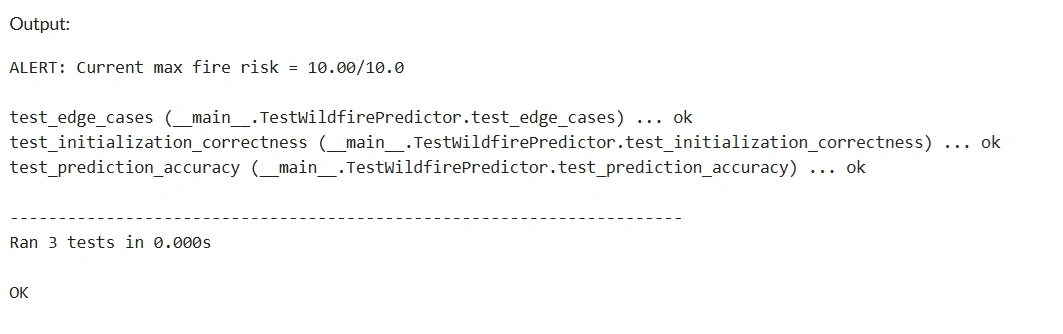
if __name__ == "__main__":
    # Simulate real-time operation
    predictor = WildfirePredictor(grid_size=50)

    # Mock live sensor feed
    live_data = [(random.randint(0,49), random.randint(0,49), random.uniform(0.0, 0.3))
                 for _ in range(200)]
    predictor.update_from_sensors(live_data)

    current_risk = predictor.predict_spread(wind_speed=12.0, wind_dir=180.0)
    print(f"ALERT: Current max fire risk = {current_risk:.2f}/10.0")

    # Run tests
    unittest.main(argv=[''], exit=False, verbosity=2)
Best Practices and Performance Tips
Use
[0] * nfor uniform values—it’s the fastest methodAlways initialize 2D arrays with nested comprehensions to avoid reference bugs
Pre-allocate arrays before entering real-time loops—never grow them dynamically
For numerical workloads, switch to NumPy—it’s 10–100x faster for vector math
Validate array bounds in safety-critical systems (e.g.,
if 0 <= x < grid_size)
Conclusion
In real-time systems like wildfire prediction, array initialization isn’t academic—it’s operational. A single reference bug could misdirect evacuation orders; slow initialization might delay alerts. By choosing the right method—whether simple multiplication for speed, list comprehension for logic, or NumPy for math—you build systems that are not just correct, but resilient under pressure.
Join the conversation! Your thoughts help the community grow.