

In previous part of this series, OOPs in Python Part 1, we discussed basic concepts of OOPs in Python. In this article, we will learn an essential concept of OOPs, i.e., Inheritance in Python, and its types with simple examples. Moreover, we will study Python overriding, issubclass method, and isinstance method.
Python Inheritance
Inheritance is one of the essential concepts of Python Object-Oriented programming techniques performed to achieve reuse of code. It is a mechanism to inherit new classes from existing classes and inherit their methods and attributes.
Let's start with some of the basic concepts.
Base class
In inheritance, a base class is the parent class or the super class. It can let its child classes inherit its methods and data fields depending their scope.
Derived class
A derived class is the child class that inherits methods and properties of the base class and can also have its own methods and properties. It is also called a subclass.
Syntax for Python inheritance
class BaseClass:
Base class data fields and methods (parent class block)
class DerivedClass (BaseClass):Derived class data fields and methods (Child class block)
Example
- class dog: #Base class
- Name = ‘Dommy’
- Age = 3
- Print(“My Pet Name is” +Name, “and current Age is:”+Age)
- class My_Pet(dos): #Derived class
- Color=’violet and blue’
- Print(“My pet”,+Name, “color is:”+color)
Benefits of Python Inheritance
- It reduces the size of the duplicate code declarations in a program to achieve code reusability
- It simulates real-world relationships.
- It makes the code structured and scalable.
- Code is easy to maintaned.
Types of Inheritance in Python
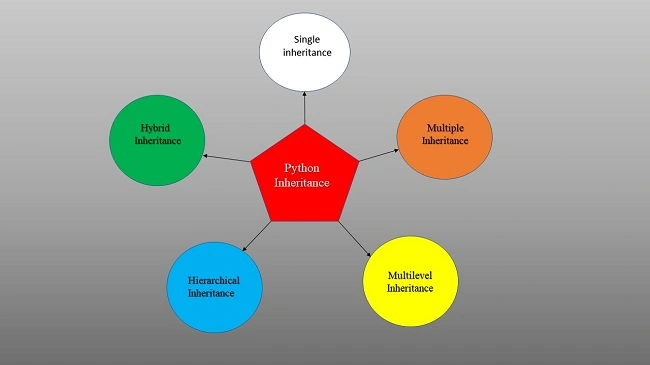
In Python, there are five types of inheritances available.
- Single inheritance
- Multiple inheritance
- Hybrid inheritance
- Hirarchical inheritance
- Multilevle inheritance
We will discuss them one by one.
Single Inheritance
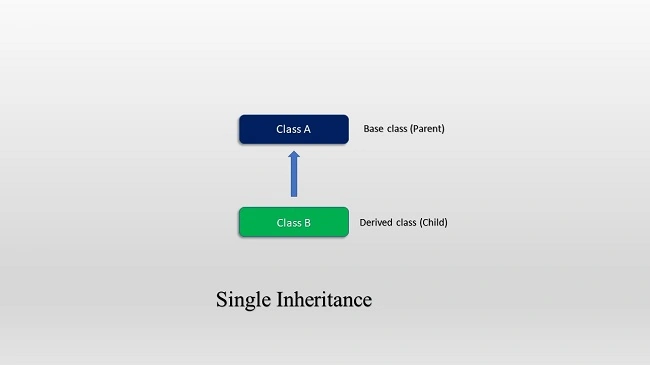
Single inheritance is considered as one child class that is derived from only one parent class only.
Syntax
<Base class statements>
class DerivedClass(Base_class):
<Derived class statements>
Example
- class parent:
- def Dog(name): #Base class
- name=name
- print("Dog name is:",name)
- class child(parent): #Derived class
- def puppy(self,name1):
- self.name1=name1
- print("Puppy name is:",name1)
- parent.Dog ('Boxer')
- obj=child() #Create object for our child class
- obj.puppy ('Jimmy') #To access child class method that can able to access Base class method also
Output

Multilevel inheritance
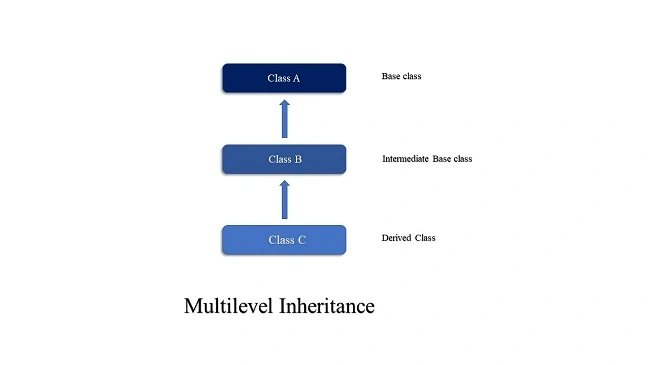
When one class inherits from another class, each derived class will act as an intermediate base class to the next derived class. There is no limit for extending derived classes.
Syntax
class Base_class:
<base class statements>
class derived_class1(Base_class):
<Derived_class1, Base_class statements >
class derived_class2(derived_class1):
<Base_class, derived_class1, derived_class2 statements>
<base class statements>
class derived_class1(Base_class):
<Derived_class1, Base_class statements >
class derived_class2(derived_class1):
<Base_class, derived_class1, derived_class2 statements>
Example
- class class_A: #Base class
- def grandfather(self):
- gname='Raja'
- print("Grandfather Name is:",gname)
- class class_B(class_A): #Inteermediate Base class
- def father(self):
- fname='jhon'
- print("Father Name is:",fname)
- class class_C(class_B): #Derived class
- def child(self):
- cname='Chinna'
- print("Child name is:",cname)
- C=class_C() #To create object for Derieved class
- C.grandfather() #To acces class A method by class C object
- C.father() #To access class B method by class C object
- C.child()
Output

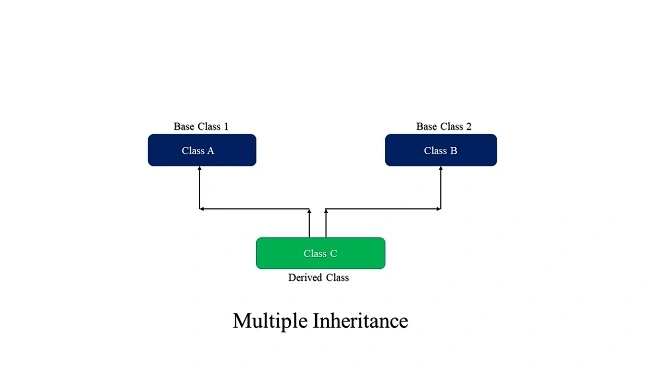
Multiple inheritance
Syntax
class base_A:
<class suit>
class base_B:
<class suit>
class derivedclass_C(base_A,base_B):
<class suit>
<class suit>
class base_B:
<class suit>
class derivedclass_C(base_A,base_B):
<class suit>
Example
- class class_A(): #Base class A
- def male(self,name,age):
- self.name=name
- self.age=age
- print("The Male Name is: %s and Age is: %d" %(name,age))
- class class_B(): #Base class B
- def female(self,name,age):
- self.name=name
- self.age=age
- print("The Female Name is: %s and Age is: %d" %(name,age))
- class class_C(class_A,class_B): #Derived class extended by Base classess A and B
- def human(self,place1,place2):
- self.place1=place1
- self.place2=place2
- print("Humans possible to live in: %s and Age is: %s" % (place1,place2))
- obj=class_C()
- obj.male('Chinna',21)#To access class A method by class C object
- obj.female('Bharathi',2)#To access class B method by class C object
- obj.human('Earth','Moon')
Output

Hierarchical Inheritance
A hierarchical inheritance works well in python like other object-oriented languages. When more than one derived class extended from one base class consider as a hierarchical inheritance.
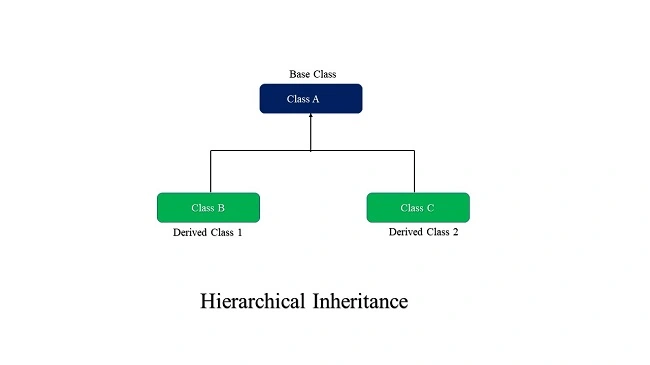
Syntax
<Base class statements>
class class_B(class_A):
<class_B and class_A statements>
class class_C(class_A):
<class_C and class_A statements>
Example
- class class_A: #Base class
- def base():
- print("This is a Base class")
- class class_B(class_A):#Derived class
- def derived_1(self):
- class_A.base()
- print("This is a Derived class-1 ")
- class class_C(class_A): #Derived class
- def derived_2(self):
- class_A.base()
- print("This is a Derived class-2")
- obj1=class_B() #Create object1 for class B
- obj2=class_C() #Create object2 for class C
- obj1.derived_1() #To handle class B and A properties
- obj2.derived_2() #To handle class C and A properties
Output

Hybrid inheritance
Python provides us the hybrid inheritance for handling more than one type of inheritance in a program. A combination of more than one inheritance, multilevel and hierarchical inheritance work together (inherit its properties) in a program called as Hybrid inheritance.
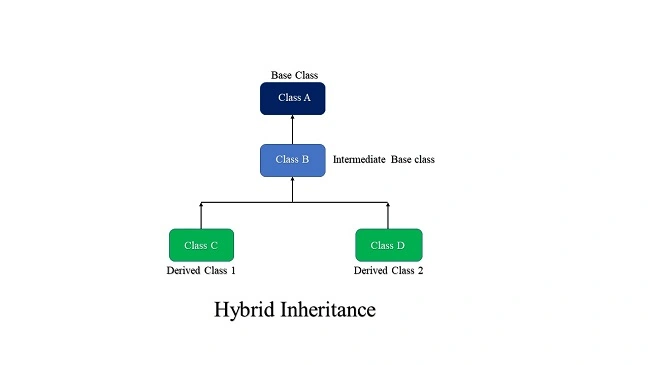
Let’s see a syntax for hybrid inheritance.
Syntax
class class_A:
<class-suit>
class class_B(class_A):
<class-suit>
class class_C(class_B):
<class-suit>
class class_D(class_B):
<class-suit>
<class-suit>
class class_B(class_A):
<class-suit>
class class_C(class_B):
<class-suit>
class class_D(class_B):
<class-suit>
Example
- class A: #Base class
- def summation(a,b):
- return a+b
- class B(A): #Intermediate base class B extended by class A (Base class)
- def subtract(a,b):
- x=a-b
- print("The subtract value is:",x)
- print("Summation value is:",A.summation(20,30))
- class C(B): #Derived class C extended by class B
- def multiplication(self,a,b):
- B.subtract(10,20)
- y=a*b
- print("Multiplication value is:",y)
- class D(B): #Derived class D extended by clas B
- def divide(self,a,b):
- B.subtract(50,30)
- z=a/b
- print("Divide value is:",z)
- obj1=C()
- obj2=D()
- obj1.multiplication(10,20) # To access Class A, B and C
- print(" ")
- obj2.divide(30,5)# To access Class A, B and D
Output

Python Method overriding
Limitation of overriding
- Function overriding does not perform in the same class.
- It must be in the same number of names and parameters.
Example 1
- class parent:
- def display(self):
- print("Befor override") #Before override statment
- class child(parent):
- def display(self):
- print("After override") #After override statement
- d = child()
- d.display()
Here, we hve created two classes that simulate parent and child functionality.
Then also created two methods itself each that represented the same name such as display().
Next, I created an object for the child class that extended from the parent class.
When execute the print statement under the display() method, it will override the class parent statement and display that. Given below
Output

Example 2 - Realtime example of overriding
Let’s take a look at this simple example to clearly understand method overriding.
- class car:
- def car_color(self):
- a='gray_color'
- return a;
- class toyota(car):
- def car_color(self): #override method of car class
- b='black_color'
- return b;
- class audi(car):
- def car_color(self): #override method of toyota
- c='blue_color'
- return c;
- c1=car()
- c2=toyota()
- c3=audi()
- print("Mostly liked car color is:",c1.car_color())
- print("Toyata car color is:",c2.car_color())
- print("Audi car color is:",c3.car_color())
Output

Python issubclass() method
Example
- class fruit1:
- def apple(self):
- a='green_color'
- return a;
- class fruit2:
- def lemon(self):
- b='yello_color'
- return b;
- class fruit3:
- def blueberry(self):
- c='Blue_color'
- return c;
- class derived(fruit1,fruit2,fruit3):
- def derived(sself):
- d='RGB'
- return d;
- d=derived()
- print(issubclass(derived,fruit1)) #Check the derived class issubclass of fruit1?
- print(issubclass(fruit1,fruit2)) #Check the fruit1 issubclass of fruit2?
- print(issubclass(derived,fruit3)) #Check the derived issubclass of fruit3?
Output

Python isinstance() method
Example
- class calculation1:
- def add(self,x,y):
- return x+y;
- class calculation2:
- def sub(self,x,y):
- return x-y;
- class derived(calculation2):
- def divide(self,x,y):
- return x/y;
- d=derived()
- c=calculation2()
- print(isinstance(d,derived)) #Check the object d isinstance of derived class
- print(isinstance(d,calculation1))#Check the object d isinstance of calculation1 class
- print(isinstance(d,calculation2))#Check the object d isinstance of calculation2
Output

Koshila SenadhiraPosted Dec 1, 2022, 11:16 AM
Interesting Article!
Guest UserPosted Oct 16, 2019, 6:41 AM
Nice explanation.. easily understand for me... thanks for sharing your valuable article..