

This article provides an overview of Post-Quantum Cryptography (PQC) at Amazon Web Services (AWS), explaining its importance, current implementations, usage, and benefits. It aims to help users understand how AWS is preparing for the potential threats posed by quantum computers and how they can leverage PQC to enhance their security posture.
Introduction to Post-Quantum Cryptography
Quantum computers, while still in their nascent stages, pose a significant threat to many of the cryptographic algorithms that currently secure our digital world. Algorithms like RSA, ECC (Elliptic Curve Cryptography), and Diffie-Hellman, which are widely used for encryption, digital signatures, and key exchange, are vulnerable to attacks from sufficiently powerful quantum computers running Shor's algorithm.
Post-Quantum Cryptography (PQC), also known as quantum-resistant cryptography, refers to cryptographic algorithms that are believed to be secure against attacks by both classical and quantum computers. These algorithms are designed to replace or augment existing cryptographic methods, ensuring the confidentiality, integrity, and authenticity of data in a post-quantum world.
AWS Approach to Post-Quantum Cryptography
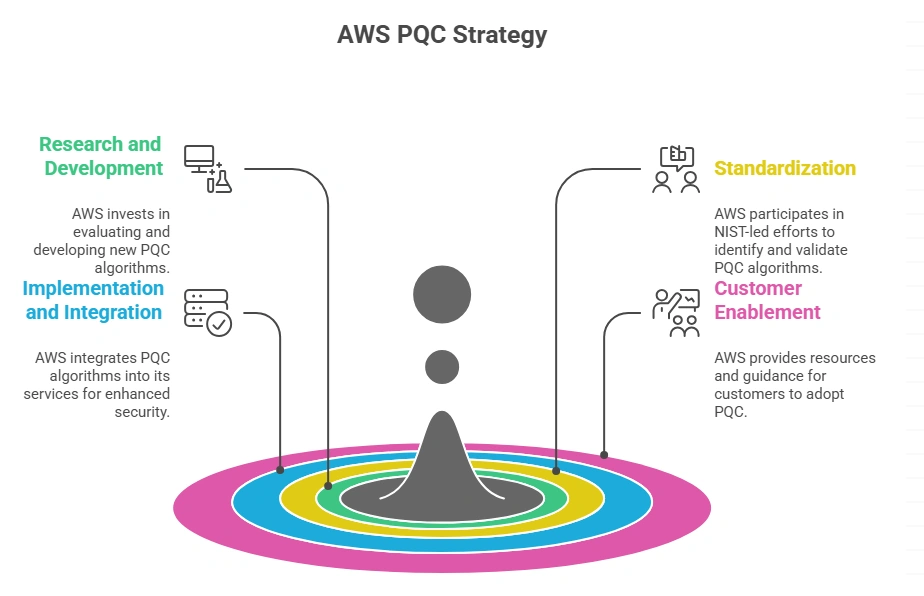
AWS recognizes the potential impact of quantum computing on security and is actively involved in research, standardization, and implementation of PQC. Their approach involves:
Research and Development: AWS invests in research to evaluate and develop PQC algorithms.
Standardization: AWS actively participates in the standardization efforts led by organizations like NIST (National Institute of Standards and Technology) to identify and validate promising PQC algorithms.
Implementation and Integration: AWS is integrating PQC algorithms into its services to provide customers with options for enhanced security.
Customer Enablement: AWS provides resources and guidance to help customers understand and adopt PQC.
PQC Algorithms
NIST is currently in the process of standardizing several PQC algorithms. Some of the leading candidates include:
Kyber: A key-encapsulation mechanism (KEM) based on the Module Learning with Errors (MLWE) problem. It's known for its efficiency and relatively small key sizes.
Dilithium: A digital signature algorithm based on the Module Learning with Errors (MLWE) problem. It offers a good balance of security, performance, and signature size.
Falcon: A digital signature algorithm based on the shortest integer solution (SIS) problem on lattices. It's known for its compact signature sizes.
Sphincs+: A stateless hash-based signature scheme. It's relatively slow but provides a high level of security and is resistant to various attacks.
PQC Implementation in AWS Services
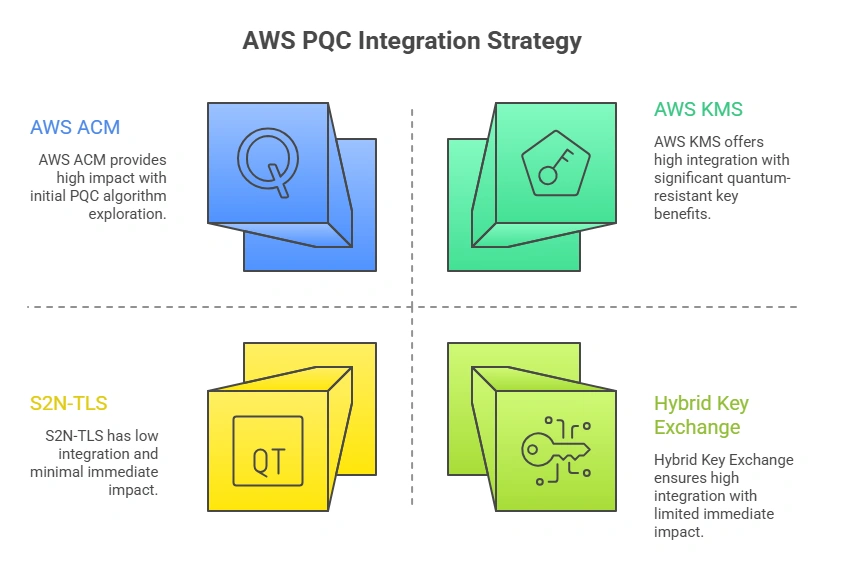
AWS is gradually incorporating PQC into its services. Here are some examples:
Usage of PQC in AWS
While PQC is still in the early stages of adoption, here's how you can potentially leverage it within AWS:
Hybrid Key Exchange: Use TLS configurations that support hybrid key exchange mechanisms. These mechanisms combine a classical key exchange algorithm (e.g., ECDHE) with a PQC algorithm (e.g., Kyber). This provides protection against both classical and quantum attacks. You can configure this in services like S2N-TLS.
Experiment with PQC-Enabled KMS: Keep an eye on AWS KMS announcements for PQC-enabled features. When available, you can create KMS keys using PQC algorithms and use them to encrypt your data.
Evaluate PQC Libraries: Explore and evaluate PQC libraries that can be integrated into your applications. These libraries provide implementations of PQC algorithms that you can use for encryption, digital signatures, and key exchange.
Monitor NIST Standardization: Stay informed about the NIST PQC standardization process. This will help you understand which algorithms are likely to become widely adopted and which ones are best suited for your needs.
Consult AWS Security Bulletins: Regularly review AWS security bulletins and announcements for updates on PQC and other security-related topics.
Benefits of Using PQC in AWS
Enhanced Security: PQC provides a higher level of security against both classical and quantum attacks.
Future-Proofing: Adopting PQC now helps future-proof your systems against the potential threat of quantum computers.
Compliance: In some industries, compliance regulations may require the use of PQC to protect sensitive data.
Competitive Advantage: Being an early adopter of PQC can give you a competitive advantage by demonstrating a commitment to security and innovation.
Smooth Transition: Hybrid approaches allow for a gradual transition to PQC without disrupting existing systems.
Considerations
Performance: PQC algorithms can be computationally intensive, which may impact performance. It's important to carefully evaluate the performance characteristics of different algorithms and choose the ones that best meet your needs.
Key and Signature Sizes: PQC algorithms may have larger key and signature sizes than classical algorithms. This can impact storage and bandwidth requirements.
Standardization: PQC is still in the process of being standardized. It's important to use algorithms that are well-vetted and have a good chance of being standardized.
Complexity: Implementing PQC can be complex. It's important to have the necessary expertise and resources to do it properly.
Conclusion
Post-Quantum Cryptography is a crucial area of focus as we prepare for the potential impact of quantum computers. AWS is actively involved in research, standardization, and implementation of PQC to provide customers with enhanced security options. By understanding the principles of PQC and how it's being implemented in AWS services, you can take steps to future-proof your systems and protect your data against both classical and quantum threats. Stay informed about the latest developments in PQC and work with AWS to adopt these technologies as they become available.
Join the conversation! Your thoughts help the community grow.