
In my previous article I described Palindrome Numbers. But in this article I describe Palindrome Strings. So let us first of all understand what a Palindrome String is.
Palindrome String
A string that is equal to itself reversed is called a Palindrome String. Just like the Palindrome number.
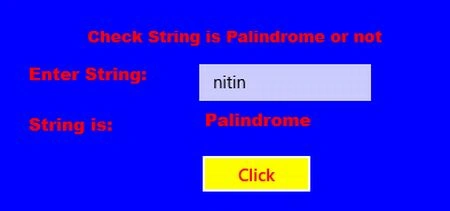
Example: String nitin is equal to itself reversed.
Use the following procedure to create the Palindrome String app.
Step 1
First of all you have to create a new Windows Store Application using the following:
- Open Visual Studio 2012
- "File" -> "New" -> "Project..."
- Choose "Template" -> "Visual C#" -> "Window Store app"
- Choose "Blank App (XAML)" then rename the application

Step 2
Write the following XAML code in "Mainpage.Xaml" (that is available in Solution Explorer):
<Page
x:Class="palindrome_string.MainPage"
xmlns="http://schemas.microsoft.com/winfx/2006/xaml/presentation"
xmlns:x="http://schemas.microsoft.com/winfx/2006/xaml"
xmlns:local="using:palindrome_string"
xmlns:d="http://schemas.microsoft.com/expression/blend/2008"
xmlns:mc="http://schemas.openxmlformats.org/markup-compatibility/2006"
mc:Ignorable="d">
<Grid Background="Blue">
<Grid.RowDefinitions>
<RowDefinition Height="38*"/>
<RowDefinition Height="23*"/>
<RowDefinition Height="31*"/>
<RowDefinition Height="20*"/>
<RowDefinition Height="42*"/>
<RowDefinition Height="614*"/>
</Grid.RowDefinitions>
<Grid.ColumnDefinitions>
<ColumnDefinition Width="555*"/>
<ColumnDefinition Width="106*"/>
<ColumnDefinition Width="705*"/>
</Grid.ColumnDefinitions>
<TextBlock Text="Check String is Palindrome or not" FontFamily="Arial" FontSize="14" FontWeight="ExtraBold" Foreground="Red" Grid.Row="1" Grid.ColumnSpan="3" TextAlignment="Center"></TextBlock>
<TextBlock Text="Enter String:" FontFamily="Arial" FontSize="15" FontWeight="ExtraBold" Foreground="Red" Grid.Column="1" Grid.Row="2"></TextBlock>
<TextBox x:Name="Textbox1" Width="150" Height="32" VerticalAlignment="Top" Grid.Column="2" Grid.Row="2" HorizontalAlignment="Left" Grid.RowSpan="2" />
<TextBlock Text="String is:" FontFamily="Arial" FontSize="15" FontWeight="ExtraBold" Foreground="Red" Grid.Column="1" Grid.Row="3"></TextBlock>
<TextBlock x:Name="text2" FontFamily="Arial" FontSize="15" FontWeight="ExtraBold" Foreground="Red" Grid.Column="2" Grid.Row="2" Margin="5,0,667,0" Height="32" VerticalAlignment="Bottom" Grid.RowSpan="2" />
<Button Content="Click" Click="Button1_click" Grid.Column="2" Grid.Row="4" FontSize="15" Foreground="Red" Background="Yellow" Width="100" Height="37" Margin="0,5,0,0" VerticalAlignment="Top" />
</Grid>
</Page>
Step 3
Now write the following C# code for the button within "Mainpage.Xaml.cs":
using System;
using System.Collections.Generic;
using System.IO;
using System.Linq;
using Windows.Foundation;
using Windows.Foundation.Collections;
using Windows.UI.Xaml;
using Windows.UI.Xaml.Controls;
using Windows.UI.Xaml.Controls.Primitives;
using Windows.UI.Xaml.Data;
using Windows.UI.Xaml.Input;
using Windows.UI.Xaml.Media;
using Windows.UI.Xaml.Navigation;
namespace palindrome_string
{
public sealed partial class MainPage : Page
{
public MainPage()
{
this.InitializeComponent();
}
protected override void OnNavigatedTo(NavigationEventArgs e)
{
}
private void Button1_click(object sender, RoutedEventArgs e)
{
string str = Textbox1.Text;
string revstr = "";
for (int i = str.Length - 1;i>=0 ; i--)
{
revstr = revstr + str[i];
}
if (str == revstr)
{
text2.Text = "Palindrome";
}
else
{
text2.Text = "Not Palindrome";
}
}
}
}
Step 4
Now Run Your app.

Join the conversation! Your thoughts help the community grow.