

In today's data-driven world, businesses are constantly seeking ways to manage their data more efficiently and cost-effectively. One of the most significant advancements in this area is the use of virtualization technology, particularly VMware's solutions. Virtualization allows for more efficient use of existing hardware resources, leading to reduced storage costs and optimized storage utilization and efficiency.
Related Image © VMware
Understanding Virtual Storage
Before diving into the specifics of how virtualization can reduce costs and improve efficiency, it’s essential to understand what virtual storage is. Virtual storage abstracts the physical storage resources, allowing multiple virtual machines (VMs) to share the same physical storage. This abstraction layer provides flexibility, scalability, and efficiency that is difficult to achieve with traditional storage methods.
Types of Virtual Disks
VMware supports different types of virtual disks, primarily thick and thin provisioning. Understanding these types is crucial to optimizing storage:
- Thick Provisioning: Allocates the entire storage space specified for the virtual disk upfront. For example, if you create a 20 GB thick-provisioned disk, 20 GB of physical storage is immediately allocated.
- Thin Provisioning: Allocates storage space on an as-needed basis. If you create an 80 GB thin-provisioned disk, it initially uses a small amount of physical storage and grows as data is written to it.
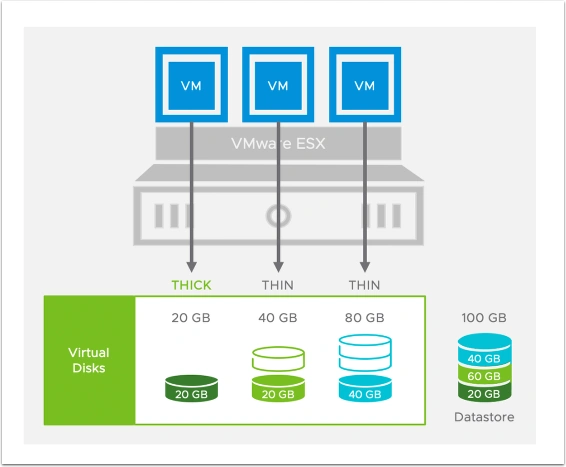
The provided image illustrates this concept with three VMs:
- A 20 GB thick-provisioned disk.
- A 40 GB thin-provisioned disk, which initially uses 20 GB.
- An 80 GB thin-provisioned disk, which initially uses 40 GB.
The data store in this example is 100 GB, showing how thin provisioning allows more efficient storage space use than thick provisioning.
Benefits of Virtualization in Reducing Storage Costs
-
Improved Storage Utilization: One of the primary ways virtualization reduces storage costs is by improving storage utilization. With traditional physical storage, each server or application typically requires dedicated storage, leading to inefficiencies and underutilized resources. Virtualization allows multiple VMs to share the same physical storage, ensuring that resources are used more effectively.
-
Thin Provisioning: As mentioned earlier, thin provisioning is a key feature in reducing storage costs. By allocating storage space on an as-needed basis, businesses can avoid over-provisioning and reduce the amount of unused storage. This leads to lower storage costs, as you are only paying for the storage that you actually use.
-
De-duplication and Compression: VMware's storage solutions often include advanced features like de-duplication and compression. De-duplication eliminates duplicate copies of repeating data, while compression reduces the size of data. Both of these features can significantly reduce the amount of physical storage required, leading to cost savings.
-
Automated Storage Management: Virtualization platforms like VMware include automated storage management features that help optimize storage usage. These features can automatically balance storage loads, reclaim unused space, and ensure that storage is used efficiently. This reduces the need for manual intervention and helps keep storage costs down.
Optimizing Storage Efficiency
-
Storage Tiers and Policies: VMware allows for the creation of different storage tiers and policies, enabling businesses to allocate storage resources based on the performance requirements of their applications. For example, critical applications can be placed on high-performance storage, while less critical applications can use lower-cost storage. This approach ensures that storage resources are used efficiently and cost-effectively.
-
Storage vMotion: Storage vMotion is a powerful feature that allows for the live migration of VM disk files across different storage arrays without downtime. This capability enables businesses to optimize storage usage dynamically and ensure that VMs are always running on the most appropriate storage resources.
-
Space Reclamation: Over time, VMs can accumulate unused or orphaned data, which can lead to wasted storage space. VMware's space reclamation features can identify and reclaim this unused space, ensuring that storage is used as efficiently as possible.
Real-World Example
Let’s consider a real-world example to illustrate these concepts. Imagine a company that operates a data center with 100 TB of physical storage. Using traditional storage methods, each server in the data center requires dedicated storage, leading to inefficiencies and underutilized resources.
By implementing VMware virtualization, the company can create a virtualized storage environment where multiple VMs share the same physical storage. Using thin provisioning, they allocate storage space on an as-needed basis, avoiding over-provisioning. With de-duplication and compression, they further reduce the amount of physical storage required.
Automated storage management features ensure that storage resources are used efficiently, while storage tiers and policies enable the company to allocate storage based on the performance requirements of their applications. Storage vMotion allows for the live migration of VM disk files, optimizing storage usage dynamically.
As a result, the company can reduce its storage costs significantly while optimizing storage utilization and efficiency. Instead of purchasing additional storage to meet growing demands, the company can make better use of its existing storage resources, leading to cost savings and improved operational efficiency.
Conclusion
Virtualization technology, particularly VMware's solutions, offers significant benefits in reducing storage costs and optimizing storage utilization and efficiency. By leveraging features like thin provisioning, de-duplication, compression, automated storage management, and storage vMotion, businesses can make better use of their storage resources, avoid over-provisioning, and reduce costs. As data continues to grow exponentially, these capabilities will become increasingly important for businesses seeking to manage their storage resources effectively and cost-efficiently.
Join the conversation! Your thoughts help the community grow.