

Here One to Many to Smart referred as
One : Monolithic Architecture
Many: Microservice Architecture
Smart: Agent-Based Architecture
Pre-requisites to Understand These Architectures
Understanding of how applications are built using any language
Client-Server Model: Knowledge of how clients interact with backend systems
System Design Fundamentals: Awareness of scalability, reliability, and performance
Distributed Systems Basics: Understanding challenges like latency, failures, and consistency
Introduction
Modern software architecture has evolved to address increasing complexity, scalability, and adaptability needs in applications. Three widely used architectural styles: Monolithic, Microservices, and Agent-Based represent different approaches to structuring systems.
Monolithic architecture combines all functionalities into a single unit, making it simple but less flexible as systems grow.
Microservices architecture breaks applications into smaller, independent services that improve scalability and maintainability.
Agent-based architecture introduces autonomous components that collaborate dynamically, making it highly suitable for intelligent and adaptive systems such as AI-driven applications.
Monolithic Architecture
Monolithic architecture is a traditional approach where all application components, such as user interface, business logic, and data access are bundled into a single codebase and deployed as one unit. This design makes development straightforward initially because everything resides in one place, simplifying testing and deployment. However, as the application grows, it becomes harder to manage, scale, and maintain due to tight coupling between components. Any small change may require redeploying the entire application, increasing risk. Scaling is typically done by replicating the whole system rather than specific parts. This architecture is best suited for small to medium-sized applications with limited complexity and teams.
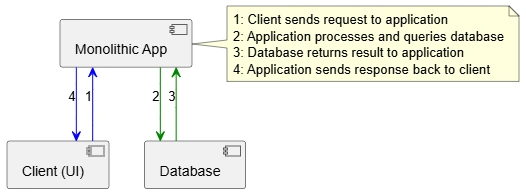
Single codebase: All features exist in one unified application.
Tight coupling: Components are interdependent.
Simple deployment: One artifact to deploy.
Hard to scale: Entire system must scale together.
Maintenance challenges: Large codebase becomes complex over time.
Faster initial development: Easy to start with minimal setup.
Microservices Architecture
Microservices architecture decomposes an application into small, independent services, each responsible for a specific business capability. These services communicate via APIs and can be developed, deployed, and scaled independently. This approach improves flexibility, allowing teams to work on different services simultaneously and adopt different technologies if needed. It also enhances fault isolation, failure in one service does not necessarily bring down the entire system. However, it introduces complexity in communication, monitoring, and deployment. Managing distributed systems requires robust infrastructure such as API gateways, service discovery, and observability tools.
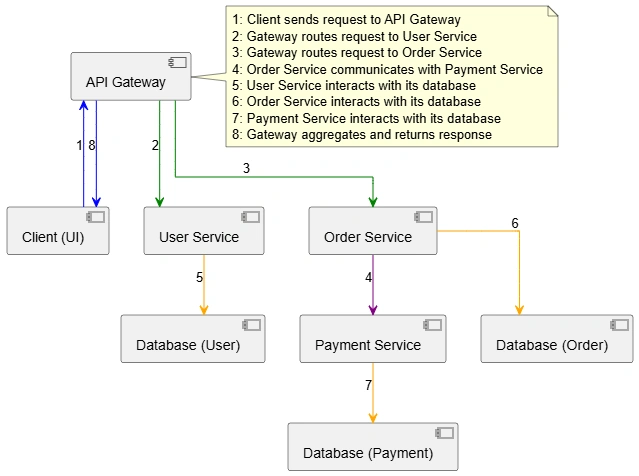
Decentralized structure: Each service is independent.
Independent deployment: Services can be updated separately.
Better scalability: Scale only required services.
Fault isolation: Failures are contained within services.
Increased complexity: Requires orchestration and monitoring.
Technology flexibility: Different stacks per service.
Agent-Based Architecture
Agent-based architecture is a modern paradigm where autonomous agents collaborate to solve complex problems. Each agent has a specific role, such as planning, execution, or analysis and can make decisions independently based on context and goals. An orchestrator often coordinates these agents, enabling dynamic workflows instead of fixed pipelines. This architecture is highly flexible and adaptive, making it suitable for AI-driven systems, automation, and complex decision-making tasks. However, it introduces challenges in coordination, debugging, and ensuring consistency across agents. Proper design of communication and control flow is critical for success.
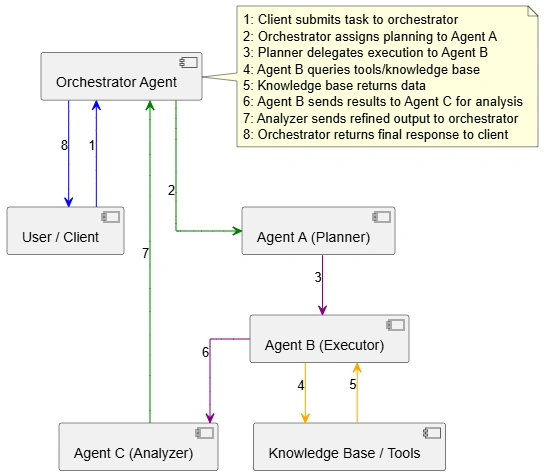
Autonomous agents: Each unit acts independently
Dynamic workflows: Execution path can change at runtime.
High flexibility: Adapts to complex tasks.
Collaboration model: Agents communicate with each other.
Complex debugging: Harder to trace execution paths.
Ideal for AI systems: Common in intelligent automation.
Differences Table
| Feature | Monolithic Architecture | Microservices Architecture | Agent-Based Architecture |
|---|---|---|---|
| Structure | Single unified application | Multiple independent services | Multiple autonomous agents |
| Coupling | Tight coupling | Loosely coupled | Loosely coupled, dynamic |
| Scalability | Scale entire system | Scale individual services | Scale agents dynamically |
| Deployment | Single deployment unit | Independent deployments | Dynamic execution, not fixed deploy |
| Complexity | Low initially, high later | Medium to high | High |
| Communication | Internal method calls | API-based communication | Message/task-based interaction |
| Fault Isolation | Low | High | Medium (depends on orchestration) |
| Flexibility | Low | High | Very high |
| Use Case | Simple applications | Enterprise systems | AI-driven, adaptive systems |
Summary
Monolithic, microservices, and agent-based architectures represent an evolution in system design from simplicity to flexibility and intelligence. Monolithic systems are easy to build and deploy but struggle with scalability and maintainability as they grow. Microservices address these limitations by breaking applications into smaller, independent units, improving scalability and resilience at the cost of added complexity. Agent-based architecture goes a step further by introducing autonomous, decision-making entities that collaborate dynamically, making it highly suitable for modern AI-driven applications. The choice among these depends on system complexity, scalability needs, and the level of adaptability required.
Join the conversation! Your thoughts help the community grow.