

Pre-requisite to understand this
Basic understanding of TLS / SSL and HTTPS
Root CA, Intermediate CA
Server certificates vs Client certificates
Certificate revocation
Familiarity with AWS core services:
AWS Certificate Manager (ACM)
AWS Private Certificate Authority (ACM PCA)
IAM roles and policies
Elastic Load Balancer (ALB / NLB)
API Gateway
Basic networking concepts (ports, endpoints, trust chains)
Introduction
Mutual TLS (mTLS) is an authentication mechanism where both client and server authenticate each other using X.509 certificates. In AWS, managing mTLS at scale requires a combination of AWS Certificate Manager (ACM), AWS Private Certificate Authority (PCA), and integration with services like Application Load Balancer (ALB), API Gateway, or CloudFront. Proper certificate lifecycle management is critical to ensure security, automation, and compliance in microservices, B2B integrations, and zero-trust architectures.
What problem we can solve with this?
mTLS certificate management in AWS solves identity, trust, and security challenges for service-to-service and client-to-server communication.
Problems solved:
Strong client authentication (not just username/password or tokens)
Prevents unauthorized service access
Enables Zero Trust architecture
Eliminates reliance on static API keys
Secures east-west traffic in microservices
Enables B2B secure integrations
Centralized certificate lifecycle management
Automated certificate rotation and renewal
How to implement/use this?
High-level approach
AWS provides a managed PKI using ACM and ACM Private CA to issue, rotate, and revoke certificates, while AWS networking services enforce mTLS at the edge or load balancer layer.
AWS components involved
AWS Private Certificate Authority (ACM PCA): Issues private client and server certificates
AWS Certificate Manager (ACM): Stores and manages certificates
ALB / NLB / API Gateway / CloudFront: Enforces mTLS
IAM: Controls who can issue and manage certificates
Secrets Manager / Parameter Store (optional): Securely distribute client certs
Step-by-step implementation
Implementing mutual TLS (mTLS) in AWS involves creating a private Public Key Infrastructure (PKI) hierarchy using AWS Private Certificate Authority (ACM PCA), issuing certificates, configuring trust stores, enabling authentication on services like ALB or API Gateway, and automating certificate lifecycles. The process begins with establishing a root CA—either kept offline for security or fully managed by ACM PCA—and one or more intermediate CAs that issue end-entity certificates to reduce the root CA's exposure to compromise. Server certificates are generated and attached to resources like Application Load Balancers (ALB), Network Load Balancers (NLB), API Gateway, or CloudFront for TLS termination, while client certificates are securely distributed to applications, IoT devices, or services via Secrets Manager or Parameter Store.
Next, trust stores must be configured by uploading the CA certificate chain (trust anchors) to the target services, such as ALB trust stores for listener validation or API Gateway trust stores to enable verification of client-presented certificates. mTLS is then activated by configuring listeners or endpoints to require client certificates, where the service validates the full certificate chain against the trust store, checks revocation status via CRL or OCSP, and enforces expiration policies to prevent insecure connections. Finally, lifecycle automation ensures sustainability through ACM PCA's support for certificate auto-renewal via short-lived certificates or scheduled re issuance, along with rotation mechanisms and revocation lists to handle compromised certificates promptly, minimizing downtime and security risks.
1. Create a Private Certificate Authority
Root CA (offline or managed)
One or more Intermediate CAs for issuing certificates
2. Issue certificates
Server certificates → attached to ALB / API Gateway
Client certificates → distributed to clients/services
3. Configure trust store: Upload CA certificates (trust anchors) to:
ALB trust store
API Gateway trust store
4. Enable mTLS
Configure listener to require client certificate
Validate certificate chain and expiration
5. Automate lifecycle
Auto-renew certificates
Rotate and revoke compromised certificates
Sequence Diagram (mTLS Flow)
This sequence shows how certificates are issued, validated, and used during an mTLS handshake in AWS.
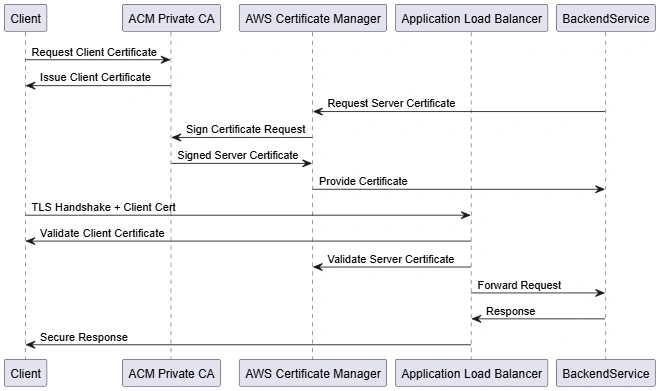
Client and server both possess certificates
ALB validates client identity
Trust is established using CA chain
Backend services are protected without custom auth logic
Component Diagram (AWS Architecture)
This component view highlights trust boundaries and responsibilities.
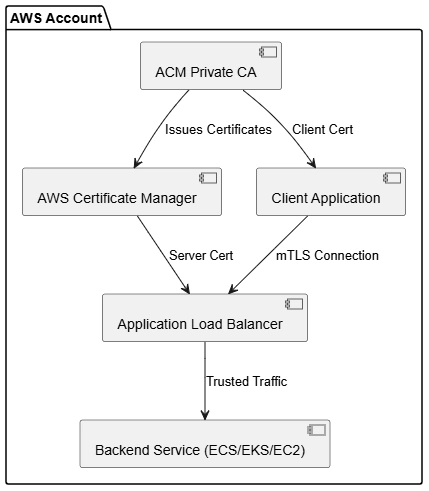
ACM + PCA manage the PKI
ALB enforces mTLS
Backend services only receive trusted traffic
Client identity is cryptographically verified
Advantages
Strong cryptographic client authentication
Centralized certificate management
No application-level authentication logic needed
Automatic certificate renewal
Scales for microservices and B2B use cases
Aligns with Zero Trust principles
Fully managed AWS-native solution
Auditable and compliant (SOC, ISO, HIPAA-ready)
Summary
Managing mTLS certificates in AWS involves setting up a private PKI using ACM Private CA, distributing certificates via ACM, and enforcing trust at the load balancer or API gateway layer. This approach enables secure, scalable, and automated mutual authentication without embedding security logic into applications. By leveraging AWS-native services, organizations can achieve strong identity-based security, simplified operations, and compliance-ready architectures.
Join the conversation! Your thoughts help the community grow.