

Pre-requisite to understand this
Basic understanding of cloud computing (AWS / Azure / GCP concepts)
Knowledge of virtual machines, containers, or pods
Understanding of application performance metrics (CPU, memory, latency, requests/sec)
Familiarity with monitoring tools (CloudWatch, Prometheus, Azure Monitor, etc.)
Basic idea of load balancers and horizontal vs vertical scaling
Introduction
Auto-scaling is a cloud capability that automatically adjusts application resources (such as servers, containers, or pods) based on real-time demand. Monitoring tools continuously collect metrics like CPU usage, memory, and request rates. These metrics are evaluated against predefined rules or policies to decide when to scale resources up or down. This ensures applications remain performant, highly available, and cost-efficient without manual intervention.
What problem we can solve with this?
Auto-scaling solves the challenge of handling variable workloads while maintaining performance and controlling infrastructure costs.
Problems addressed:
Sudden traffic spikes causing application downtime
Over-provisioning resources during low traffic (wasted cost)
Manual scaling delays and human error
Poor user experience due to slow response times
Inefficient use of cloud resources
How to implement / use this?
Auto-scaling is implemented by integrating monitoring tools with scaling mechanisms such as Auto Scaling Groups, Kubernetes HPA, or cloud-native scaling services.
High-level steps:
Deploy application behind a load balancer
Enable monitoring & metric collection
Define scaling policies (thresholds & actions)
Configure auto-scaling engine
Continuously evaluate metrics and scale dynamically
Components involved:
Monitoring Tool (metrics & alerts)
Scaling Policy Engine
Cloud Infrastructure (VMs / Containers)
Load Balancer
Sequence Diagram (Auto-Scaling Flow)
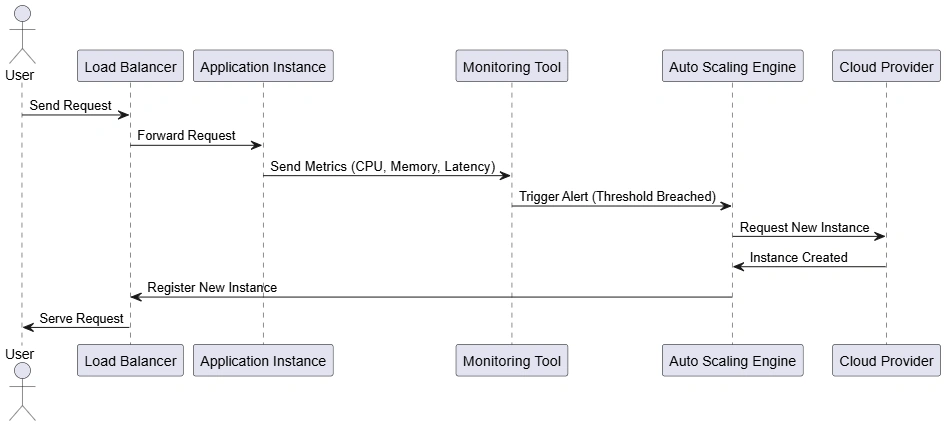
User traffic hits the load balancer.
Load balancer routes traffic to application instances.
Application sends performance metrics to the monitoring tool.
Monitoring tool detects threshold breach (e.g., CPU > 70%).
Auto-scaling engine is triggered.
Cloud provider launches a new instance.
New instance is registered with the load balancer.
Traffic is redistributed automatically.
Component Diagram (Architecture View)
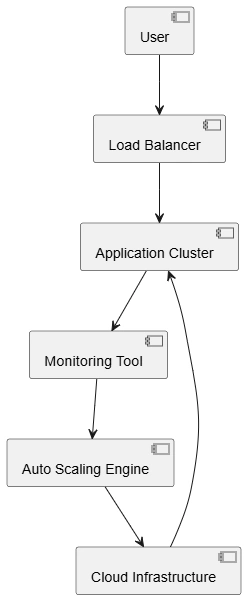
User accesses the application via the load balancer.
Application Cluster hosts multiple instances/pods.
Monitoring Tool continuously collects metrics.
Auto Scaling Engine evaluates metrics against policies.
Cloud Infrastructure provisions or de-provisions resources dynamically.
Advantages
Automatic handling of traffic spikes
Improved application availability and reliability
Cost optimization through dynamic scaling
Reduced manual intervention
Better user experience
Faster incident response
Scales both horizontally and vertically (depending on setup)
Summary
Auto-scaling using monitoring tools is a foundational cloud design pattern that ensures applications remain responsive, resilient, and cost-effective. By continuously monitoring key performance metrics and dynamically adjusting resources, cloud systems can automatically adapt to changing workloads. The integration of monitoring tools, scaling policies, and cloud infrastructure removes operational overhead while delivering high availability and performance at scale.
Join the conversation! Your thoughts help the community grow.