

MLOps Workflow Architecture
Machine Learning Operations (MLOps) is the discipline that operationalizes machine learning models, ensuring they are developed, deployed, monitored, and maintained effectively. This whitepaper outlines the main components of the ML lifecycle, the principles of MLOps, and practical guidance on data processing, continuous training, experiment tracking, and model integration.
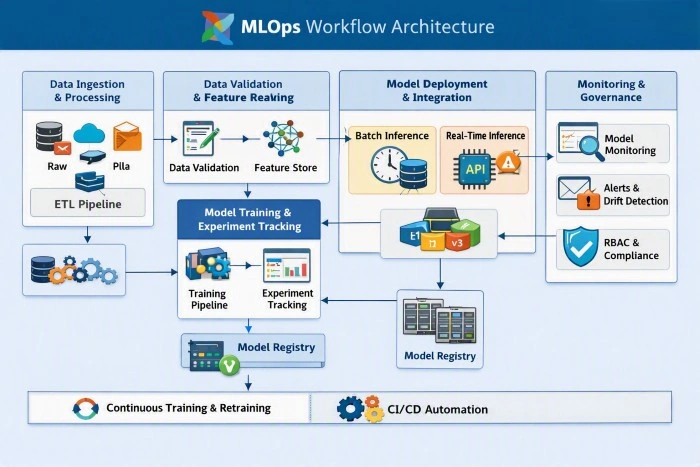
MLOps workflow architecture diagram
Diagram visually maps the entire lifecycle from data ingestion and validation, through training and experiment tracking, to model registry, deployment, monitoring, and governance, with continuous training and CI/CD automation running across the bottom.
Machine Learning Lifecycle Components
The ML lifecycle consists of interconnected stages:
Data Collection & Processing – Ingest raw data from diverse sources.
Data Validation & Feature Engineering – Ensure quality and consistency; build reusable features.
Model Development & Training – Experiment with algorithms, hyperparameters, and architectures.
Evaluation & Selection – Benchmark models against metrics and baselines.
Deployment & Integration – Serve models via APIs, batch pipelines, or edge devices.
Monitoring & Maintenance – Track drift, accuracy, latency, and retrain as needed.
Principles and Lifecycle of MLOps
MLOps extends DevOps principles to ML systems:
Automation: Automate pipelines for data ingestion, training, and deployment.
Reproducibility: Version control for code, data, and models.
Scalability: Architect workflows to handle growing datasets and workloads.
Collaboration: Enable seamless communication between data scientists, engineers, and operations.
Continuous Improvement: Integrate CI/CD for ML to ensure models evolve with new data.
Lifecycle stages: Development → Integration → Deployment → Monitoring → Retraining.
Data Processing, Validation, and Feature Store Management
Data Processing: Use ETL pipelines to clean, transform, and enrich raw data.
Validation: Apply schema checks, anomaly detection, and quality rules.
Feature Store: Centralize feature definitions for consistency across training and inference (e.g., Feast, TFX Feature Store).
Best Practice: Treat features as first-class citizens—document, version, and reuse them across projects.
Continuous Training and Experiment Tracking
Continuous Training (CT): Automate retraining when new data arrives or drift is detected.
Experiment Tracking: Use MLflow, Weights & Biases, or Neptune.ai to log hyperparameters, metrics, and artifacts.
Best Practice: Store experiments in a centralized repository for reproducibility and comparison.
Model Management, Versioning, and Integration
Model Management: Use registries (MLflow Model Registry, Azure ML, SageMaker) to organize models.
Versioning: Maintain multiple versions for rollback, A/B testing, and shadow deployments.
Integration Approaches:
Batch Inference: Scheduled predictions for reporting.
Real-Time Inference: APIs for instant decision-making.
Edge Deployment: Lightweight models for IoT/mobile.
Monitoring: Track latency, accuracy, and drift with Prometheus/Grafana dashboards.
Governance and Enterprise Considerations
Security: Apply RBAC, secure APIs, and audit logs.
Compliance: Align with GDPR, HIPAA, or industry-specific regulations.
High Availability: Deploy redundant services for resilience.
Version Control: Store DAGs, pipelines, and models in Git for traceability.
Monitoring & Alerts: Integrate with enterprise observability tools.
| Category | Recommendation |
|---|---|
| Data | Validate inputs, centralize features |
| Training | Automate retraining, track experiments |
| Models | Use registries, version models |
| Integration | Choose batch vs. real-time wisely |
| Governance | Enforce RBAC, compliance, monitoring |
MLOps transforms machine learning from isolated experiments into production-ready systems. By mastering the lifecycle—from data processing and validation to continuous training, model management, and integration—organizations can build ML solutions that are scalable, reliable, and impactful.
Join the conversation! Your thoughts help the community grow.