

In this article I would like to experiment with the Memento pattern. Memento
pattern provides an Object Oriented way of saving the state of an object.
The state called as Memento can be used to restore the object later.
The English meaning of Memento is Reminder of Past Events.
Challenge
You are working on a drawing application which allows the user to draw lines on
a Canvas. The user should be able to save the state on particular intervals so
any further mistakes could be undone. You need to provide a solution for the
problem.
Definition
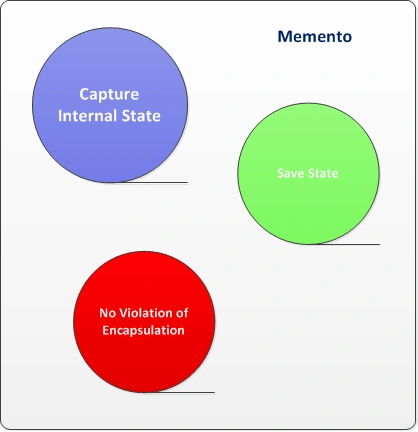
"Without violating encapsulation, capture and externalize an object's internal
state so that the object can be restored to this state later".
Implementation
The above problem can be solved using the Memento Pattern. This pattern, as stated
in the definition, saves the internal state of the object for restoration later.
The object state is saved without violating Encapsulation.
Following is the Drawing class definition:
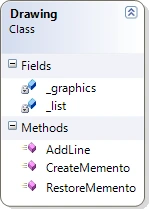
- The AddLine() method allows to add line on the graphics. These information are stored inside the _list object as state.
- The CreateMemento() allows to get a copy of the internal state without violating Encapsulation.
- The RestoreMemento() allows to restore the state to the given memento.
Following is the Memento class definition:
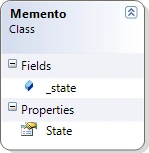
It contains the State property to hold the State of Drawing class.
Executing the Application
You can try executing the attached application. After executing draw a series of
lines in the Canvas and use the Save button to save the memento.
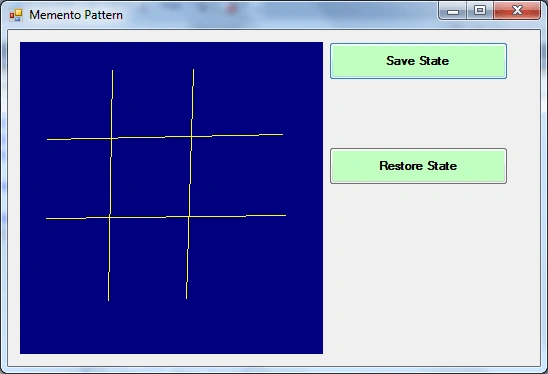
Now try to add some unwanted lines:
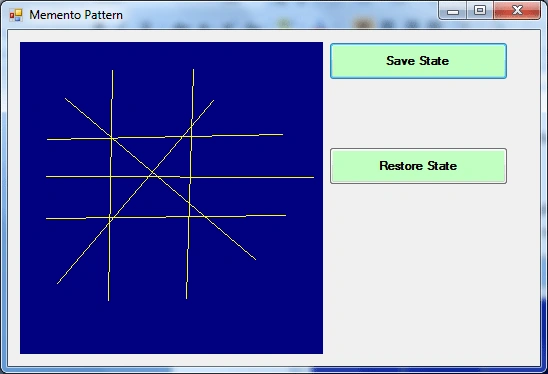
Use the Restore State to get the old valid state.
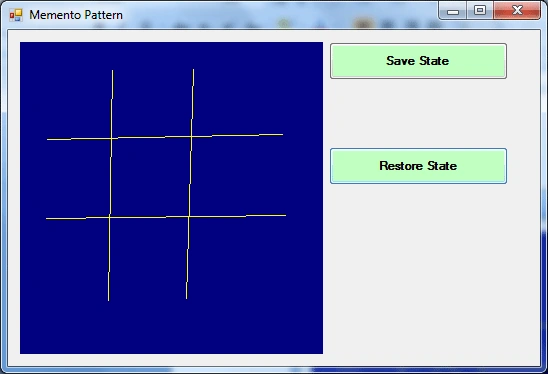
So this concludes our application implementing Memento pattern.
Comparing Command and Memento Patterns
The Command pattern also provides the Undo / Redo functionality by converting
actions to commands. The difference would be that the Command pattern stores
each action but the Memento pattern saves the state only on request.
Additionally, the Command pattern has Undo and Redo operations for each action,
but the Memento does not need that.
Depending on the scenario, Command / Memento pattern could be used.
Summary
In this article we have explore the Memento pattern. The attached source code
contains the example we discussed.
raghavendrasankaPosted Sep 7, 2012, 2:14 AM
Thanks, it really helped me in understanding this pattern.
Arjun PanwarPosted Jan 6, 2012, 11:13 PM
Thanks Jean you have very experiment ,very usefull.
Akash AhlawatPosted Jan 6, 2012, 11:11 PM
Thanks Jean for introducing us to this new topic..it will motivate us to explore new areas
Daisy KrausePosted Jan 6, 2012, 4:25 AM
You have displayed your article very nicely. Its very presentable. I have truly enjoyed it.
Rajesh KumarPosted Jan 6, 2012, 4:01 AM
Nice Representation....
Sonakshi SinghPosted Jan 5, 2012, 11:04 PM
That's true Sam...but may be the person who has given this name may have some interesting reasons for doing this... By the way Jean you did your job nicely.
Sam HobbsPosted Jan 5, 2012, 9:43 PM
Thank you, Jean Paul. I know you did not create the term Memento pattern. Perhaps the person that chose that term does not realize that a memento typically has nostalgic value. So I think the term is innaproriate for computer data. I however do not doubt the value of the Memento pattern.