

Pre-requisite to understand this
To understand MCP clearly, it helps to be familiar with:
Large Language Models (LLMs): AI models trained to understand and generate human-like text.
Client–server architecture: A system where clients request services and servers provide them over a network.
REST/RPC style APIs: Interfaces for communication where REST focuses on resources and RPC focuses on calling remote functions.
Tool calling/function calling in LLMs: Letting AI models invoke external functions or tools to perform tasks beyond text generation.
Concepts of context, prompts, and tokens: Context is conversation history, prompts are input instructions, and tokens are chunks of text the model processes.
Basic understanding of agent-based AI systems: AI systems where autonomous agents perceive, decide, and act to achieve goals.
Introduction
MCP (Model Context Protocol) is an open protocol that standardizes how AI models communicate with external tools, data sources, and services. Instead of tightly coupling AI models to specific APIs or plugins, MCP introduces a clean separation between the AI (client) and the systems that provide data or actions (servers). This allows AI systems to dynamically discover, request, and use capabilities in a consistent, secure, and scalable way.
In short, MCP turns AI models into first-class clients of real-world systems without hardcoding integrations.
What problem can we solve with MCP?
Without MCP, integrations to AI systems are often:
Custom-built
Hard to maintain
Tightly coupled to one model
Difficult to reuse across different AI providers
Problems MCP solves:
Hardcoded tool integrations per model
Vendor lock-in (OpenAI-only, Claude-only tools)
Poor scalability of AI-agent systems
Inconsistent tool schemas and calling methods
Security risks from direct system access
With MCP, we can:
Standardize AI to tool communication
Reuse tools across multiple AI models
Enable multi-agent and autonomous systems
Securely expose enterprise systems to AI
Build composable AI architectures : Designing AI systems in a way where different AI components or modules can be combined, replaced, or reused easily, much like building blocks
How to implement/use MCP?
MCP uses a client-server architecture:
MCP Client → Typically the AI application or agent
MCP Server → Exposes tools, resources, and prompts
Transport → stdio, HTTP, WebSocket, etc.
High-level implementation flow:
Build an MCP Server that exposes:
Tools (functions/actions)
Resources (files, DB records)
Prompts (templates)
Connect an AI model as an MCP Client
Let the model dynamically discover and invoke capabilities
Typical use cases:
AI accessing company databases
AI reading/writing files
AI controlling DevOps or CI pipelines
AI-powered IDEs
MCP Sequence Diagram
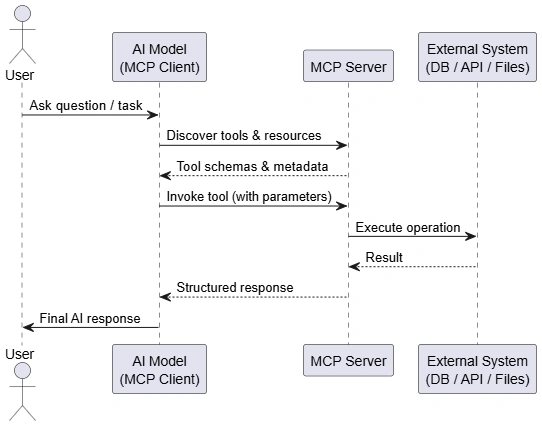
This diagram shows how MCP enables structured interaction between an AI model and external systems.
Steps:
User initiates a request
AI Model (MCP Client) interprets intent
Client discovers available tools dynamically
AI selects and invokes the appropriate tool
MCP Server executes the request safely
Result is returned in a structured format
AI uses the result to generate a final response
Why this matters:
AI never directly accesses systems
Tools are discoverable, not hardcoded
Clear separation of responsibilities
Enables autonomous reasoning + action loops
MCP Component Diagram
Component Diagram
This diagram illustrates the logical architecture of MCP in an AI system.
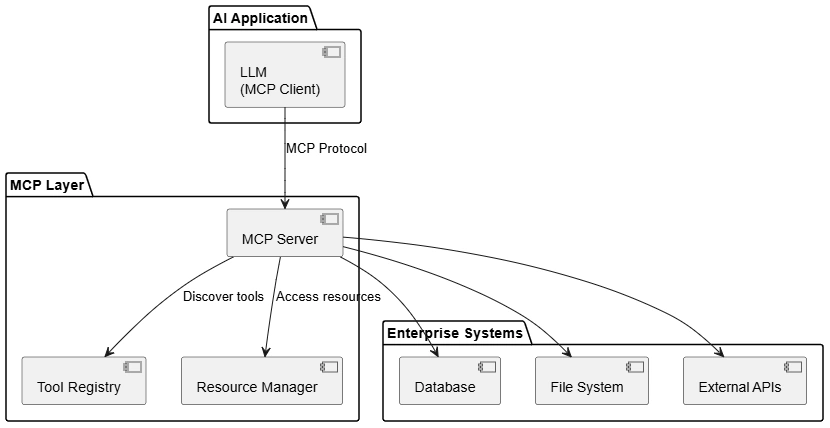
LLM (MCP Client): The AI model that sends structured requests to MCP, reads tool metadata, and generates responses based on results.
MCP Server: Acts as the central coordinator, enforcing access rules and executing requested tools safely.
Tool Registry: Maintains a catalogue of available tools, including their actions, input/output schemas, and usage contracts.
Resource Manager: Manages access to files, databases, and documents that the AI or tools may need.
Enterprise Systems: Backend systems (databases, APIs, files) that remain secure and isolated, accessed only through MCP.
Architectural benefits:
Loose coupling
Replaceable AI models
Centralized governance
Clear security boundaries
Advantages of MCP
Plug-and-play AI integrations
Model-agnostic
Secure access to sensitive systems
Reusable tools across projects
Better agent reasoning and autonomous
Scalable enterprise AI architecture
Clear schemas and contracts
Faster development
Summary
MCP (Model Context Protocol) is a foundational protocol that transforms how AI systems interact with the real world. By standardizing tool discovery, invocation, and data access, MCP removes tight coupling between AI models and external systems. This enables scalable, secure, and reusable AI architectures that support advanced use cases like autonomous agents, enterprise AI, and multi-model ecosystems. MCP is not just a tooling solution—it is an architectural shift toward AI as a first-class system client.
Join the conversation! Your thoughts help the community grow.