

This article explores the distinctions between Model Context Protocol (MCP) and Agent-to-Agent (A2A) communication paradigms, particularly within the context of multi-agent systems and distributed AI. It highlights their respective strengths, weaknesses, and suitability for different application scenarios, focusing on how they facilitate interaction, knowledge sharing, and coordination among intelligent entities.
What is Model Context Protocol (MCP)?
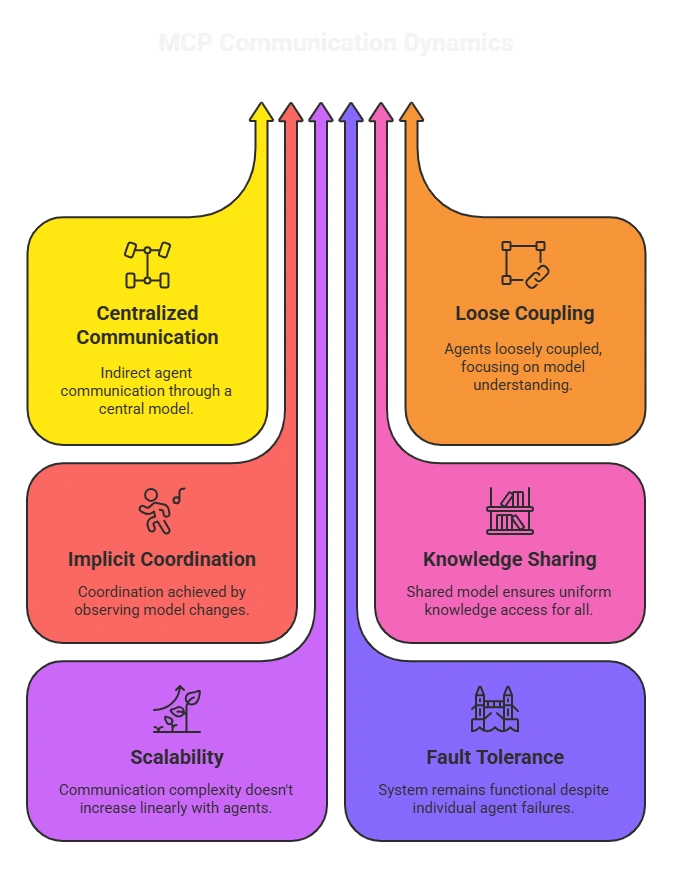
MCP represents a communication paradigm where agents primarily interact through a shared, centralized model or context. Instead of directly exchanging messages with each other, agents read from and write to this shared model.
This model acts as a central repository of information, representing the current state of the environment, the agents' beliefs, goals, and plans, or any other relevant data.
Advantages
Simplified Communication: Simplifies communication by abstracting away the complexities of direct agent interaction.
Improved Coordination: Facilitates coordination by providing a common ground for agents to understand each other's actions and intentions.
Enhanced Knowledge Sharing: Enables efficient knowledge sharing by providing a central repository of information.
Scalability: Supports large-scale multi-agent systems.
Fault Tolerance: Increases the robustness of the system.
Disadvantages
Single Point of Failure: The shared model can become a single point of failure.
Concurrency Issues: Requires mechanisms to handle concurrent access to the shared model.
Model Complexity: Designing and maintaining a complex shared model can be challenging.
Latency: Accessing the shared model can introduce latency, especially in distributed environments.
Limited Expressiveness: May not be suitable for complex interactions that require direct negotiation or argumentation.
Agent-to-Agent (A2A) Communication
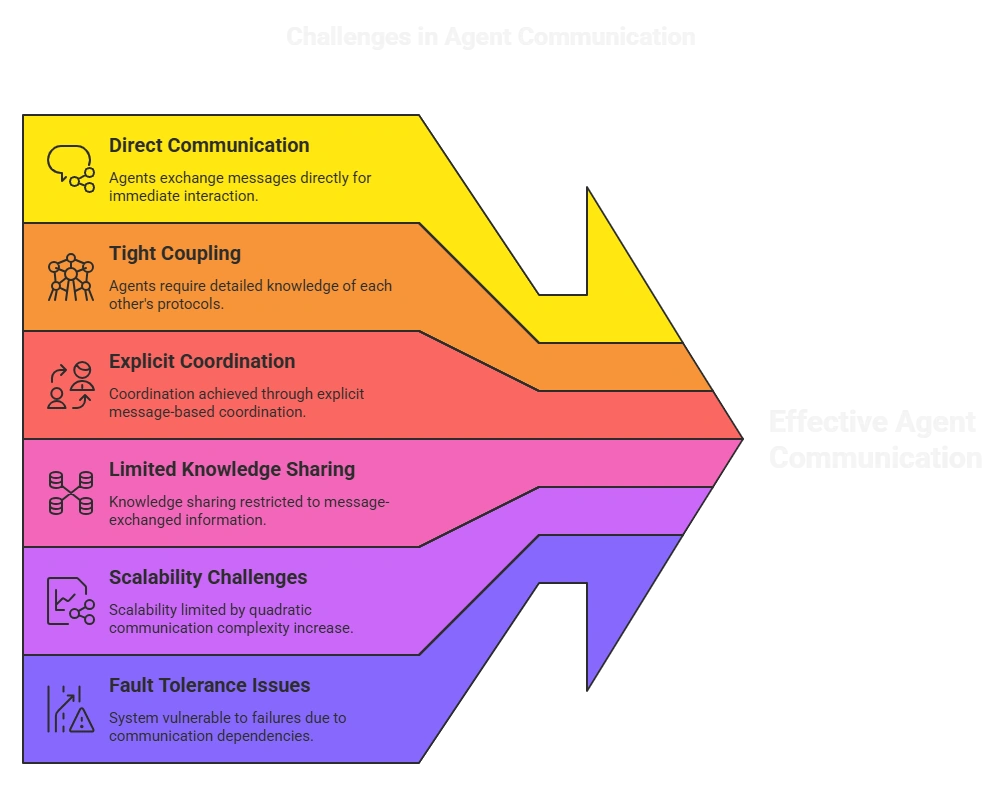
A2A communication involves direct message exchange between agents. Agents communicate by sending messages to each other, typically using a standardized communication protocol. This paradigm allows for more flexible and expressive interactions, but it also introduces complexities related to message routing, protocol negotiation, and security.
Advantages
Flexibility: Allows for flexible and expressive interactions.
Direct Negotiation: Supports direct negotiation and argumentation.
Decentralization: Promotes decentralization and autonomy.
Real-time Communication: Enables real-time communication and responsiveness.
Customization: Allows for customized communication protocols and message formats.
Disadvantages
Complexity: Introduces complexities related to message routing, protocol negotiation, and security.
Scalability Issues: Can be challenging to scale to a large number of agents.
Fault Tolerance Issues: Can be vulnerable to failures if agents are unable to communicate with each other.
Coordination Challenges: Requires sophisticated coordination mechanisms to avoid conflicts and deadlocks.
Security Risks: Introduces security risks related to message interception and tampering.
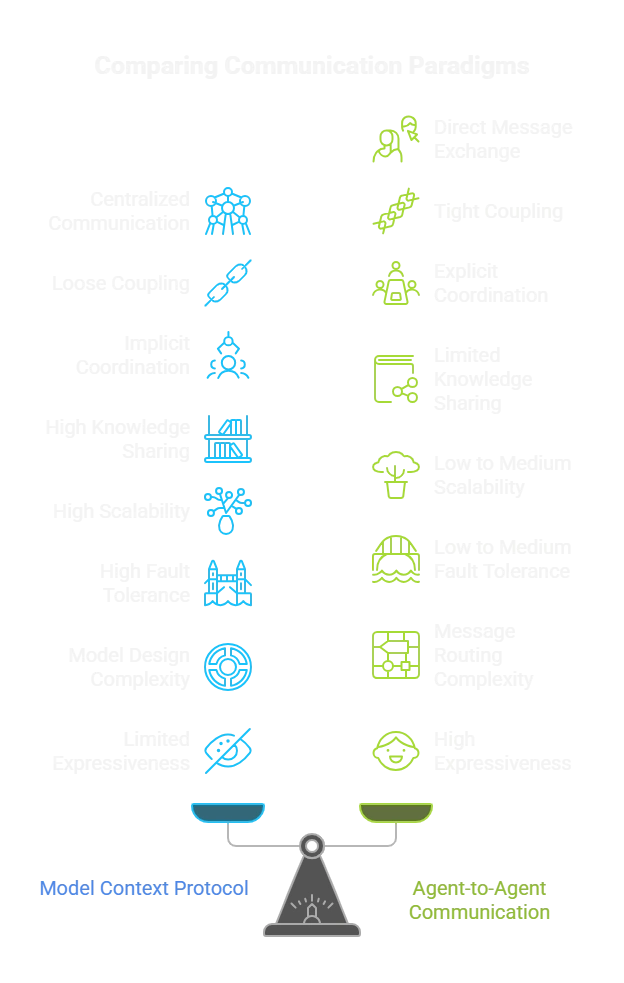
MCP vs A2A: A Comparative Analysis
Choosing the Right Paradigm
The choice between MCP and A2A depends on the specific requirements of the application.
MCP is suitable for
Applications that require high scalability and fault tolerance.
Applications where knowledge sharing is critical.
Applications where agents can coordinate implicitly through a shared understanding of the environment.
A2A is suitable for
Applications that require flexible and expressive interactions.
Applications where direct negotiation and argumentation are necessary.
Applications where decentralization and autonomy are important.
In some cases, a hybrid approach that combines the strengths of both MCP and A2A may be the most appropriate solution. For example, agents could use MCP for general knowledge sharing and coordination, while using A2A for specific negotiations or critical communications.
Summary
Both MCP and A2A offer distinct advantages and disadvantages for multi-agent communication. MCP provides a centralized, scalable, and fault-tolerant approach, while A2A offers flexibility, expressiveness, and decentralization. The optimal choice depends on the specific requirements of the application, and a hybrid approach may be the most effective in some cases. Understanding the trade-offs between these paradigms is crucial for designing effective and efficient multi-agent systems.
Join the conversation! Your thoughts help the community grow.