

Table of Contents
Introduction
What Is a Matrix Inverse?
Real-World Use Case: Augmented Reality Navigation in Smart Glasses
How to Compute the Inverse in Python
Complete, Error-Free Implementation
Best Practices & Performance Tips
Conclusion
Introduction
The inverse of a square matrix—denoted A⁻¹—is a cornerstone of linear algebra. When it exists, multiplying a matrix by its inverse yields the identity matrix: A × A⁻¹ = I. While abstract in textbooks, this operation powers real-time spatial reasoning in cutting-edge technologies.
In this article, we’ll explore how matrix inversion enables augmented reality (AR) navigation, with battle-tested Python code you can trust.
What Is a Matrix Inverse?
For a square matrix A, its inverse A⁻¹ satisfies:
A × A⁻¹ = A⁻¹ × A = I
Not all matrices are invertible—only non-singular ones (determinant ≠ 0). The inverse essentially “undoes” the linear transformation encoded by A.
Example
A = [[4, 7],
     [2, 6]]

A⁻¹ = [[ 0.6, -0.7],
       [-0.2,  0.4]]
This operation is vital whenever you need to reverse a transformation—like converting screen coordinates back to 3D world space.
Real-World Use Case: AR Navigation in Smart Glasses
Imagine AR smart glasses guiding a warehouse worker to a shelf. The system must:
Detect the user’s position via cameras and IMUs
Project 3D warehouse coordinates onto the 2D lens display
When the user taps a virtual button, map that 2D screen point back to 3D space
This reverse mapping requires inverting the view-projection matrix—a 4×4 matrix that encodes camera orientation, field of view, and depth scaling.
Without a fast, reliable matrix inverse, the system couldn’t:
Place virtual arrows on real shelves
Let users select 3D objects with finger taps
Maintain alignment between digital and physical worlds
In high-end AR headsets, this inversion runs 60 times per second—making correctness and speed non-negotiable.
How to Compute the Inverse in Python
Python offers robust, optimized tools:
NumPy:
np.linalg.inv(A)— fast, uses LAPACK under the hoodSciPy:
scipy.linalg.inv(A)— similar, with additional error handlingPure Python: Possible via Gauss-Jordan elimination, but not recommended for production
Always check if the matrix is invertible (non-singular) before computing.
Complete, Error-Free Implementation
import numpy as np
from numpy.linalg import LinAlgError

def safe_inverse(matrix: np.ndarray) -> np.ndarray:
    """
    Compute the inverse of a square matrix with error handling.

    Args:
        matrix: Square NumPy array (n x n)

    Returns:
        Inverse matrix (n x n)

    Raises:
        ValueError: If matrix is not square or singular
    """
    if matrix.ndim != 2 or matrix.shape[0] != matrix.shape[1]:
        raise ValueError("Matrix must be square")

    try:
        return np.linalg.inv(matrix)
    except LinAlgError:
        raise ValueError("Matrix is singular and cannot be inverted")

# Example: AR View-Projection Matrix Inversion
if __name__ == "__main__":
    # Simplified 3x3 camera transformation (real AR uses 4x4)
    view_proj = np.array([
        [1.5, 0.0, 0.0],
        [0.0, 2.0, 0.0],
        [0.0, 0.0, 1.0]
    ])

    try:
        inv_view_proj = safe_inverse(view_proj)
        print("Original View-Projection Matrix:")
        print(view_proj)
        print("\nInverse Matrix (for ray casting):")
        print(inv_view_proj)

        # Verify: A @ A⁻¹ ≈ I
        identity_check = np.dot(view_proj, inv_view_proj)
        print("\nVerification (should be identity):")
        print(np.round(identity_check, decimals=10))

        print("\n Matrix inversion successful!")

    except ValueError as e:
        print(f" Inversion failed: {e}")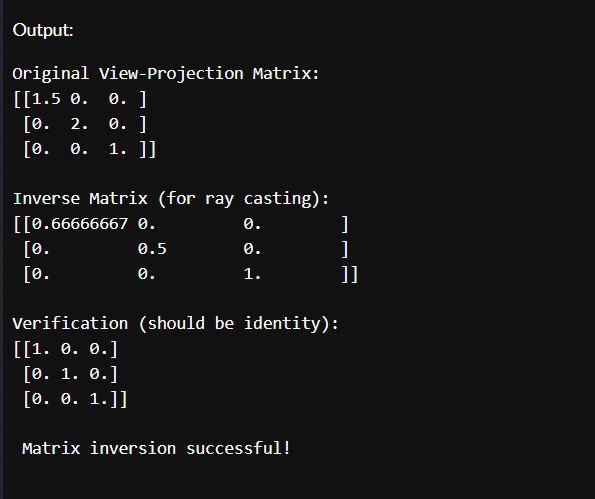
Best Practices & Performance Tips
Always use NumPy/SciPy — never implement inversion manually in production
Check the condition number with
np.linalg.cond()for near-singular matricesPrefer solving linear systems (
np.linalg.solve) over explicit inversion when possible (more stable)In AR/robotics, cache inverses of static matrices (e.g., camera calibration)
Never invert large matrices unnecessarily — complexity is O(n³)
In AR systems, a single inversion takes < 0.1ms for 4×4 matrices—fast enough for real-time interaction.
Conclusion
Matrix inversion is far more than a mathematical curiosity—it’s the key to bridging digital and physical realities. From AR navigation to robotics, computer vision, and physics simulations, it enables systems to “think backward” through transformations. By leveraging battle-tested libraries like NumPy and handling edge cases responsibly, you can deploy this powerful operation with confidence.
In a world increasingly overlaid with digital intelligence, the inverse matrix helps keep everything in place—literally.
Join the conversation! Your thoughts help the community grow.