

Load balancers are a key component that serves as the first point of contact for incoming network traffic in modern application architectures. If you are an architect, developer, or operations professional working on scalable and secure applications, this article will be particularly useful. By understanding the roles of load balancers, you can make informed decisions about how to design and implement an enterprise-grade application architecture. Let's dive deeper into the details of load balancers.
Understanding Load Balancers
Load balancers intelligently distribute incoming network traffic across multiple servers. They act as a single entry point, routing requests to available backend servers based on configured load-balancing algorithms and health checks. This ensures that your applications are highly available.
There are different types of load balancers, each with its own characteristics and use cases:
- Software Load Balancers: These are software-based solutions that run on servers or virtual machines. Examples include HAProxy, NGINX, and Apache. They are cost-effective and flexible but may have limited scalability and performance compared to hardware-based solutions.
- Hardware Load Balancers: These are dedicated appliances designed specifically for load balancing. They offer high performance, low latency, and advanced features like SSL/TLS offloading. However, they tend to be more expensive and less flexible than software solutions.
- Cloud-based Load Balancers: Major cloud providers like AWS, Azure, and Google Cloud offer managed load-balancing services. These services are highly scalable, reliable, and easy to set up, but they may have limited customization options and can be more expensive for high-traffic workloads as they are generally charged by the volume of data processed.
Load balancers can also be classified based on the Open Systems Interconnection (OSI) layer at which they operate:
- Layer 4 Load Balancers (Transport Layer): These load balancers operate at the transport layer (TCP/UDP) and distribute traffic based on attributes like source/destination IP addresses and ports. They are fast and efficient but provide limited application-level insights.
- Layer 7 Load Balancers (Application Layer): These load balancers operate at the application layer and can inspect and distribute traffic based on application-level data, such as HTTP headers, URLs, and cookies. They offer more advanced features like content-based routing but can be more resource-intensive.
Additionally, load balancers can be classified based on their load-balancing algorithms, such as:
- Round-Robin: Requests are distributed sequentially across servers.
- Least Connections: Requests are sent to the server with the fewest active connections.
- IP Hash: Requests from the same client IP are always sent to the same server for session persistence.
Here's a typical load balancer architecture:
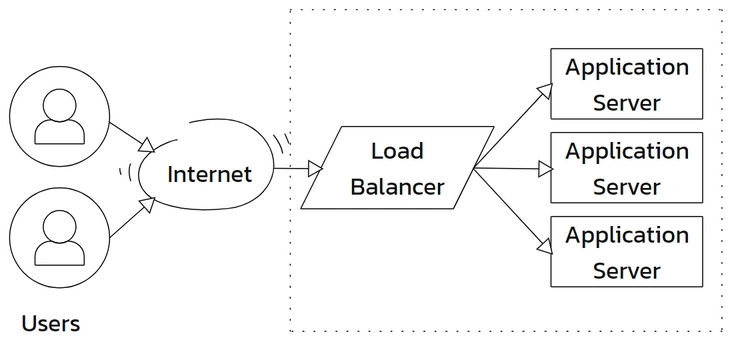
In this architecture, the load balancer acts as a single entry point for incoming traffic. It receives requests from users and distributes them across multiple backend servers based on a load-balancing algorithm, such as round-robin, least connections, or IP hash. The load balancer continuously monitors the health of the backend servers and automatically routes traffic away from unhealthy or overloaded servers, ensuring that requests are always served by available and responsive servers.
Benefits of Load Balancers
The use of load balancers in application architectures offers several advantages. Here are some key benefits that make load balancers an important architecture component:
- Distribution of traffic across multiple servers: By distributing incoming traffic across multiple servers, load balancers ensure that no single server becomes overwhelmed, improving application performance and availability.
- Improved application scalability: Load balancers allow you to easily scale your application by adding or removing backend servers as needed without disrupting the application's availability.
- Enhanced availability and redundancy: If one or more backend servers fail, the load balancer can automatically route traffic to the remaining healthy servers, providing redundancy and ensuring that your application remains available.
Use Cases for Load Balancers
Load balancers are widely used in various scenarios to distribute traffic effectively and ensure high availability. Some common use cases include:
- High-traffic distribution across multiple servers: Load balancers are essential for applications that receive a high volume of traffic, as they can distribute the load across multiple servers, preventing any single server from becoming overwhelmed.
- Load balancing for improved scalability and availability: Load balancers enable you to scale your application horizontally by adding more servers as needed, ensuring that your application can handle increasing traffic loads while maintaining high availability.
- SSL Termination: Load balancers can offload the computationally expensive task of SSL/TLS encryption and decryption from the backend servers, improving overall performance and reducing the load on the servers.
- Session persistence: Load balancers can ensure that subsequent requests from the same client are routed to the same backend server, maintaining the session state and improving user experience.
- Backend server health checks: Load balancers can periodically check the health of backend servers and automatically remove unhealthy servers from the load balancing pool, ensuring that traffic is only routed to healthy and responsive servers.
Azure Load Balancers
Azure's load-balancing services are designed to enhance application availability and performance by distributing traffic among multiple servers or services. Here are the types of load balancers available in Azure, their features, and their use cases.
Azure Load Balancer (ALB)
ALB is a Layer 4 (L4) service in the OSI model, meaning it operates at the transport layer, dealing with protocols like TCP and UDP. This makes it suitable for all types of traffic, particularly non-HTTP(S) ones. ALB is ideal for scenarios requiring high performance, ultra-low latency, and the capability to handle millions of requests per second. It's designed to ensure high availability by distributing traffic across virtual machines (VMs), both within and across availability zones, enhancing the resilience of applications against failures in any single datacenter location. It supports both regional and cross-region traffic distribution, making it versatile for various deployment topologies.
Azure Application Gateway (AAG)
Azure Application Gateway (AAG) is a Layer 7 (L7) load balancer operating at the application layer. It's optimized for HTTP(s)-based applications, offering advanced features such as SSL termination, which offloads SSL processing from the application servers, thereby improving performance. AAG is particularly useful for applications requiring session affinity, URL-based routing, and secure sockets layer (SSL) termination. It also supports the integration of a Web Application Firewall (WAF) for enhanced security.
Azure Traffic Manager (ATM)
Azure Traffic Manager (ATM) is a DNS-based load-balancing service that distributes traffic across global Azure services and external websites. It determines the most suitable endpoint for a user request based on factors such as endpoint health, geographic location, and traffic-routing methods like performance, failover, and round-robin. Although ATM is not involved in the actual data path, its DNS-based redirection mechanism is crucial for optimizing user experience by directing users to the nearest or most optimal endpoint.
Azure Front Door (AFD)
Azure Front Door combines global load balancing with site acceleration features, making it ideal for applications requiring high availability across multiple regions. It supports advanced routing, SSL offloading, and integrates seamlessly with Azure's security features like WAF. Front Door is particularly well-suited for dynamic content and applications that demand high performance and instant global scalability.
Join the conversation! Your thoughts help the community grow.