

This is third part of the 'LINQ' series articles that I have started from here. In this article, you will learn something about "Generic" collections such as what they are and why we need them in LINQ.
First of all let's understand what "Arrays" are, what ".NET Collections" are and what ".NET Generic Collections" are. You will see the following advantages and disadvantages in the examples given below.
| Collection Types | Advantages | Disadvantages |
| Arrays | Strongly Typed (Type Safe) |
|
| .NET Collections (like ArrayList, Hashtable etc) |
|
Not Strongly Typed |
| .NET Generic Collections (like List<T>, GenericList<T> etc) |
|
Now, let's discuss each of the collection types given in the above table to feel the real pain of development.
Array
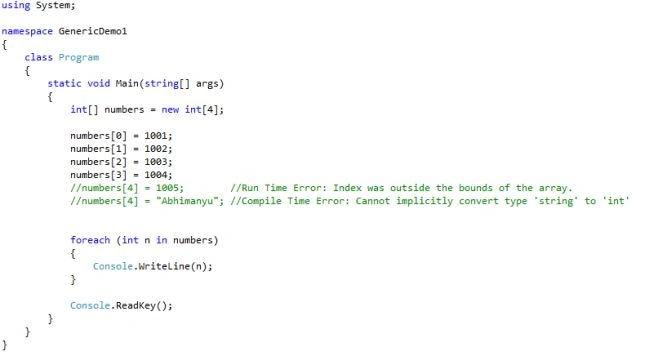
If you use array:
- You can't enter more values beyond the initialized size otherwise you will see a runtime error saying "index was outside the bounds of the array".
- If you declare an array as an int type then, you are limited to enter integer values only otherwise you will see a compile time error saying "cannot implicitly convert type string to int", all because the array is type-safe.
- Array is index based, so you always need to write index number to insert value in collection.
- You don't have add and remove methods here.
ArrayList (System.Collection)
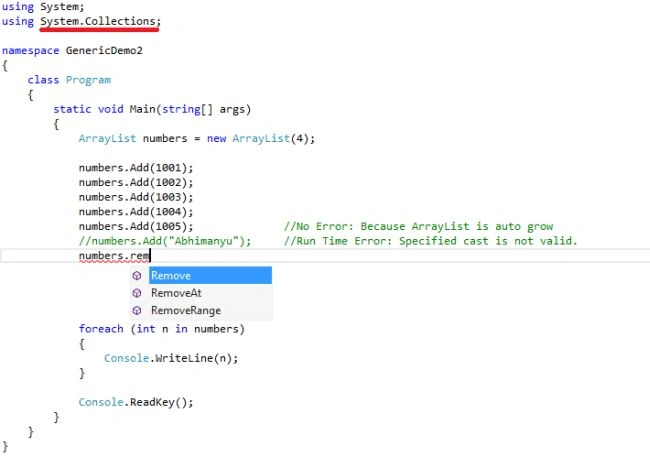
If you use ArrayList:
- You will get the auto grow feature, which means the initial size will not limit you.
- You don't have the option to declare the data type at declaration time initially, so you can add any value type like string, Boolean, int etc. Remember to care it in foreach loop at runtime.
- You will have some very useful methods like Remove, RemoveAt, RemoveRange etc. You don't however have any property like index.
List<T> (System.Collection.Generic)

Now, in short we can say, a list has both the features that we have in arrays and arraylists.
Why we need List (which is generic type) in LINQ?
LINQ queries are based on generic types, which were introduced in version 2.0 of the .NET Framework. LINQ queries return collections and we don't even know what type of data we will get from the database and that is the reason we use a generic type like List<T>, IEnumerable<T>, IQueryable<T> etc. For example:
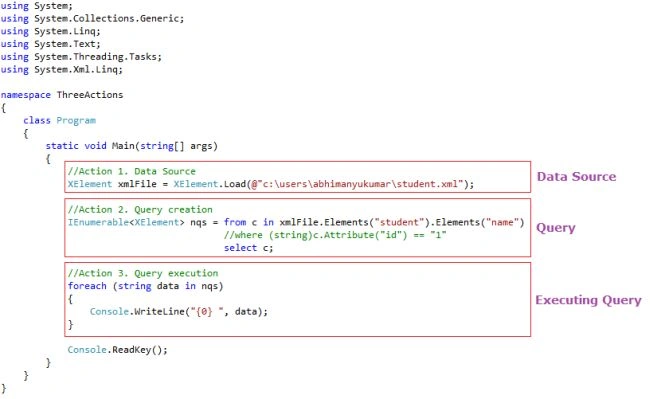
In the above example, we have used the IEnumerable<T> interface and a LINQ query and then by using a foreach loop I'm able to get my data.
One more example:
IEnumerable<Customer> customerQuery =
from cust in customers
where cust.City == "Bokaro"
select cust;
foreach (Customer customer in customerQuery)
{
Console.WriteLine(customer.LastName + " = " + customer.Age);
}
In the above example you can see, using a LINQ query I'm not only limited to select the string value that is LastName, I'm also able to select an integer value that is Age.
So, this could be the great example of generic classes.
Here is some counterpart of Generic Collections over non-generic collections:
|
Collections (System.Collection) |
Generic Collection (System.Collection.Generic) |
| ArrayList | List<T> |
| Hasgtable | Dictionary<Tkey, Tvalue> |
| Stack | Stack<T> |
| Queue | Queue<T> |
I hope you will find it useful. Thanks for reading.
Gowtham RajamanickamPosted Apr 11, 2015, 1:26 PM
good one
Gopesh SharmaPosted Sep 10, 2012, 5:34 AM
Nice article, it helps a lot...
Abhimanyu K VatsaPosted Sep 4, 2012, 12:03 AM
@Rushal: It means, restrictions on the intermixing that is permitted to occur, preventing the compiling or running of source code which uses data in what is considered to be an invalid way.
Rushal AroraPosted Sep 3, 2012, 8:29 PM
What is Strongly Typed (Type Safe) ?