

Introduction
Today, in this article let's play around with one of the interesting and most useful concepts of design patterns, which will be hosted in a web app.
Question: What is Proxy Pattern?
In simple terms "In this pattern, an interface actually points out to the specific implemented class to perform a specific operation".
I think we are now good to go to implement this wonderful concept.
Step 1: The complete code of Default.aspx looks like this:
<%@ Page Language="C#" AutoEventWireup="true" CodeBehind="Default.aspx.cs" Inherits="ProxyPatternApplication._Default" %>
<!DOCTYPE html PUBLIC "-//W3C//DTD XHTML 1.0 Transitional//EN" "http://www.w3.org/TR/xhtml1/DTD/xhtml1-transitional.dtd">
<html xmlns="http://www.w3.org/1999/xhtml">
<head id="Head1" runat="server">
<title></title>
</head>
<body>
<form id="form1" runat="server">
<div>
<h1 style="text-align: center; font-family: Verdana; font-size: large; color: Maroon">
Proxy Pattern - Design Patterns</h1>
<center>
<table>
<tr>
<td>
<asp:Label ID="Label1" runat="server" Text="Please Enter First Number" Font-Size="Small"
Font-Bold="true" Font-Italic="true" Font Names="Verdana"></asp:Label>
</td>
<td>
<asp:TextBox ID="TextBox1" runat="server"></asp:TextBox>
</td>
</tr>
<tr>
<td>
<asp:Label ID="Label2" runat="server" Text="Please Enter Second Number" Font-Size="Small"
Font-Bold="true" Font-Italic="true" Font-Names="Verdana"></asp:Label>
</td>
<td>
<asp:TextBox ID="TextBox2" runat="server"></asp:TextBox>
</td>
</tr>
<tr>
<td colspan="2">
<asp:Button ID="Button1" runat="server" Text="Addition" Width="165px" Font-Names="Verdana" BackColor="Orange" OnClick="Button1_Click" />
</td>
</tr>
<tr>
<td colspan="2">
<asp:Button ID="Button2" runat="server" Text="Subtraction" Width="165px" Font-Names="Verdana" BackColor="Orange" OnClick="Button2_Click" />
</td>
</tr>
<tr>
<td colspan="2">
<asp:Button ID="Button3" runat="server" Text="Multiplication" Width="165px" Font-Names="Verdana" BackColor="Orange" OnClick="Button3_Click" />
</td>
</tr>
<tr>
<td colspan="2"><asp:Button ID="Button4" runat="server" Text="Division" Width="165px" Font-Names="Verdana"
BackColor="Orange" OnClick="Button4_Click" />
</td>
</tr>
</table>
<table>
<tr>
<td colspan="2">
<asp:Label ID="lblResult" runat="server" Font-Names="Verdana" ForeColor="Brown"></asp:Label>
</td>
</tr>
</table>
</center>
</div>
</form>
</body>
</html>
Step 2: The complete code of IAdd.cs looks like this:
using System;
using System.Collections.Generic;
using System.Linq;
using System.Text;
namespace ProxyPatternApplication
{
public interface IAdd
{
double Add(double a, double b);
}
}
Step 3: The complete code of ISub.cs looks like this:
using System;
using System.Collections.Generic;
using System.Linq;
using System.Text;
namespace ProxyPatternApplication
{
public interface ISub
{
double Sub(double a, double b);
}
}
Step 4: The complete code of IMul.cs looks like this:
using System;
using System.Collections.Generic;
using System.Linq;
using System.Text;
namespace ProxyPatternApplication
{
public interface IMul
{
double Mul(double a, double b);
}
}
Step 5: The complete code of IDiv.cs looks like this:
using System;
using System.Collections.Generic;
using System.Linq;
using System.Text;
namespace ProxyPatternApplication
{
public interface IDiv
{
double Div(double a, double b);
}
}
Step 6: The complete code of AdditionClass.cs looks like this:
using System;
using System.Collections.Generic;
using System.Linq;
using System.Web;
namespace ProxyPatternApplication
{
public class AdditionClass : IAdd
{
public double Add(double a, double b)
{
return a + b;
}
}
}
Step 7: The complete code of SubtractionClass.cs looks like this:
using System;
using System.Collections.Generic;
using System.Linq;
using System.Web;
namespace ProxyPatternApplication
{
public class SubtractionClass : ISub
{
public double Sub(double a, double b)
{
return a - b;
}
}
}
Step 8: The complete code of MultiplicationClass.cs looks like this:
using System;
using System.Collections.Generic;
using System.Linq;
using System.Web;
namespace ProxyPatternApplication
{
public class MultiplicationClass : IMul
{
public double Mul(double a, double b)
{
return a * b;
}
}
}
Step 9: The complete code of DivisionClass.cs looks like this:
using System;
using System.Collections.Generic;
using System.Linq;
using System.Web;
namespace ProxyPatternApplication
{
public class DivisionClass : IDiv
{
public double Div(double a, double b)
{ return a / b;
}
}
}
Step 10: The complete code of Default.aspx.cs looks like this:
using System;
using System.Collections.Generic;
using System.Linq;
using System.Web;
using System.Web.UI;
using System.Web.UI.WebControls;
namespace ProxyPatternApplication
{
public partial class _Default : System.Web.UI.Page
{
protected void Page_Load(object sender, EventArgs e)
{
}
public void Button1_Click(object sender, EventArgs e)
{
if (string.IsNullOrEmpty(TextBox1.Text) || string.IsNullOrEmpty(TextBox2.Text))
{
lblResult.Text = "Please Enter Some Values";
}
else
{
lblResult.Text = "Addition Result of " + TextBox1.Text + " and " + TextBox2.Text + " is: <b>" + objAdd.Add(Convert.ToDouble(TextBox1.Text), Convert.ToDouble(TextBox2.Text)).ToString() + "</b>"; TextBox1.Text = ""; TextBox2.Text = "";
}
}
public void Button2_Click(object sender, EventArgs e)
{
if (string.IsNullOrEmpty(TextBox1.Text) || string.IsNullOrEmpty(TextBox2.Text))
{
lblResult.Text = "Please Enter Some Values";
}
else
{
lblResult.Text = "Subtraction Result of " + TextBox1.Text + " and " + TextBox2.Text + " is: <b>" + objSub.Sub(Convert.ToDouble(TextBox1.Text), Convert.ToDouble(TextBox2.Text)).ToString() + "</b>"; TextBox1.Text = ""; TextBox2.Text = "";
}
}
public void Button3_Click(object sender, EventArgs e)
{
if (string.IsNullOrEmpty(TextBox1.Text) || string.IsNullOrEmpty(TextBox2.Text))
{
lblResult.Text = "Please Enter Some Values";
}
else
{
lblResult.Text = "Multiplication Result of " + TextBox1.Text + " and " + TextBox2.Text + " is: <b>" + objMul.Mul(Convert.ToDouble(TextBox1.Text), Convert.ToDouble(TextBox2.Text)).ToString() + "</b>"; TextBox1.Text = ""; TextBox2.Text = "";
}
}
public void Button4_Click(object sender, EventArgs e)
{
if (string.IsNullOrEmpty(TextBox1.Text) || string.IsNullOrEmpty(TextBox2.Text))
{
lblResult.Text = "Please Enter Some Values";
}
else
{
lblResult.Text = "Division Result of " + TextBox1.Text + " and " + TextBox2.Text + " is: <b>" + objDiv.Div(Convert.ToDouble(TextBox1.Text), Convert.ToDouble(TextBox2.Text)).ToString() + "</b>"; TextBox1.Text = ""; TextBox2.Text = "";
}
}
#region Instance VariblesIAdd objAdd = new AdditionClass();ISub objSub = new SubtractionClass();IMul objMul = new MultiplicationClass();IDiv objDiv = new DivisionClass();#endregion
}
}
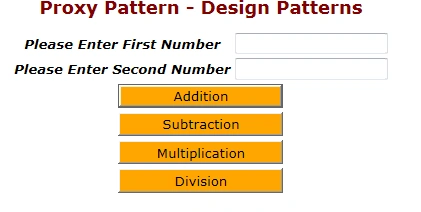
Step 11: The output of the application looks like this:
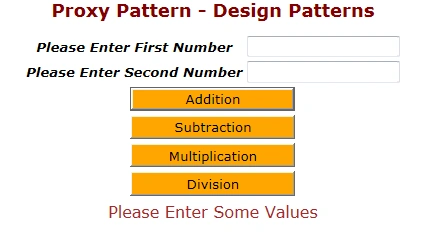
Step 12: The output of the nothing entered application looks like this:
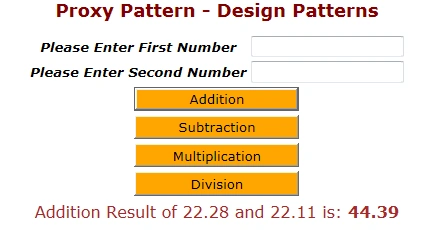
Step 13: The output of the addition operation application looks like this:
I hope this article is useful for you. I look forward to your comments and feedback.
Arjun PanwarPosted Apr 23, 2012, 12:42 AM
Hi, What is wrapper patterns in c#?
Gaurav GuptaeditedPosted Apr 23, 2012, 12:30 AMEdited Apr 23, 2012, 12:30 AM
Hi... Nice Article, It's Helps to understand design Patterns.. Thanx For Sharing.