

Pre-requisites to understand this
Containers: Lightweight units that package an application with its dependencies.
Container Runtime: Software like containerd that runs containers on a host.
Pods: The smallest deployable unit in Kubernetes, grouping one or more containers.
Cluster: A group of machines (nodes) working together to run containerized apps.
Nodes: Individual machines (VMs or physical) that run workloads.
CI/CD: Continuous Integration and Deployment pipelines for automating delivery.
DevOps: Practices combining development and operations for faster releases.
Orchestration: Automated management of container deployment, scaling, and networking.
Introduction
Kubernetes (K8s) is an open-source platform designed to automate deployment, scaling, and management of containerized applications across clusters. It provides flexibility and extensibility but requires manual setup for many features.
Red Hat OpenShift is an enterprise-ready platform built on Kubernetes that adds developer tools, security, and automation features out of the box. It simplifies operations and enhances productivity with integrated components.
Kubernetes (K8s)
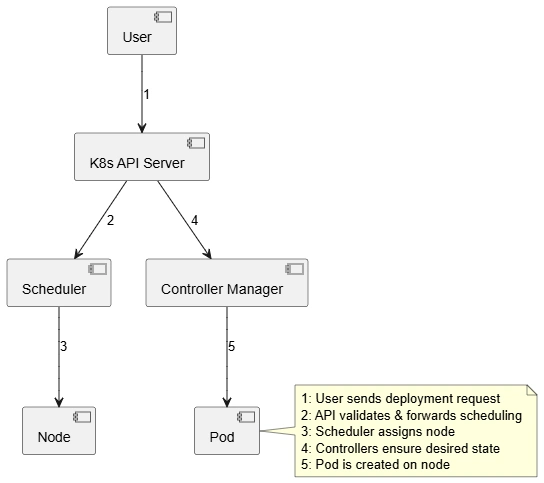
Component Diagram
Kubernetes operates as a container orchestration system that manages application workloads across a cluster of nodes. A user interacts with the API server to submit deployment requests, which are validated and processed. The scheduler determines the best node to run the workload based on resource availability. Controllers continuously monitor the cluster state to ensure it matches the desired configuration. Pods are then created and managed on nodes, encapsulating application containers. Kubernetes provides flexibility, scalability, and extensibility but requires additional tooling for CI/CD, monitoring, and security. Its modular design makes it highly customizable for different use cases.
Open-source container orchestration platform
Highly flexible and extensible architecture
Requires manual setup for CI/CD and security
Supports multi-cloud and hybrid deployments
Large ecosystem and community support
OpenShift
Component Diagram
OpenShift extends Kubernetes by providing a complete application development and deployment platform. Developers can push code directly, triggering automated builds using integrated pipelines. The platform includes a built-in image registry and deployment configurations, simplifying the application lifecycle. OpenShift enforces stricter security policies, such as running containers with non-root permissions by default. It also provides a web console and CLI tools for easier management. By integrating CI/CD, monitoring, and networking, OpenShift reduces the operational overhead compared to raw Kubernetes. This makes it ideal for enterprise environments requiring consistency, governance, and developer productivity.

Built on top of Kubernetes
Provides integrated CI/CD pipelines
Includes built-in image registry
Strong security defaults (non-root containers)
Developer-friendly web console and tools
Difference Between Kubernetes and OpenShift
| Feature | Kubernetes (K8s) | OpenShift |
|---|---|---|
| Nature | Open-source platform | Enterprise Kubernetes distribution |
| Setup | Requires manual configuration | Comes pre-integrated with tools |
| CI/CD | External tools needed | Built-in pipelines |
| Security | Configurable but manual | Strict security by default |
| User Interface | Basic dashboard | Rich web console |
| Image Registry | External setup required | Built-in registry |
| Target Users | DevOps engineers | Enterprises & developers |
| Flexibility | Highly customizable | Opinionated but easier |
Summary
Kubernetes is a powerful and flexible container orchestration platform that provides the foundation for managing containerized applications at scale. However, it requires additional setup and integration to achieve a production-ready environment. OpenShift builds on Kubernetes by adding enterprise-grade features like integrated CI/CD, enhanced security, and developer-friendly tools, making it easier to use but slightly less flexible. In essence, Kubernetes offers control and customization, while OpenShift delivers convenience and a complete platform experience.
Join the conversation! Your thoughts help the community grow.