

Retrieval-augmented generation (RAG) is an AI framework designed to enhance the quality of responses generated by large language models (LLM). It leverages external knowledge sources, typically knowledge graphs or other knowledge bases, such as Wikipedia, to augment the generation capabilities of these models. This integration enables the model to incorporate additional external information during text generation, thereby improving its accuracy and applicability while ensuring access to the latest reliable information.
The retrieval-augmented generator (RAG) was initially introduced in “REALM: Retrieval-Augmented Language Model Pretraining” by Guu et al. (2020), where they discuss the utilization of dense retrievers to enhance language model pre-training.
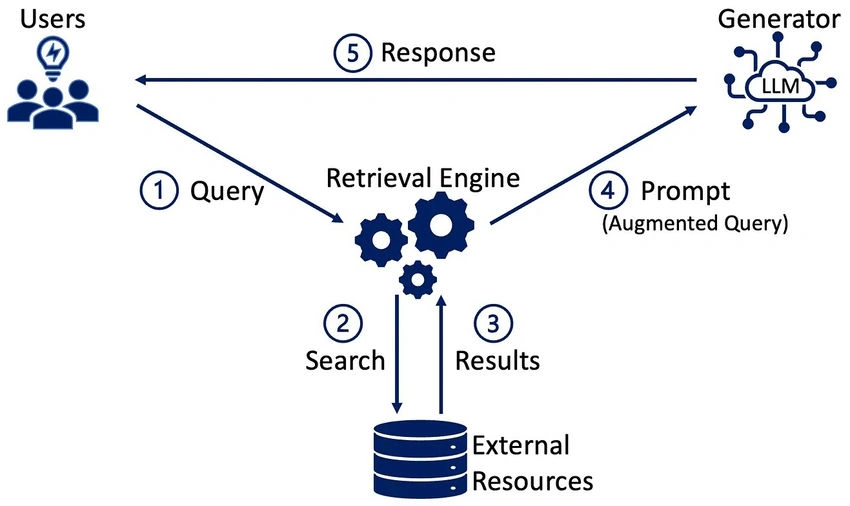
RAG can be likened to a detective and storyteller duo. Imagine you are trying to solve a complex mystery. The detective's role is to gather clues, evidence, and historical records related to the case. Once the detective has compiled this information, the storyteller designs a compelling narrative that weaves together the facts and presents a coherent story. In the context of AI, RAG operates similarly.
The Retriever Component acts as the detective, scouring databases, documents, and knowledge sources for relevant information and evidence. It compiles a comprehensive set of facts and data points.
The Generator Component assumes the role of the storyteller. Taking the collected information and transforming it into a coherent and engaging narrative, presenting a clear and detailed account of the mystery, much like a detective novel author.
RAG consists of two distinct phases: retrieval and content generation. In the retrieval phase, algorithms search for and retrieve relevant information from external knowledge bases. This information is then used in the generative phase, where the LLM synthesizes an answer based on both the augmented prompt and its internal representation of training data.
Phase 1. Retrieval
- Relevant information is retrieved from external sources based on the user's prompt or question.
- Sources vary depending on the context (open-domain internet vs. closed-domain enterprise data).
Phase 2. Content Generation
- The retrieved information is appended to the user's prompt and fed to the LLM.
- The LLM generates a personalized answer based on the augmented prompt and its internal knowledge base.
- The answer can be delivered with links to its sources for transparency.
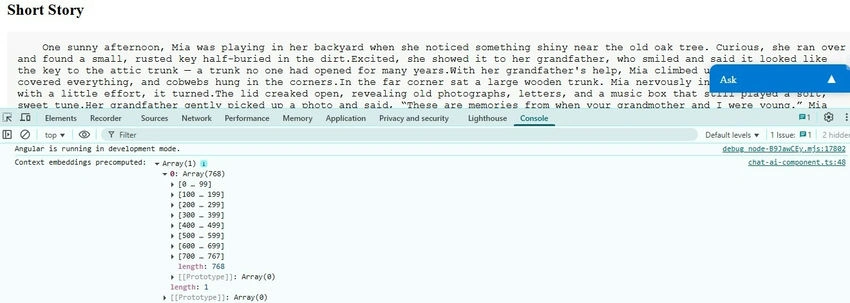
Here's another example to understand this better.
I have a short story that illustrates the scene or situation, and based on that, we can create a list of questions, similar to a comprehension exercise.

We can raise out question in chat window and RAG will revert you with favorable and most relevance answer to it.

Implementation of RAG
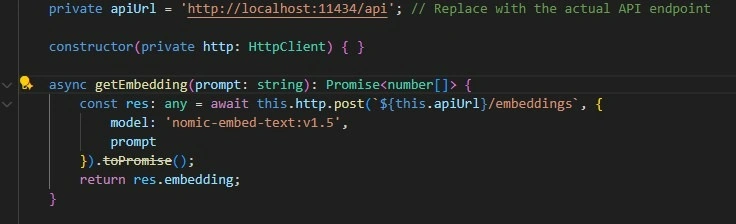
For the above scenario, we have used Ollama’s embedding and text generation LLM model and Angular for the front end.
To understand Ollama in detail, please go through the earlier article [Introduction to Ollama] for your reference.
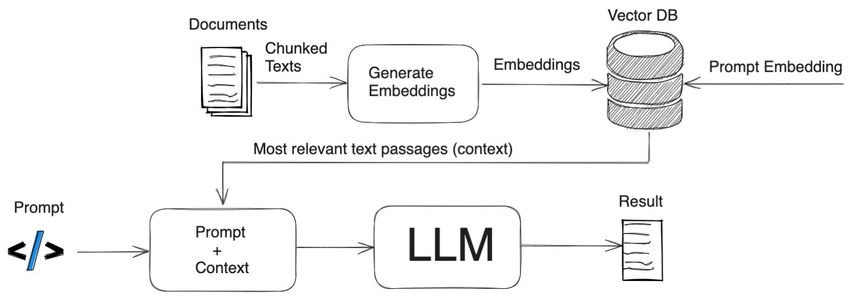
In the above scenario, we have been taking the short story as context and converting it into an embedding using OpenAI’s LLM model.
Processing the context into a vector database converts the text into numbers.
The same goes for the query or question we ask in chat, which gets converted into an embedding, too.
We will compare the two embeddings to find the best match, then send that context to various Ollama models for text generation, aiming to provide a proper output or response to your query.
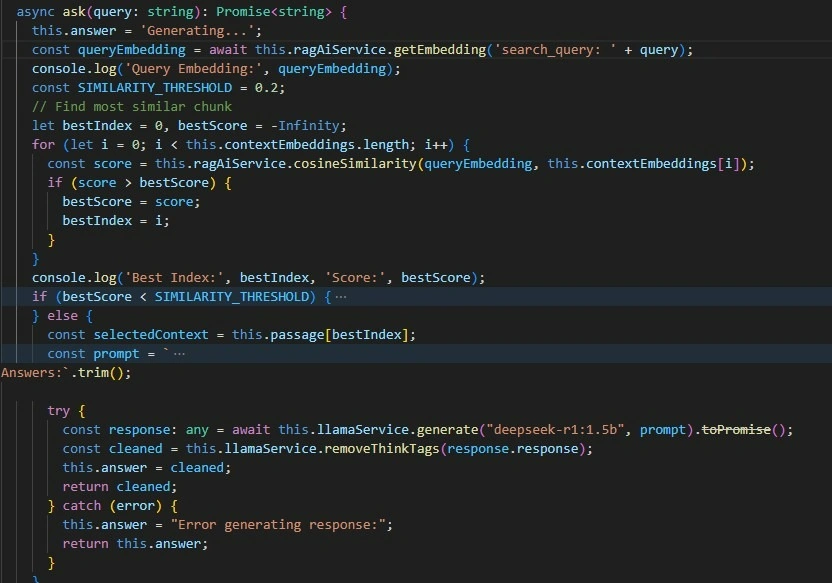
Here, we have maintained the threshold value to estimate the best score that matches the context and query embedding. Once we have figured out the relevance piece, we send it out to another Ollama’s text generation model as a prompt, which gives us the expected result.
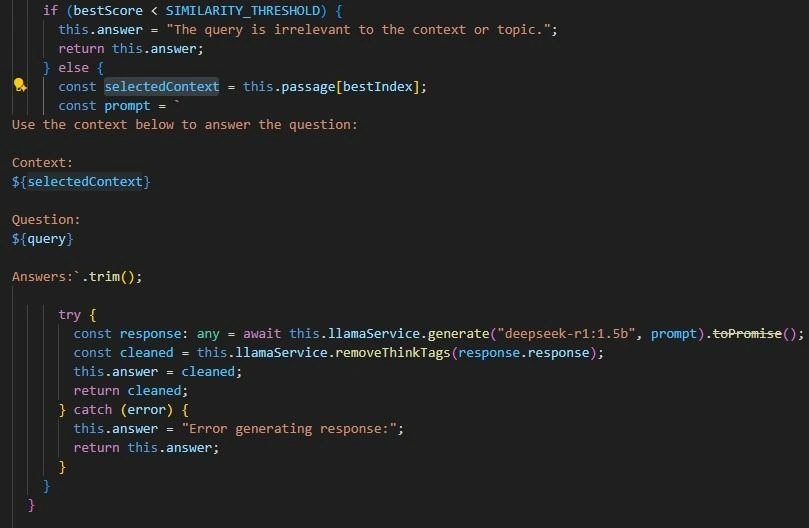
Instead of the custom hard-coded context, we can utilize data from the database or a document file to create a vector database, enabling us to find the best match for your query.
The Benefits of Retrieval-Augmented Generation
Retrieval Augmented Generation offers a range of benefits in the field of NLP and text generation.
- Improved Accuracy: RAG models provide factually accurate information by leveraging knowledge from external sources. This makes them valuable in applications where precision and reliability are paramount, such as question-answering and content generation for educational purposes.
- Contextual Relevance: RAG enhances the contextual relevance of the generated text. By incorporating external context, RAG-generated responses are more likely to align with the user's query or context, providing more meaningful and contextually appropriate answers.
- Enhanced Coherence: The integration of external context ensures that RAG-generated content maintains logical flow and coherence. This is particularly valuable when generating longer pieces of text or narratives.
- Versatility: RAG models are versatile and can adapt to a wide range of tasks and query types. They are not limited to specific domains and can provide relevant information across various subjects.
- Efficiency: RAG models can efficiently access and retrieve information from large knowledge sources, saving time compared to manual searches. This efficiency is especially valuable in applications where quick responses are essential, such as chatbots.
- Content Summarization: RAG is helpful in summarizing lengthy documents or articles by selecting the most relevant information and generating concise summaries. This aids in information digestion and simplifies content consumption.
- Customization: RAG systems can be fine-tuned and customized for specific domains or applications. This allows organizations to tailor the models to their unique needs and requirements.
- Multilingual Capabilities: RAG models can access and generate content in multiple languages, making them suitable for international applications, translation tasks, and cross-cultural communication.
- Decision Support: RAG can assist in decision-making processes by providing well-researched, fact-based information that supports informed choices in various fields, including healthcare, finance, and legal.
- Reduce Manual Effort: RAG reduces the need for manual research and information retrieval, saving human effort and resources. This is particularly valuable in scenarios where large volumes of data need to be processed.
- Innovative Applications: RAG opens doors to innovative NLP applications, including intelligent chatbots, virtual assistants, automated content generation, and more, enhancing user experiences and productivity.
Applications of RAG
RAG finds applications in various domains and industries, leveraging its ability to combine retrieval-based and generative techniques to enhance text generation and information retrieval. Here are some notable applications of RAG.
- Question Answering Systems: RAG is particularly valuable in question-answering applications. It can retrieve and generate precise and contextually relevant answers to user queries, making it suitable for virtual assistants, FAQs, and expert systems.
- Chatbots and Virtual Assistants: RAG-powered chatbots can provide more accurate and informative responses to user inquiries. They excel in natural language interactions, making them ideal for customer support, information retrieval, and conversational AI.
- Content Summarization: RAG can be employed to summarize lengthy documents, articles, or reports by selecting the most salient information and generating concise summaries. This is useful for content curation and information digestion.
- Information Retrieval: RAG can enhance traditional information retrieval systems by providing more contextually relevant and coherent results. It improves the precision and recall of search engines, making it valuable in research and knowledge management.
- Content Generation: RAG is used to generate content for various purposes, including news articles, reports, product descriptions, and more. It ensures that the generated content is factually accurate and contextually relevant.
- Educational Tools: RAG can assist in creating educational materials by generating explanations, study guides, and tutorials. It ensures that the content is informative and aligned with the educational context.
- Legal Research: In the legal domain, RAG can be applied to retrieve case law, statutes, and legal opinions. It helps lawyers and legal professionals access relevant legal information efficiently.
- Healthcare Decision Support: RAG can assist healthcare professionals in decision-making by providing up-to-date medical information, research findings, and treatment guidelines. It aids in evidence-based medicine.
- Financial Analysis: RAG models can generate financial reports, market summaries, and investment recommendations based on real-time data and financial databases, assisting analysts and investors.
- Cross-Lingual Applications: RAG's multilingual capabilities are beneficial for translation tasks, cross-cultural communication, and information retrieval in multiple languages.
- Content Moderation: RAG can assist in content moderation on online platforms by identifying and generating responses to user-generated content that violates guidelines or policies.
- Knowledge Bases and Expert Systems: RAG can be used to update and expand knowledge bases in real-time, ensuring that expert systems have access to the most current information.
- Search Engine Optimization (SEO): RAG can assist in generating SEO-friendly content by selecting relevant keywords and optimizing content for search engine rankings.
- Data Extraction: RAG can be used to extract structured information from unstructured text data, facilitating data mining and analysis tasks.
- Historical Data Analysis: RAG can help historians and researchers analyze historical texts, documents, and archives by providing contextually relevant information and generating historical narratives.
These applications highlight the versatility and utility of RAG in various fields, where the combination of retrieval and generation capabilities significantly enhances text-based tasks and information retrieval processes.
Conclusion
RAG is a promising approach for improving LLM accuracy and reliability, offering benefits like factual grounding, reduced bias, and lower maintenance costs. While challenges remain in areas like unknown recognition and retrieval optimization, ongoing research is pushing the boundaries of RAG capabilities and paving the way for more trustworthy and informative LLM applications.
Reference Site for more details: https://www.promptingguide.ai/research/rag
Join the conversation! Your thoughts help the community grow.