

Introduction
Quality Assurance (QA) testing is a crucial part of software development, ensuring that applications are robust, reliable, and free of bugs. Python, known for its simplicity and readability, offers several powerful testing frameworks that make QA testing efficient and effective. In this article, we will explore some of the most popular QA testing frameworks in Python and provide a step-by-step implementation of the pytest framework.
QA Testing Frameworks in Python
- unit test: This is the built-in testing framework in Python, inspired by JUnit. It supports test automation, sharing of setup and shutdown code for tests, aggregation of tests into collections, and independence of tests from the reporting framework.
- pytest: A popular testing framework that is easy to use and has a rich set of features. It supports simple unit tests as well as complex functional tests.
- Robot Framework: A keyword-driven testing framework that is used for acceptance testing and acceptance test-driven development (ATDD).
- Selenium: A powerful tool for automating web browsers, often used for testing web applications.
- Nose2: A successor to the nose testing framework, it extends the unit test framework with additional features and plugins.
- Testify: A lightweight testing framework that provides a simple way to write tests.
Steps of Implementation of Pytest
In this section, we will walk through a step-by-step implementation of the pytest framework. pytest is known for its simplicity and ease of use, making it a great choice for both beginners and experienced testers.
Step 1. Install pytest pytest using pip.
pip install pytest
Step 2. Create a Test File.
Create a new Python file named test_example.py.
# test_example.py

def test_addition():
    assert 1 + 1 == 2

def test_subtraction():
    assert 5 - 3 == 2
Step 3. Run the Tests.
Run the tests using the pytest command.
pytest test_example.py
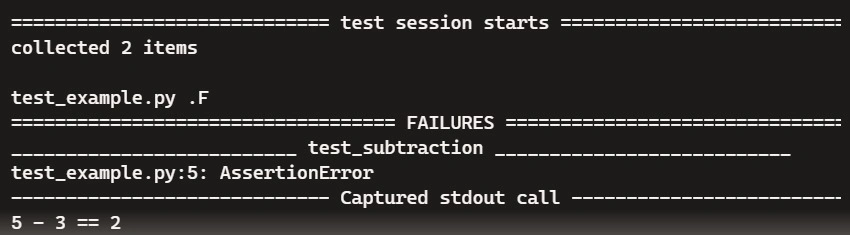
Sample Output
When you run the tests, pytest will automatically discover and execute the test functions in the file.
Explanation
- **.**: Indicates that thetest_addition` passed.
- F: Indicates that the test_subtraction failed.
- AssertionError: This shows that the assertion in test_subtraction failed because 5 - 3 does not equal 2.
Conclusion
QA testing frameworks in Python, such as unit test, pytest, and Robot Framework, provide robust tools for ensuring the quality of your software. By following the step-by-step implementation of pytest, you can start automating your tests and improve the reliability of your applications.
Join the conversation! Your thoughts help the community grow.