

AI governance is essential to ensuring that artificial intelligence systems are deployed responsibly and ethically, and in compliance with evolving regulations. Organizations can build governance frameworks through structured policies, risk management practices, and cross-functional oversight that balance innovation with accountability.
What is AI Governance?
AI governance refers to the frameworks, policies, and practices that guide the responsible development, deployment, and monitoring of AI systems. It ensures that AI aligns with organizational values, legal requirements, and societal expectations.
Why AI Governance matters?
AI governance is not just a compliance exercise—it is a strategic necessity for organizations adopting AI.
Trust and Reputation: Transparent governance builds stakeholder confidence and public trust.
Risk Mitigation: Prevents bias, discrimination, and unintended consequences in critical areas like healthcare, finance, and hiring.
Legal Compliance: Avoids severe penalties under regulations such as the EU AI Act, which can impose fines up to €35 million or 7% of global turnover.
Business Value: Responsible AI adoption enables scalability, innovation, and competitive advantage.
Societal Impact: Ensures AI systems contribute positively to society, respecting human rights and ethical norms.
Without governance, organizations risk legal exposure, reputational damage, and erosion of public trust—all of which can outweigh the benefits of AI adoption.
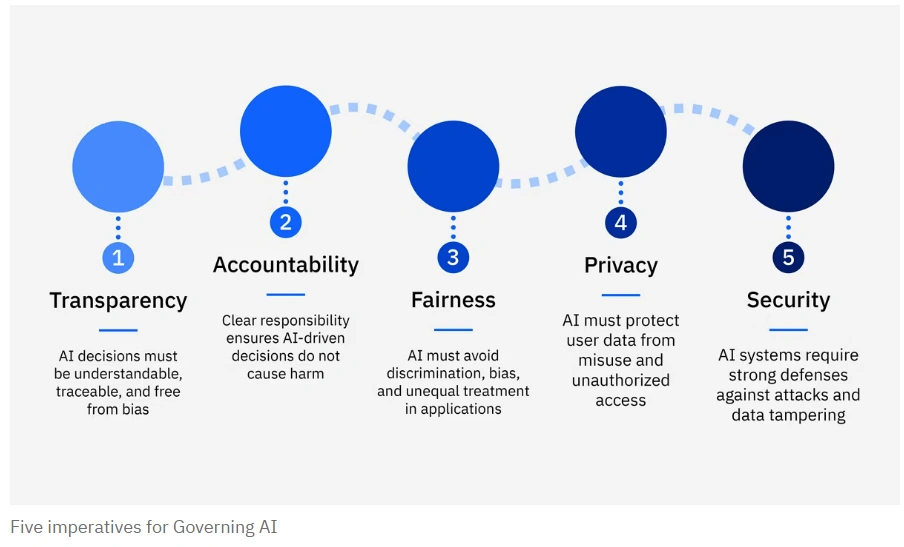
Implementing AI governance: Step-by-Step guide
Effective AI governance begins with a well-structured implementation strategy one that aligns business leaders, technical teams, compliance groups, and executive decision-makers.
Step 1: Establishing the purpose and scope of AI Governance.
This is the first step and lays the groundwork for a strong AI governance program by defining purpose, priorities, and success metrics. Before policies or controls can be deployed, the organization must first define why AI governance is needed and what it aims to achieve. This foundational step aligns governance with business goals, manages risk, and creates a measurable base for all future controls and policies.
Step 2: Design the Governance framework.
This step is about people, roles, and authority. Once AI governance goals are defined, the next step is to put a clear operating framework in place. This includes defining the governance domains your policies must cover and assigning clear ownership to remove ambiguity and support decisions across the AI lifecycle. This provides end-to-end oversight across AI development, deployment, and operations.
Key roles include
AI Ethics Board: - Oversees high-risk AI for fairness, transparency, and regulatory alignment.
AI Risk Officers:- Classify risk, validate models, and monitor performance and incidents.
Model Owners: - Own the full model lifecycle, from build to production.
Business Unit Leads: - Own business value and accept business risk.
MLOps and Engineering: - Run secure pipelines, monitoring, and rollback controls.
Clear reporting lines define escalation and decision authority, ensuring accountability throughout the AI lifecycle.
Step 3: Create AI policies and standards.
This step converts governance intent into enforceable guidance, giving teams clear direction on:
What is permitted and prohibited in AI development and use.
How AI systems must be designed, tested, deployed, and monitored
The baseline requirements for ethics, mitigate risk, privacy, security, and accountability.
At its core, this step defines what must be done and how it is enforced. Policies set what and why establishing expectations for ethical, fair, and secure AI. Standards define the how specifying required controls such as bias testing, model validation, monitoring and audit logging. Together, they make AI governance practical, consistent, and enforceable.
Step 4: Create a Central AI System and Data Register.
This step creates visibility across all AI initiatives by identifying every AI system in use, no matter how it entered the organization. A centralized AI inventory removes blind spots, exposes use of shadow use of AI, supports risk mitigation, regulatory compliance and establishes clear ownership . With full visibility in place, teams can assess risk, help meet regulatory requirements, and make faster, better-informed decisions laying the groundwork for secure, scalable, and responsible use of AI.
Step 5: Create risk management framework.
Once AI systems are visible, the next step is to understand the risks they introduce. Not every AI system needs the same level of review. A risk taxonomy helps focus attention on what matters most. This makes it easier to spot high-risk AI and use governance effort wisely.
Each AI system is assessed based on:
The sensitivity of the data it uses.
To what extent its AI outcomes influence people and business decisions for various AI applications.
The risk of bias in training data, errors, or unfair outcomes.
Based on this evaluation, models are grouped into risk levels:
High Risk: Decisions that can seriously affect health, finances, or legal rights.
Medium Risk: Decisions that affect customer experience or business processes.
Low Risk: Internal or low-impact models.
The outcome is a comprehensive Risk Register, which enumerates all AI systems, their assigned risk level, and mandated controls. This helps teams apply stronger controls to high-risk AI and simpler checks to systems with lower risk.
Step 6: Integrate AI governance into AI development.
At this stage, AI governance framework becomes operational. Policies move from concept into practice. Risks and controls are built directly into engineering workflows. Design reviews and risk documentation are mandatory from the start. Training and testing include automated checks for bias, explainability, and performance. Deployment is controlled through gated approvals in CI/CD pipelines. Model updates follow clear change-management steps. Reassessment and reapproval are required before release. Continuous monitoring tracks drift, bias, and incidents in real time.
Step 7: Real‑time monitoring and accountability.
AI models are not static. Their behavior changes as data, context, and usage evolve.
This step establishes continuous oversight to catch issues early and respond fast. Monitoring tracks performance, drift, fairness, bias, hallucinations, toxicity, and misuse signals. Security patterns are observed alongside model behavior. Regular internal and regulatory audits verify compliance with policies, standards, and legal requirements. Clear incident reporting and rollback processes enable rapid detection, escalation, and correction without disrupting the business. The outputs are practical and auditable: monitoring dashboards, audit trails, and incident logs. Together, these controls maintain compliance, protect trust, and keep AI systems reliable across their lifecycle.
Step 8: Review, Improve, and Scale AI Governance.
This step ensures AI governance does not stand still. It focuses on improvement, scale, and long-term effectiveness.
It ensures:
Governance processes are reviewed on a regular basis.
Outdated controls are removed. Gaps are closed.
Findings from audits, monitoring, and incidents are used to strengthen risk reviews and approval flows.
Guardrails evolve as real-world usage evolves.
Policies are refreshed to reflect new models, new regulations, and shifting business goals.
Established standards are applied consistently across new teams, products, and MLOps pipelines.
Ongoing training builds shared understanding and accountability.
Metrics and dashboards provide visibility into compliance and response quality.
The outcome is adaptive governance designed to scale, respond, and mature alongside the AI ecosystem.
Strong AI governance turns principles into technical enforcement and algorithmic accountability. Ethical AI sits at the core, with ethical considerations embedded through governance structures and enforced through practices aligned to ethical guidelines and ethical standards. This ensures human oversight and explainability, builds trust, and reduces non-compliance.
Through clear AI governance policies, responsible AI practices are applied consistently across AI tools. Aligned with the NIST AI Risk Management Framework, governance enables continuous monitoring and regular audits as AI-driven systems, machine learning models, and generative AI evolve.
Join the conversation! Your thoughts help the community grow.