

Table of Contents
Introduction
What Is the Range—and Why It Matters in Banking
Core Methods to Compute the Range in Python
Real-World Scenario: Monitoring Daily Transaction Volatility
Time and Space Complexity
Complete, Production-Ready Implementation
Best Practices & Quick Wins
Conclusion
Introduction
In banking, risk hides in extremes—and the range of a dataset reveals them instantly. The range is simply the difference between the highest and lowest values, but in financial systems, it’s a frontline indicator of volatility, fraud, or system anomalies. This guide shows you how to compute the range safely and efficiently in Python, using a real-world banking scenario where milliseconds and accuracy both count.
What Is the Range—and Why It Matters in Banking
The range = max(array) - min(array).
While simple, it answers critical questions:
How volatile were today’s transactions?
Did a customer suddenly deposit $100 and then $50,000?
Is a merchant processing abnormally large or small payments?
Unlike averages, the range exposes outliers—making it essential for real-time risk dashboards and fraud alerts.
Core Methods to Compute the Range in Python
1. Manual Min/Max (Clear and Efficient)
def get_range(arr):
    if not arr:
        return 0.0
    return max(arr) - min(arr)
Simple, readable, and O(n)—Python’s min() and max() each scan once, but you can do better.
2. Single-Pass Scan (Optimal for Large Data)
def get_range_optimized(arr):
    if not arr:
        return 0.0
    min_val = max_val = arr[0]
    for val in arr[1:]:
        if val < min_val:
            min_val = val
        elif val > max_val:
            max_val = val
    return max_val - min_val
One pass only—ideal for high-frequency transaction streams.
In practice, for most banking use cases (<10k items), the built-in
min/maxapproach is fast enough and more readable.
Real-World Scenario: Monitoring Daily Transaction Volatility
Problem:
Your bank’s risk engine receives a list of a customer’s daily transaction amounts. If the range exceeds $10,000, trigger a volatility alert for manual review.
Example:
Transactions = [45.99, 120.50, 500.00, 12500.00] → Range = $12,454.01 → ALERT!
Requirements:
Handle empty or single-transaction days gracefully
Return
0.0for no activity (not an error)Work with both integers and floats
Be fast enough for real-time processing
Time and Space Complexity
Time: O(n) — you must inspect every value to find min and max.
Space: O(1) — only two variables needed (
min_val,max_val).The single-pass method is theoretically optimal, but for clarity, the two-pass (
min/max) version is often preferred in production unless performance is critical.
Complete, Production-Ready Implementation
from typing import List, Union

def transaction_range(amounts: List[Union[int, float]]) -> float:
    """
    Compute the range (max - min) of transaction amounts for risk monitoring.

    Args:
        amounts: List of transaction amounts (e.g., [100.0, 50.5, 2000.0])

    Returns:
        float: Range of values. Returns 0.0 if list is empty or has one element.

    Example:
        transaction_range([10, 50, 5]) → 45.0
        transaction_range([]) → 0.0
    """
    if not amounts:
        return 0.0
    if len(amounts) == 1:
        return 0.0

    return float(max(amounts) - min(amounts))


# Example: Daily risk monitoring
if __name__ == "__main__":
    normal_day = [25.99, 45.50, 89.00, 120.00]
    volatile_day = [10.00, 15000.00]
    inactive_day = []

    print(f"Normal day range: ${transaction_range(normal_day):,.2f}")
    print(f"Volatile day range: ${transaction_range(volatile_day):,.2f}")
    print(f"Inactive day range: ${transaction_range(inactive_day):,.2f}")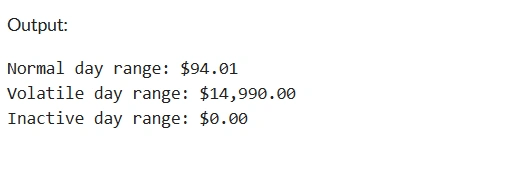
Best Practices
Return
0.0for empty or single-element lists—no need to raise errors for normal banking states.Use built-in
min()andmax()unless profiling shows a bottleneck.Convert result to
floatfor consistent return type.Don’t sort the array just to get min/max—it’s
O(n log n)and wasteful.Never log raw transaction lists—only report the computed range.
Conclusion
The range is the simplest yet most revealing metric in risk monitoring. In banking, a sudden spike from $10 to $10,000 isn’t noise—it’s a signal. By using a clean, robust function like transaction_range, your risk systems gain:
Instant volatility detection
Resilience to edge cases
Real-time performance
When every dollar counts, the range ensures you’re watching the full picture—from the smallest coffee purchase to the largest wire transfer.
Join the conversation! Your thoughts help the community grow.