

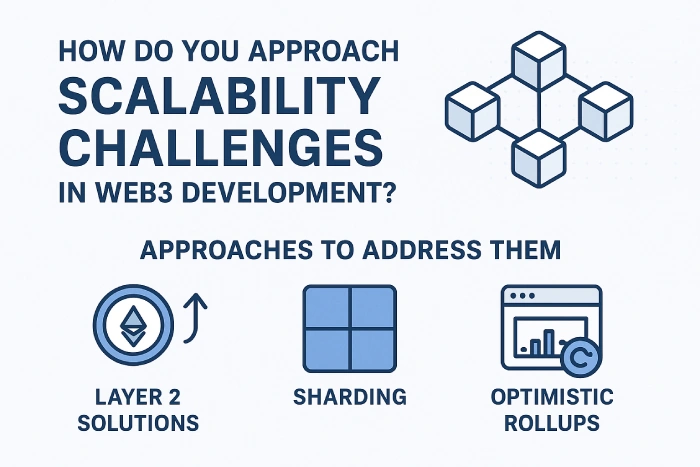
Scalability is one of the most pressing issues in Web3 development. While blockchain technology has revolutionized how we think about trust, ownership, and decentralization, its growth potential is often limited by transaction throughput, latency, and resource efficiency. For developers, the challenge is not only about building decentralized applications (dApps) that work but also about ensuring they scale to meet real-world adoption.
Let’s explore how scalability challenges manifest in Web3 and the approaches developers can take to address them.
1. Understanding Scalability in Web3
Scalability in Web3 refers to a blockchain network’s ability to handle increased usage—measured in transactions per second (TPS), data storage, and user interactions—without compromising performance, decentralization, or security.
Traditional blockchains like Bitcoin and Ethereum face the so-called “Blockchain Trilemma”: balancing decentralization, security, and scalability. Improving one often creates trade-offs with the others.
2. The Scalability Challenges Developers Face
When building Web3 applications, common bottlenecks include:
- Low Transaction Throughput: Ethereum handles ~15–30 TPS compared to Visa’s 65,000 TPS capability.
- High Gas Fees: Network congestion drives up transaction costs, making dApps impractical for mass users.
- Latency: Confirmations can take seconds to minutes, affecting user experience.
- Storage & State Growth: As more data is added, full nodes must store massive ledgers, leading to centralization risks.
- Interoperability: dApps often need cross-chain communication, which adds complexity.
3. Strategies to Tackle Scalability in Web3 Development
(A) Layer-1 Improvements (Base Protocol Optimizations)
- Sharding: Splits the blockchain into smaller partitions ("shards") that process transactions in parallel. Ethereum 2.0 plans to adopt this.
- Consensus Mechanisms: Moving from Proof of Work (PoW) to Proof of Stake (PoS) improves energy efficiency and scalability.
- Protocol-level Upgrades: Examples include Ethereum’s EIP-1559 (fee mechanism) and danksharding (future data scaling).
(B) Layer-2 Solutions (Offloading Workloads)
- State Channels: Two parties conduct transactions off-chain and only submit the final state to the blockchain (e.g., Lightning Network, Raiden).
- Rollups: Bundle multiple transactions into one, posting compressed data on-chain.
- Optimistic Rollups: Assume transactions are valid unless challenged.
- Zero-Knowledge Rollups (ZK-Rollups): Use cryptographic proofs to verify off-chain transactions.
- Sidechains: Independent blockchains connected to the main chain (e.g., Polygon).
(C) Off-Chain Storage & Computation
- Decentralized Storage: Use systems like IPFS, Filecoin, or Arweave to store large files, keeping blockchain for critical data.
- Hybrid Computation Models: Offload heavy computation to decentralized networks (e.g., Chainlink Functions) and keep only proofs on-chain.
(D) Cross-Chain & Interoperability Solutions
- Bridges: Enable asset and data transfer between blockchains (though vulnerable if poorly designed).
- Interoperability Protocols: Projects like Polkadot, Cosmos, and Chainlink CCIP focus on enabling multi-chain ecosystems.
(E) Application-Level Optimizations
- Efficient Smart Contracts: Write gas-optimized code (e.g., reduce storage use, avoid unnecessary loops).
- Transaction Batching: Bundle multiple interactions into fewer transactions.
- Caching & Indexing: Use tools like The Graph to query blockchain data efficiently.
4. Balancing Scalability with Security and Decentralization
A scalable solution is only viable if it doesn’t compromise the network’s trust model. Developers must evaluate trade-offs:
- Too much reliance on sidechains: weaker security guarantees.
- Over-centralized validators: scalability improves, but decentralization suffers.
- Complex rollup solutions: faster throughput but harder for new developers to adopt.
A thoughtful approach involves layered scaling: improving Layer-1 efficiency while leveraging Layer-2 and off-chain solutions for high-volume use cases.
5. Developer Mindset for Scalable Web3 dApps
When approaching scalability challenges, developers should:
- Identify the bottleneck: Is it transaction throughput, storage, or gas cost?
- Choose the right scaling layer: Base protocol upgrade, L2, or off-chain.
- Design modularly: Build dApps that can migrate to future scaling solutions.
- Test under load: Use stress tests to simulate real-world traffic.
- Stay updated: The scaling ecosystem evolves rapidly; rollup tech today may look different in a year.
6. Real-World Examples of Scalable Web3 Solutions
- Ethereum + Rollups (Arbitrum, Optimism, zkSync): Scaling Ethereum’s congested base layer.
- Polygon: A sidechain that offloads transactions from Ethereum.
- Solana: High-throughput Layer-1 focused on parallel transaction execution.
- Polkadot & Cosmos: Multi-chain networks designed for interoperability and scaling.
Conclusion
Scalability in Web3 is not a single problem with a single solution—it’s a layered challenge. Developers must approach it holistically: optimizing smart contracts, leveraging Layer-2 solutions, exploring cross-chain interoperability, and staying mindful of the blockchain trilemma.
Join the conversation! Your thoughts help the community grow.