

Introduction
Data access is one of the most critical aspects of any application. The speed and efficiency of data retrieval can affect the user experience, the scalability, and the cost of running an application. In this article, we will explore how caching can improve data access performance by reducing the need to query the main database.
What is Caching?
Caching is a technique that involves storing frequently accessed or recently accessed data in a temporary storage area called a cache. A cache is usually located closer to the client (which can be a smartphone, computer, or other device) than the main database, and it can store data in memory or on disk. The main purpose of caching is to reduce the latency and the load on the database by serving data from the cache whenever possible.
How Caching Works?
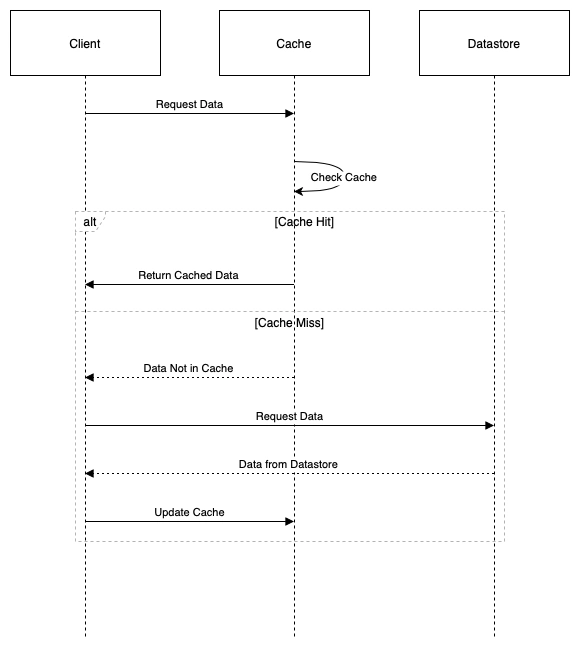
The basic workflow of caching is as follows.
- Client Request: When a client makes a request for data, the first step is to check the cache.
-
Look in Cache
-
Cache Hit: If the data the client is requesting is already stored in the cache, it's a "cache hit". The data is then immediately returned to the client without querying the main SQL database. This results in faster response times and lower resource consumption.
-
Cache Miss: If the data is not in the cache, it's a "cache miss". In this case, the system will then proceed to look for the data in the persistent datastore (e.g., SQL Database).
-
-
Look in Persistent Datastore: If the requested data is not in the cache, the system queries the main SQL Database. This process usually takes longer than retrieving from the cache because databases are designed for durability and storage rather than speed. However, databases can handle complex queries and large amounts of data that may not fit in the cache.
- Prime Cache with Data: After retrieving data from the SQL Database due to a cache miss, the system usually "primes" or updates the cache with this data. This ensures that if the same data is requested in the near future, it can be directly fetched from the cache, leading to faster response times.
The following diagram illustrates this workflow:
Benefits of Caching
Caching can provide several benefits for data access performance, such as:
- Reduced Latency: Caching can reduce the time it takes to access data by serving it from a nearby location rather than querying a remote database. This can improve the user experience and satisfaction by providing faster responses.
- Reduced Load: Caching can reduce the load on the database by decreasing the number of queries and transactions. This can improve the scalability and availability of the database by preventing bottlenecks and failures.
- Reduced Cost: Caching can reduce the cost of running an application by saving resources and bandwidth. This can lower operational expenses and increase the profitability of an application.
Challenges of Caching
Caching can also pose some challenges to data access performance.
- Cache Invalidation: Caching involves storing a copy of data that may change over time. Therefore, it is important to ensure that the cache is updated or invalidated whenever there is a change in the original data source. Otherwise, the cache may serve stale or outdated data that may cause errors or inconsistencies.
- Cache Size: Caching involves allocating a limited amount of space for storing data. Therefore, it is important to choose an appropriate cache size that can balance between performance and storage. Otherwise, the cache may become full or overflow, which may cause evictions or replacements of existing data.
- Cache Policy: Caching involves choosing a policy or algorithm that determines which data to store and which data to evict from the cache. Therefore, it is important to choose an optimal cache policy that can maximize the hit rate and minimize the miss rate. Otherwise, the cache may store irrelevant or infrequent data that may waste space or reduce performance.
Conclusion
In this article, I have explained how caching works and what are its benefits and challenges. Caching is a powerful technique that can improve data access performance by reducing the need to query the main SQL database. However, caching also requires careful design and implementation to overcome its challenges and achieve its benefits.
Thank you for reading!
Join the conversation! Your thoughts help the community grow.