

Schrödinger's AI is your invitation to look inside. Right now, AI feels like a mystery , wired like a brain, yet running on pure math.
Each article is a new layer of the box. We start with the first spark of an idea and move all the way to the models reshaping everything we thought we knew .Train Once, Use Everywhere
Part 6: Foundation Models: Everything, Everywhere, All at Once!
Old-school AI models were like one-trick ponies, you’d train one just to spot cats, another to translate French, another to detect spam. Boring.
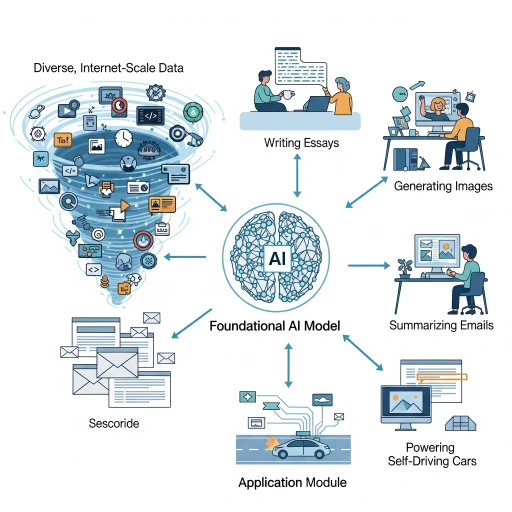
A foundation model (FM): Something that you train it once on insane amounts of data, text, images, maybe even video, so it learns the general patterns of the world. After that, you don’t start from scratch every time. You just tweak it, prompt it, or fine-tune it, and suddenly it’s writing essays, generating images, summarizing emails, running chatbots, or even powering self-driving cars.
Generative AI runs on foundation models. Instead of grinding through labeled data and building a separate model for each task, you build one powerhouse FM and flex it across endless use cases.
Few examples
GPT (OpenAI) – A text-based foundational model, used for chatbots, writing, and reasoning.
CLIP (OpenAI) – Connects text and images, powering tasks like text-to-image search.
LLaMA (Meta), PaLM (Google), Gemini (Google), Claude (Anthropic) – Other well-known foundational models.
The Anatomy
1. Transformer Architecture
Almost every modern foundation model is transformer-based. So, what’s a transformer? If you have time, read the original paper “Attention is All You Need” by Vaswani et al., 2017. But here’s the short version:
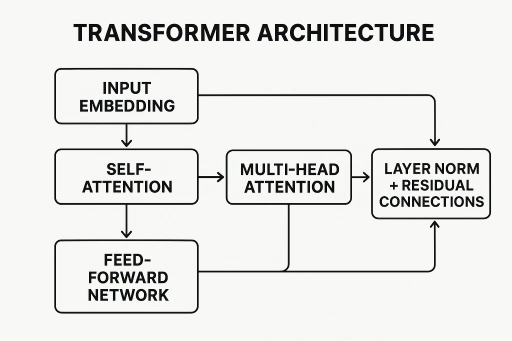
Input Embedding: Words get turned into numbers (vectors) that capture meaning. Positional encoding gets added so the model knows the word order, transformers don’t read left-to-right like humans.
Self-Attention: Each word checks out the other words in the sentence to get context. Example: in “The cat sat on the mat,” “sat” pays attention to “cat” to know who’s sitting. Weighted scores decide which words matter most.
Multi-Head Attention: Instead of one perspective, the model uses multiple “attention heads” to see different relationships at once like looking at a sentence through multiple lenses.
Feed-Forward Network: Each word’s vector gets passed through a mini neural net to tweak and refine its meaning.
Layer Norm + Residual Connections: Keep things stable and prevent the signal from vanishing, basically, make training deep models smooth and reliable.
2. Pretraining
Pretraining is where the foundation model eats insane amounts of data, text, images, maybe even video, and just… learns. No specific task yet, just figuring out how the world works: grammar, facts, patterns, relationships.
3. Scale
Think billions and trillions of parameters plus huge compute budgets. Scale unlocks capabilities that smaller models don’t show.
4. Adaptation
After the big pretrain, you can:
Prompt it (give examples or instructions in the input),
Fine-tune it on task-specific data,
Use adapters or LoRA for cheaper customization,
Combine it with retrieval (RAG) so it can cite or use up-to-date info.
5. Multimodal
Some foundational models train on mixed inputs (text + images + audio) so they can reason across media, like reading a meme and writing the caption or subtitles.
Risks
Hallucinations: Basically, your model’s that confident friend who’s always wrong. “Trust me, the capital of France is Berlin”.
Bias & Fairness: Learns the world like a gossip, and yep, it picks up all the nasty stereotypes too.
Data Leakage / Privacy: Watch out, it might accidentally spill secrets it shouldn’t. Your diary isn’t safe.
Cost & Carbon: Training these monsters isn’t cheap, and the planet feels it too.
Concentration of Power: Huge costs mean only big players can train from scratch, raising governance and competitive questions.
Making Your FM Actually Behave
1. Prompt Engineering
Your foundation model is a super-smart but lazy intern. It knows everything, but it won’t act unless you tell it exactly what you want. That’s where prompts come in.
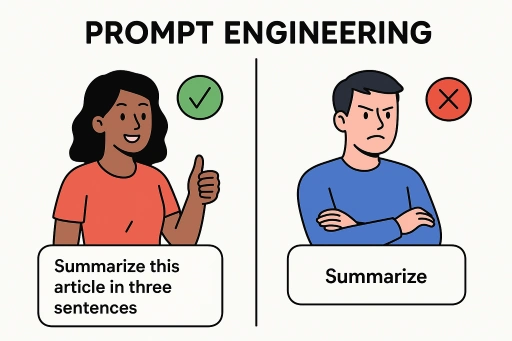
Give instructions clearly: “Write a 3-sentence summary” vs. “Do something with this text.”
Provide examples: Show the model what “good output” looks like, and it starts mimicking that style.
Steer behavior: You can make it formal, funny, technical, or poetic, all via clever prompts.
Chain prompts: Break big tasks into smaller prompts to guide reasoning step by step.
And honestly, this is why they’re making you learn prompt engineering: because the model got trained, not you. You gotta speak its language if you want it to behave.
2. Knowledge Base
A knowledge base is a structured stash of facts, documents, or info that a model can reference, like a personal library, encyclopedia, or cheat sheet.
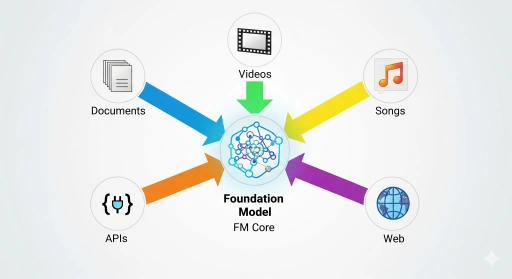
Instead of relying only on what it memorized during pretraining, the FM can look up real, up-to-date info.
Used with things like RAG, the knowledge base helps the model:
Give accurate answers
Cite sources
Stay current without retraining
3. RAG: Retrieval Augmented Generation
Foundation models only know what they’ve seen during pretraining. They can hallucinate, get outdated, or just straight-up forget stuff. That’s where RAG comes in:
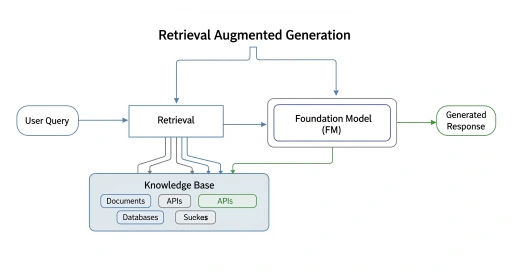
Retrieval: When you ask a question, the system searches a database or documents to find relevant info.
Augmentation: The model combines the retrieved info with its own knowledge to generate an answer.
Why it helps:
Reduces hallucinations, the model cites real sources.
Keeps responses up-to-date without retraining the FM.
Let the model handle huge knowledge bases without exploding in size.
4. Guardrails
If foundation models are left unchecked, they can spit out nonsense, offensive stuff, or even confidential info. That’s why you need guardrails:
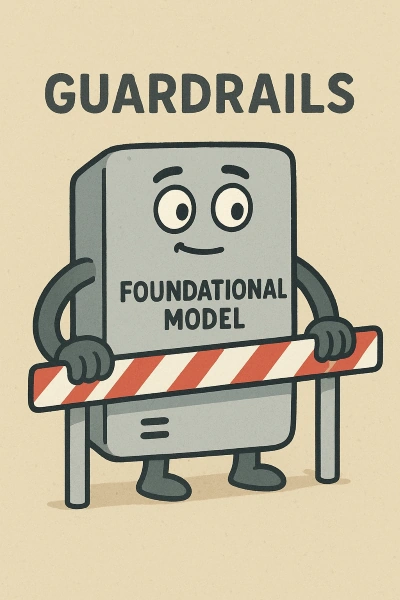
Content filters: Stop the model from generating toxic, unsafe, or off-limits outputs.
Human-in-the-loop: For high-stakes tasks (legal advice, medical info, financial decisions), a human double-checks before it goes live.
Logging: Keep a record of what the model says, for auditing, debugging, or just to roast it later when it messes up.
5. Evaluation & Feedback Loops
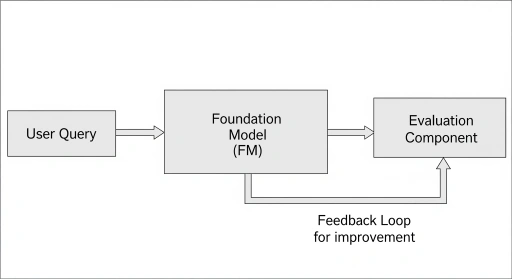
Evaluation: Test the model’s outputs regularly. Check accuracy, relevance, bias, and safety. Think of it as report cards for your AI.
Feedback Loops: Feed corrections or human reviews back into the system so it improves over time. The model learns what’s good, what’s bad, and what’s just plain “wtf”. Even a simple like and unlike button goes a long way.
Powering Your FM
AWS
Amazon SageMaker – train, fine-tune, and deploy foundation models at scale.
Bedrock – use foundation models from providers like Anthropic, AI21, and Cohere without managing infrastructure.
EC2 + GPUs/Trainium – raw compute for heavy-duty pretraining.
S3 – store massive datasets for pretraining and fine-tuning.
Azure
Azure OpenAI Service – access GPT, Codex, DALL·E, and other foundation models directly.
Azure Machine Learning – training, fine-tuning, and deploying large models.
NV-series VMs – GPU instances for training heavy models.
Azure Data Lake / Blob Storage – store huge datasets efficiently.
Google Cloud
Vertex AI – train, fine-tune, and deploy FMs; supports large-scale workloads.
PaLM API – Google’s own foundation models accessible via API.
TPUs – Google’s high-speed chips optimized for training massive models.
BigQuery / Cloud Storage – handle massive datasets for training and retrieval.
Why is this different from “old” ML / DL?
Older models were built for one job and trained end-to-end for that task. Foundational models are trained once to learn general knowledge/skills, then reused.
My 2 cents
And there you have it, foundation models: you train them once, and suddenly they’re capable of doing everything. Sure, they come with risks, hallucinations, bias, privacy concerns, and hefty costs, but with prompt engineering, knowledge bases, RAG, guardrails, and feedback loops, we can harness their power safely and effectively.
The cat is neither alive nor dead and honestly, that's the most exciting place to be. There are a lot more layers to uncover.
Previous: Part 5: Transformers in AI
Next: Part 7: What Is an AI Agent
Join the conversation! Your thoughts help the community grow.